Baggy clothes feel like a solution. They cover the stomach, drape over the hips, hide the upper arms. For anyone uncomfortable with their body, the logic is obvious: less visible means less noticeable. The problem is that the logic is wrong, and the wrongness is structural, not a matter of taste or fashion convention.

Clothing creates silhouette. That is its visual function before colour, fabric, or pattern even enters the picture. What a viewer’s eye reads first is the outline of a person, and a baggy garment does not erase that outline. It replaces it with a larger one.

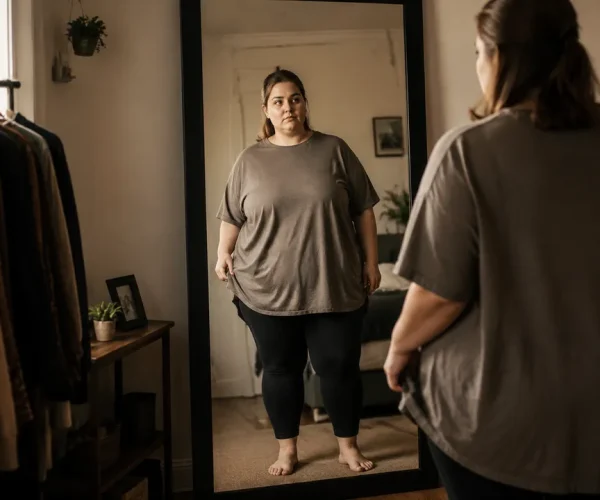
A woman wearing a loose, oversized tunic that falls to mid-thigh is not presenting a neutral or absent shape. She is presenting the shape of the tunic, which is wider than her body, boxier than her body, and hangs in soft folds that the eye reads as bulk. The actual body underneath has disappeared, but the visual impression is of something larger, not smaller.


The Silhouette Problem

When fabric falls away from the body without any point of contact, it fills the negative space between the garment and the skin with air. That air has no visual weight, but the envelope containing it does. A tent is not a thin object just because most of its interior is empty.

This is why tailors have spent centuries doing what they do. Structure in clothing is not about vanity or convention. It is about giving the eye something to follow: a waist, a shoulder line, a hem at a particular point on the leg. Without those reference points, the eye cannot locate the body at all. It sees only the garment, and the garment, if it is shapeless, reads as shapeless. Large and shapeless are not the same thing, but the visual impression collapses into the same category.

The problem intensifies with proportion. A person of average height wearing a very long, very wide top has reduced their visible leg length to a stub and widened their perceived torso to something significantly broader than their actual measurements. Both of those effects read as larger on a figure.

Where the Eye Lands Instead

Fit works by creating relationships between points. The narrowing at the waist makes the hip curve legible. The shoulder seam sitting at the edge of the actual shoulder anchors the whole upper half. When those points of contact are absent, the eye has no visual map of the body’s actual shape, and it defaults to reading the widest point of the clothing as the widest point of the person.

On a draped, loose garment, the widest point is usually the hem, or wherever the fabric swings out furthest from the body. That is almost always wider than the actual hip or thigh it is supposed to be concealing. So the generous cut meant to hide a hip ends up presenting an even wider outline at knee level, which reads to an observer as a larger lower half than the real one beneath.

Fabric weight makes this worse. Heavy jersey, thick linen, dense wool: these fabrics hold their own shape rather than responding to the body’s shape. They create rigid, outward-projecting forms that have almost nothing to do with the figure inside them. A thick, heavy oversized jumper on a small frame does not read as a small frame in a big jumper. It reads as a big shape.

The Camouflage Instinct and Why It Fails

The impulse behind baggy dressing is camouflage. Cover the part you dislike, and it ceases to be a problem. This works in certain literal contexts: a patterned background, broken light, enough chaos in the environment that outlines lose their meaning. It does not work on a person standing in a room in ordinary daylight, because a human figure is always perceived as a figure. The brain processes it as such automatically.

What camouflage can do, in clothing terms, is obscure specifics. A well-cut loose garment can prevent someone from knowing exactly where your waist sits or precisely what your hips measure. But it cannot make you look as though you have no width at all, because the garment itself has width, and that width is what the eye measures.

The specific failure point is the waist. Hiding the waist does not make it smaller. It removes the narrowest point from view, which means the eye reads the entire torso as one uniform width from armpit to hip. That uniform width is never the narrowest measurement. It is always wider. So the concealment of the waist produces a visual impression that is broader than the waist actually is.

What Actually Creates the Impression of Less

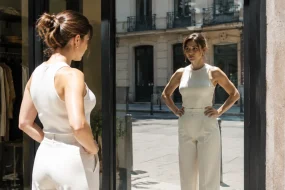
Fit is not the same as tight. This distinction matters enormously and gets lost constantly. Clothing that fits follows the body closely enough to show where the shoulder ends, where the waist is, and where the hip is, without gripping or compressing. It is not about showing skin or creating a second skin. It is about maintaining the body’s actual outline rather than replacing it with the garment’s outline.

A straight-cut trouser that skims the thigh without clinging to it will read as narrower than a wide-leg trouser cut loose from the hip. The wide-leg trouser adds fabric on both sides. Each centimetre of extra width on either side is a centimetre the eye adds to its reading of the leg.

Vertical line also does real work. A long cardigan with clean, unbroken vertical seams draws the eye down the length of the body rather than across its width. A horizontal band of contrast, a patterned block across the hip, a wide waistband in a different colour, all of these draw the eye sideways across the broadest part, which is the opposite of the intended effect.

Hem length is a variable people underestimate. A top that ends at the widest part of the hip is not neutral. It places a horizontal terminus exactly where most people least want one. An inch higher, ending just above the hip, or longer, extending past it, both produce a different reading. The eye does not ignore hem lines. It stops at them.

The Specific Shapes That Work Against Their Wearers

Oversized blazers are perhaps the most common current offender. The fashion for very large blazers, worn with the shoulders dropping well past the actual shoulder and the body a wide rectangle, looks confident and deliberate on certain frames and body types. On a shorter or rounder frame it absorbs the waist entirely, widens the shoulder line beyond the actual shoulder, and creates a block shape that, from a few metres away, presents as simply large. The person wearing it looks as though they are borrowing clothes from someone much bigger.

Wide-leg trousers cut loose from the waist to the floor are a similar case. They can be elegant when they skim at the hip and widen only below the knee. They become a volume problem when the extra fabric begins at the hip itself, adding circumference at precisely the point most wearers are trying to reduce.

Shapeless midi dresses in a single neutral colour are the subtlest version of the same trap. Nothing about them is obviously wrong. The length is modest, the colour is quiet, the fit is loose without being extreme. But loose through the entire body length, with no defined waist and a hem that bisects the calf at its widest point, tends to present as a large, uniform column. The body inside can be half that visual width.

The One Genuine Exception

Volume in one place, balanced against fit in another, can work. Wide trousers with a close-fitting top. A full skirt with a tucked-in shirt. A loose, drapey blouse with tailored, straight-cut trousers. The contrast itself creates the waist impression: the eye sees fullness in one zone and proximity in another, and reads the boundary between them as the narrowest point of the body, which is usually accurate.

What does not work is fullness everywhere simultaneously. Volume on volume, loose on loose, a situation in which no part of the garment has any relationship to the body’s actual shape. That produces the tent effect in its most complete form: a shape that is all width and no structure, where the person inside has effectively vanished and the clothing is doing all the visual work, and doing it badly.

The person who spends years pulling on the largest available size in everything, hoping each morning that today the shape will finally read as smaller, is in a loop. The clothes keep expanding the silhouette. The solution is not smaller clothes in the tight sense. It is clothes where at least one point of the body, the shoulder, the waist, the hip, is visible and legible. One anchor is enough to change everything the eye reads next.

Leave a Reply

Your email address will not be published. Required fields are marked *