


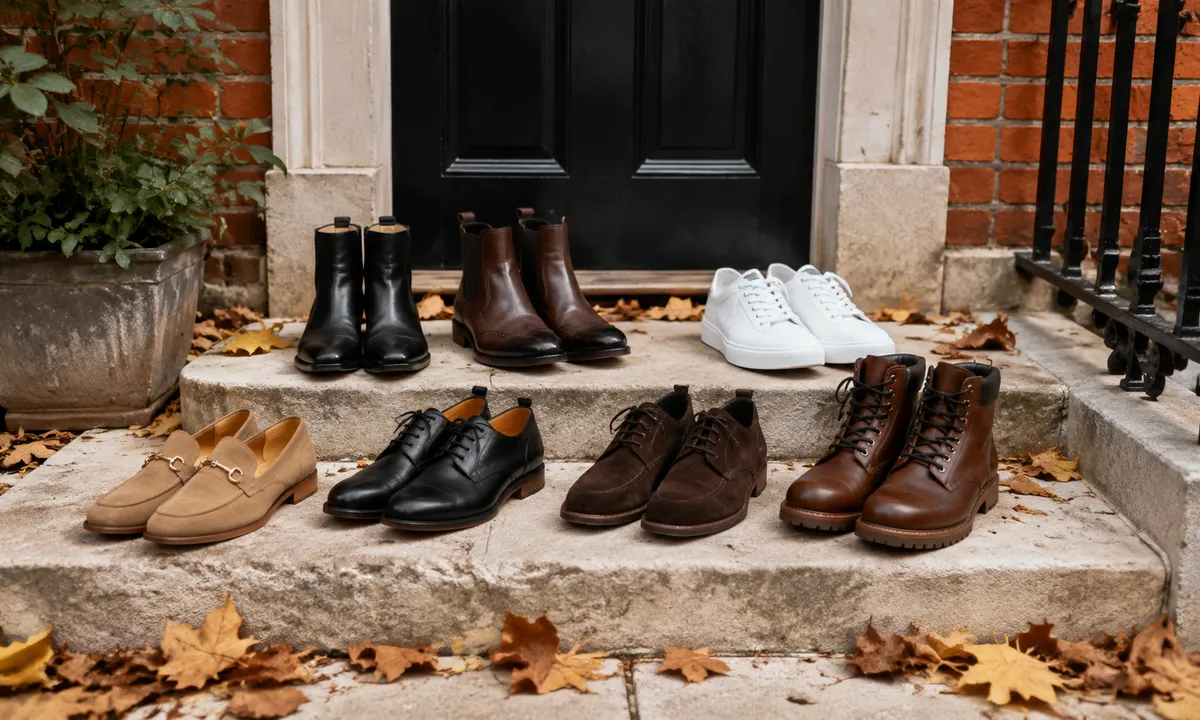
Four pairs is probably the honest answer. Three if the wardrobe is genuinely small. But the number almost everyone actually owns sits somewhere between eight and twelve, and most of those shoes spend October through November at the back of the rack, waiting for a weather window that never quite arrives.
Autumn is the season that exposes over-buying more clearly than any other. Summer footwear has a logic: sandals for heat, trainers for movement, one smart option for evenings. Winter simplifies things too, eventually collapsing to boots and weather-proof options. But the in-between months, roughly September through early December in Britain, ask the foot to handle cold mornings, mild afternoons, wet pavements, dry parks, and the occasional dinner that requires something with a heel or a proper sole. The temptation is to have a separate shoe for each condition. The result is a pile of footwear that mostly overlaps.
What Autumn Weather Actually Demands
The practical demands of autumn footwear come down to three things: warmth, water resistance, and grip. Everything else, colour, silhouette, formality, follows once those are satisfied.
Warmth does not mean insulation in the ski-boot sense. Autumn in Britain sits mostly between 5 and 15 degrees Celsius. That range does not require the lined interior of a winter boot. What it does require is a closed upper, a sole thick enough to keep cold ground from conducting through, and enough coverage at the ankle or at least the top of the foot to stop windchill finishing the job. A thin leather Oxford with a leather sole fails this badly. A canvas sneaker fails it worse.
Water resistance matters more than most people plan for when they buy shoes in August. British autumn delivers prolonged damp rather than dramatic downpours: wet pavements at 7 am, slow drizzle that never quite becomes rain, puddles where the kerb meets the drain. A shoe rated for heavy rain is overkill for most days. A shoe that absorbs moisture within ten minutes is wrong for most days. What autumn actually rewards is treated leather or suede with a reasonable wax or spray maintenance routine, or a synthetic upper with sealed seams. Full waterproofing is genuinely useful mainly when walking on ground rather than paving.
Grip is the most underrated of the three. Fallen leaves compress into a film that behaves almost like ice on stone steps, wet iron gratings, and polished floors inside buildings that have just been entered from outside. A hard leather sole is a liability from October onwards. Rubber, or at minimum a rubber heel insert, is worth seeking out specifically for this season.
The Case for Three Working Pairs
A structured working week alongside a reasonable social life and occasional outdoor time can be handled by three pairs, as long as each one is genuinely fit for its purpose rather than a compromise.
The first is a smart-casual leather or leather-look shoe with a rubber sole, something that works with chinos or dark jeans, passes in a smart-casual office, and handles a damp commute. Derby shoes in dark brown or black tend to do this best because the open lacing accommodates slight foot swelling in cold weather better than the Oxford’s closed throat. A Goodyear-welted sole makes resoling realistic and means the shoe can genuinely last a decade of autumns with maintenance. A cemented sole is cheaper upfront and easier to replace at shoe repairs, but the seam around the welt is a water entry point worth waxing regularly.
The second is a clean, slightly chunkier trainer or low-top shoe for casual days, errands, and any weekend that stays on paved surfaces. The key is that the sole should be at least 20 mm thick to provide actual ground insulation, and the upper should be treatable with a water-resistant spray. White or light-coloured uppers are not practical choices for October and November unless someone genuinely enjoys cleaning shoes.
The third is the pair that handles rain and uneven ground: a Chelsea or chukka boot in oiled leather or a waterproof synthetic, ankle height at minimum, with a lug or commando sole. This is the pair for Saturday walks through parks, country visits, or the kind of sustained rain where the first two pairs become irrelevant. It is also the pair that justifies its cost most obviously in autumn because it makes outdoor time genuinely comfortable rather than something to endure.
Where the Fourth Pair Earns Its Keep
Three covers most situations. Four handles them all without compromise.
The fourth slot belongs to whatever the first three cannot do. For most people in practice, that is a formal shoe or heel for occasions that the smart-casual Derby is not quite right for: a wedding in October, a dinner where the room requires something with more intention. Autumn is wedding season in Britain, and a single pair of proper black Oxfords or low-heeled court shoes worn two or three times a year is a reasonable fourth addition rather than a luxury. The mistake is buying something specifically formal and then feeling it has to justify itself by being worn more often, which pulls formal footwear into casual rotation where it looks wrong.
Beyond four, the returns drop sharply. A fifth pair for the gym is technically footwear but serves a different function entirely and should be counted separately. What does not earn its place is a second smart shoe in a slightly different shade, a second boot in nearly the same silhouette, or a pair bought for a single occasion and never rotated again. Those are the shoes that account for most of the overcrowding in the average hallway cupboard.
Why Suede Deserves More Credit in October
Suede has a reputation as a fair-weather material, and in untreated form it deserves it. Water marks it, salt stains it, and city grime gets into the nap permanently if left unattended. The conventional wisdom says save it for dry days or summer.
But suede treated with a proper protector spray and maintained with a suede brush performs genuinely well in light to moderate autumn conditions. The nap provides more insulation against windchill than smooth leather at the same thickness. It breathes better, which matters on the kind of day that starts cold and ends mild. And the aesthetic range of suede, from a caramel chukka to a slate-grey Derby, sits particularly well with the earthy tones that dominate autumn wardrobes without looking as deliberately seasonal as a tan leather brogue.
The maintenance commitment is real but not onerous: a spray application at the start of the season, a brush after any wet day, and occasional use of a suede eraser for dry marks. That routine, realistically fifteen minutes across a whole season, keeps suede functional and presentable through October and November without the full waterproofing a boot requires.
The Rotation Problem Most Wardrobes Have
Even people who own the right shoes often wear them incorrectly for the season. The problem is not ownership, it is rotation.
Leather needs 24 hours minimum between wears to dry fully and recover its shape. In autumn, when shoes regularly arrive home damp, that cycle matters more than in any other season. Wearing the same pair on consecutive wet days compresses the insole before it has dried, breaks down the leather at the flex point faster, and introduces the conditions for the kind of interior odour that no cedar insert fully corrects once established.
Three or four pairs also work as a genuine rotation: each pair worn once every three or four days, dried thoroughly on cedar shoe trees if possible, brushed and resprayed as needed. That rotation extends the life of every pair in it. A single workhorse pair worn daily through autumn will look visibly aged by November even if it cost twice as much as the budget for a proper rotation.
The practical implication is that owning three well-chosen pairs and rotating them costs less over five years than buying one very good pair and wearing it every day. The maths are straightforward once the repair and replacement cycle is factored in.
The Heel-to-Ground Reality of Autumn Dressing
Heels deserve a specific note, because autumn is the season where the trade-off between appearance and function becomes most visible in heel-wearing footwear.
A heel of 60 to 75 mm on a slim stiletto base concentrates bodyweight onto a surface area smaller than a pencil eraser. On wet stone, iron drainage covers, or compacted leaves, that contact patch has essentially no friction. Block heels and kitten heels, which spread load over a larger base, perform meaningfully better on autumn surfaces without requiring flat footwear. The difference in stability between a 15 mm block heel and a 70 mm stiletto on a wet pavement is not aesthetic, it is physical.
Heel tips also wear faster in autumn because grit on damp pavements acts like fine sandpaper against the tip’s hard plastic or rubber. A heel tip replaced at the start of October costs a few pounds at any cobbler. Left until the metal rod underneath has worn through and begun to damage the heel stack itself, the repair cost multiplies and the heel may need rebuilding rather than simply re-tipping.
The shoe that gets overlooked most often in autumn planning is a block-heel ankle boot with a sole that has genuine tread. It does the work of two pairs in one, handling both the smart and the practical ends of the daily range that autumn demands, and it sits on pavements, stairs, and damp grass with a confidence that a slim-heeled equivalent simply cannot match once the leaves start coming down.