


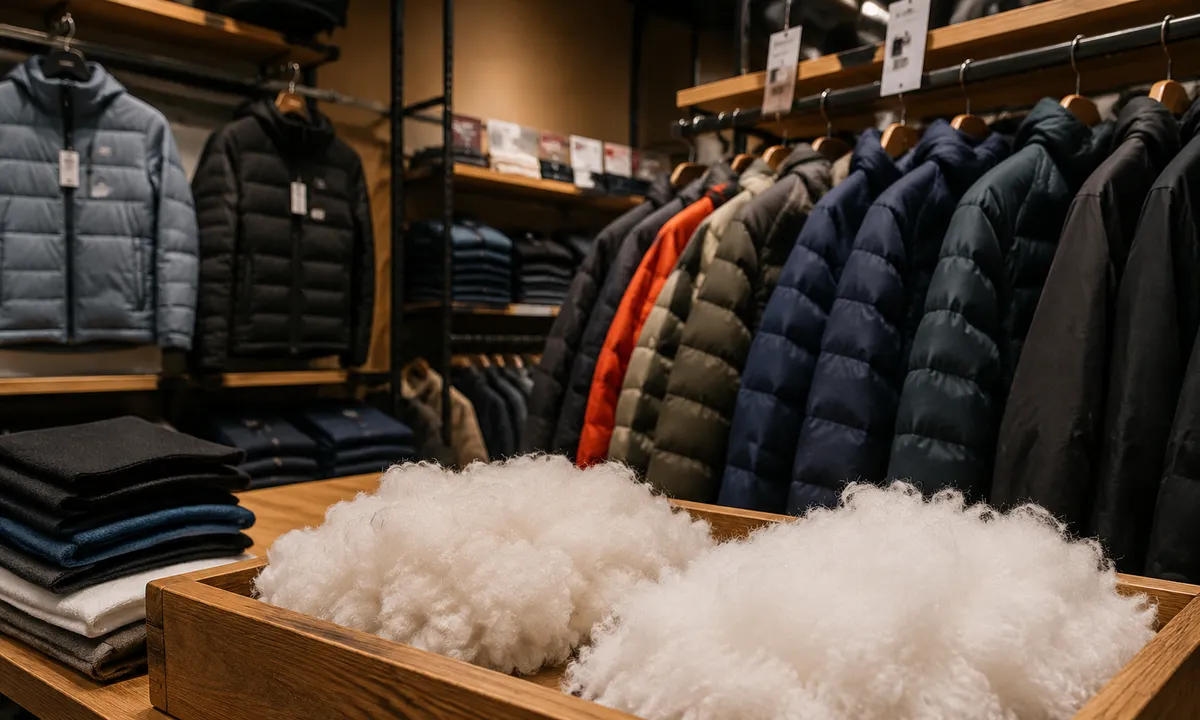
Walk into any mid-range retailer in October and the coatracks will be loaded with polyester-filled jackets, their hangtags promising warmth through vague, trademarked filler names that mean nothing in particular. The fill is synthetic. So is most of the shell. So, often, is the price point, which gets marked up considerably for a product that costs very little to manufacture. This is not new, but it has gotten more pronounced, and understanding why requires looking at the economics of the coat industry with clear eyes rather than the soft focus of seasonal marketing.
What “Synthetic Fill” Actually Refers To
The fill inside a winter coat does one thing: trap air. Dead air is an insulator. The fill itself is mostly irrelevant; its job is to create a structure that holds warm air close to the body and resists collapse under light compression. Down feathers accomplish this through clusters that loft outward from a central quill, creating a three-dimensional tangle of tiny air pockets. Good down is remarkably efficient at this per unit of weight.
Synthetic fills try to replicate that structure with polymer fibers, usually polyester, sometimes blended with other petrochemicals. Early versions were stiff and heavy. Newer iterations have gotten lighter and softer, and some high-end technical synthetics perform reasonably well in wet conditions where down can struggle. But the synthetic fill inside a $90 coat at a fast-fashion chain is not a high-end technical synthetic. It is a commodity product, extruded in enormous volumes, and it behaves accordingly.
Commodity polyester fill compresses permanently over time. After a season or two of regular use, the batting in a synthetic coat flattens in the places that get the most pressure: the back where you lean against a seat, the shoulders, the sides where arms rest. Once that loft is gone, the insulation value drops and it does not come back. Down, washed and air-dried carefully, will re-loft. Cheap polyester batting does not.
The Supply Chain That Makes This Inevitable
Garment manufacturing runs on margin compression. Brands, especially those operating at high volume and moderate price points, are under constant pressure to reduce the cost of goods. Fill material is one of the most controllable variables in that equation. Down is priced on commodity markets and fluctuates with poultry supply cycles. Responsible down, sourced with supply chain certification and animal welfare standards, costs more still. Synthetic fill is cheaper, more stable in cost, and arrives in consistent bulk quantities with no certification requirements attached.
For a manufacturer producing hundreds of thousands of units, the difference between filling each coat with certified down versus commodity polyester batting translates to millions of dollars in annual costs. That number is not abstract to a CFO. It is a line item that gets optimized away.
At the retail end, the consumer cannot easily tell what is inside a coat by handling it in the store. A polyester-filled jacket can be made to feel voluminous and soft at point of sale. It might even compress nicely in the hand the way down does. The performance difference shows up over time, in sustained cold, and after repeated use. By then the coat has been purchased, the return window has closed, and the brand has moved on to next season’s product.
How Fill Power Gets Quietly Swapped for Fill Weight
Down quality is measured in fill power, a number describing how many cubic inches one ounce of down occupies when allowed to loft freely. Higher fill power means lighter and warmer. A coat filled with 800-fill-power down can weigh very little and still provide serious insulation. A coat filled with 550-fill-power down needs more of it to achieve the same warmth, meaning more weight and bulk.
Synthetic fill has no equivalent standard. Brands describe it by weight per square meter, or by proprietary names, or not at all. The hangtag says something like “300g fill” and leaves the buyer with no frame of reference. Three hundred grams of what? At what loft? How does it compare to the coat next to it that says “280g synthetic insulation”? It does not compare cleanly, which is the point. The lack of a universal benchmark makes it impossible for a consumer standing in a store to do an apples-to-apples evaluation.
This opacity benefits the manufacturer. A coat stuffed with a generous weight of cheap batting can be marketed as heavily insulated without that claim being technically false or independently verifiable. A coat with 100 grams of excellent down fill might actually be warmer but sounds, on paper, like less.
What Retailers Are Actually Selling When They Sell a Winter Coat
At most price points, a winter coat is sold as an aesthetic object first and a functional garment second. The silhouette, the color, the hardware on the zipper, the fit: these are the reasons mostcoats are bought. Warmth is assumed rather than tested. People trycoats on in heated stores while wearing layers and make decisions based on how they look in the mirror.
Brands know this and design accordingly. The shell fabric is where the visible quality signals live, and shell fabric is where more of the material cost goes. A coat with a nice woven face fabric and elegant cut can look expensive. The fill is invisible. Skimping on it does not affect first impression or sell-through rates. It affects the buyer six months later, standing at a bus stop in January, wondering why the coat that looked so good in October is not doing much.
The fast-fashion business model accelerates this logic. If a coat is designed to last one to two seasons before being replaced, then fill longevity is irrelevant. The coat is not built to outlast its own fashion cycle. Durable fill material in a garment with a planned obsolescence baked in is a wasted investment from the manufacturer’s perspective.
When Synthetic Fill Is the Right Answer
Synthetic insulation does have genuine advantages in specific contexts. It maintains some insulating value when wet, whereas down collapses and loses almost all of its thermal performance if the clusters become saturated. For outdoor activities in wet climates, orcoats likely to getrained on repeatedly, a well-made synthetic fill from a reputable technical brand can be the better choice.
Some people also prefer synthetic for ethical reasons: down sourcing, even when certified, involves animals. That is a coherent position and the market has responded with genuinely capable synthetic alternatives at the performance end of the price range.
The problem is not synthetic fill as a category. The problem is cheap synthetic fill sold at margins that suggest something better, insidecoats that use the absence of meaningful fill standards as cover for a quiet downgrade.
What the Fill Weight in a Cheap Coat Actually Feels Like After One Winter
Pull a two-season-old synthetic-filled coat out of the closet and hold it up. The spots where the fill has compressed are easy to find: flatter panels, areas where the quilting feels thin rather than puffy, sections where the shell and lining seem almost to touch. The coat still looks like a coat. It still has the shell fabric and the branded zipper pulls. But run a hand across the back and the insulation value is clearly diminished from what it was the first time the coat went on.
Compare that with a coat filled with quality down, properlycared for, five years old. The clusters are still doing their job. The loft is there. It is heavier and it cost more and there may be an ethical sourcing question attached to it, but it is still the coat it was when it was bought.
That difference, playing out over years rather than one shopping trip, is where the real cost of cheap synthetic fill lives. A coat bought for $80 and replaced every two seasons costs $40 a year. A coat bought for $300 with quality fill and a durable shell, worn for eight years, costs less than that, produces less waste, and keeps its wearer warmer in year seven than the cheap version did in year one. The fill choice is not a detail. It is the product.