


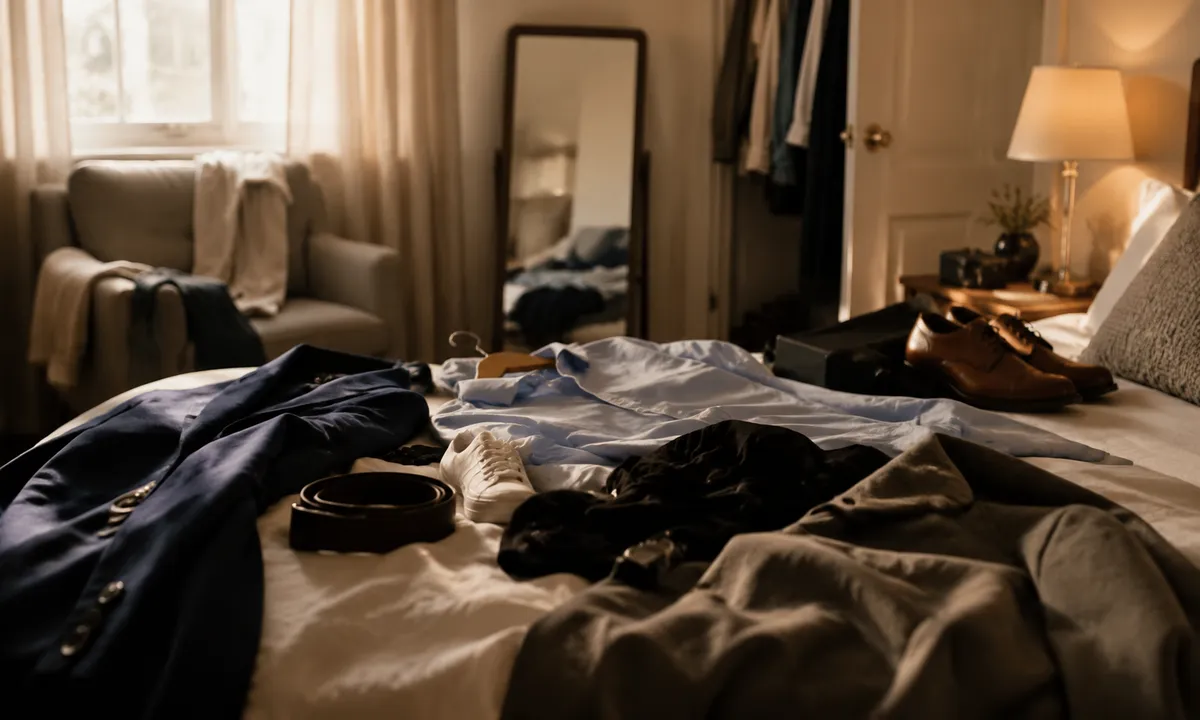
Overcorrection is the real villain of first-date dressing. Not the outfit that is too casual, not the one that is too formal, but the outfit chosen in a state of low-grade panic about being judged, assembled from pieces that were never intended to work together, worn by someone who spent the hour before leaving the house changing their mind three times. The result is clothes that announce effort without announcing anything true about the person inside them.
Dressing to impress and dressing to perform are not the same thing, though they get confused constantly. Impressing someone means showing them something real that they find attractive. Performing means putting on a version of yourself calibrated entirely to what you imagine they want, based on very limited information, gathered mostly from an Instagram grid and a handful of text exchanges. The performance version rarely works, because the person sitting across the table has extremely good antennae for inauthenticity, even if they cannot name what they are sensing.
The Wrong Question at the Wrong Moment
Most people, when getting dressed for a first date, ask themselves some version of: what will they think of this? That question is seductive and also almost entirely useless, because the answer is unknowable. The person you are meeting has taste you have only partly glimpsed, associations you cannot predict, a history of ex-partners whose style may or may not have left a mark. Dressing for their imagined preferences is a guessing game with very poor odds.
The better question is one most people do not get round to asking: what do I actually feel like myself in? It sounds obvious. It is not, because answering it honestly requires knowing your own wardrobe well enough to be clear about which pieces you wear because you like them and which ones have accumulated because they were on sale, or were a gift, or seemed fine at the time. Many people reach for first-date clothes from that second category, because those pieces feel safe and unremarkable, and unremarkable feels low-risk. It is not. It is its own kind of risk.
What Borrowed Confidence Actually Looks Like
A blazer that belongs to someone else’s life will sit wrong on your shoulders all evening. Not physically, necessarily. But there is a quality of self-consciousness that attaches to wearing something that does not quite fit your sense of yourself, and it leaks into everything: the way you hold your wine glass, the lag before you answer a question, the small adjustments you keep making when you think no one is watching. Your date is watching. Everyone is watching, not out of scrutiny but because that is what human attention does in close social proximity.
Physical comfort and psychological comfort are deeply linked in clothing. A first date is already a situation of low-level alertness, the kind where the body is slightly heightened and small discomforts become amplified. Shoes that are normally fine become unbearable. A collar that sits slightly too high becomes a persistent distraction. The evening gets narrower.
This is not an argument for wearing whatever is nearest to hand. It is an argument for knowing the difference between clothes that give you ease and clothes that give you the performance of ease. The former actually help. The latter are just a costume.
The Formality Miscalculation
There is a specific social anxiety that drives people to overdress for first dates, and it is understandable: arriving underdressed feels like a statement that you did not think the evening was worth the effort. So the correction goes in the other direction, and suddenly someone who lives almost entirely in jeans is sitting in a restaurant in a suit they last wore to a wedding, feeling faintly absurd.
What this misses is that dressing too formally relative to your actual life creates an odd social problem: it sets a precedent you cannot sustain. If the date goes well and there is a second one, the bar has been set somewhere that requires ongoing performance. More immediately, it creates an imbalance in the room. If your date arrives in dark trousers and a nice shirt and you are in full eveningwear, one of you has misread the situation, and both of you know it.
Slightly elevated from your everyday baseline is usually the right calibration. A version of yourself that looks like you made an effort, not a version of yourself that looks like you have been hired to play a more sophisticated character.
New Clothes on a First Date
Wearing something brand new to a first date is a specific and common error. The logic behind it is appealing: fresh start, first impression, clean slate. The practical reality is that clothes behave differently on their first wear. Stiff seams, unfamiliar lengths, shoes that have not yet learned the shape of your foot. All of this compounds the physical self-consciousness already present in the situation.
Clothes that have been worn a few times have settled. They have been tested against movement, against different lights, against the experience of sitting down in them for two hours. You know how they behave. That knowledge, small as it sounds, is a form of confidence. It means one less thing demanding your attention during an evening when your attention is already working hard.
The Signal Problem
Clothes carry information. They have always carried information. The mistake is in thinking that the only information worth broadcasting on a first date is seriousness and effort and having-made-an-attempt. Those things matter, but they are baseline. What actually moves a first date forward is specificity: some evidence of an actual person with actual preferences, rather than a smoothed-down presentation designed to give no offence.
An unusual detail, something small and unconventional in an otherwise straightforward outfit, tends to do more conversational work than a flawless head-to-toe look. It invites a question. It suggests a history. It gives the other person something to respond to. First dates are often described as interviews, but the interviews that go somewhere are ones where both people reveal something real, not the ones where everyone answers the questions perfectly and no one remembers the exchange a week later.
When the Body Gets Involved
Clothes interact with nerves in ways that are easy to underestimate. When anxiety is already present, anything that draws attention to the body becomes more intrusive: the too-tight waistband, the hemline that keeps riding up, the top that gaps in a way it did not in the changing room mirror. These are not catastrophes, but they are cumulative. Each small physical preoccupation is attention taken away from the conversation, from reading the other person, from being actually present.
The body also tends to express discomfort nonverbally in ways that read as social signals rather than physical ones. Crossing arms to manage a cold shoulder in a dress that turned out to be too breezy for the restaurant reads as defensiveness. Fussing with a collar reads as nerves. The other person picks up on these things and draws conclusions, not with any cruelty, just with the ordinary perceptual machinery that human beings bring to social situations.
Wearing something that lets you forget you are wearing it is a genuine asset in a situation where the goal is to actually connect with another human being across a table.
The Version That Turns Up Again
There is a practical consequence to all of this that extends past the first evening. If a date goes well and leads somewhere, the clothes worn on that first night become the opening image in someone else’s memory of you. Not in a pressured or permanent way, but they are part of the record. Whatever you wore becomes, for a little while, what they thought of when they thought of you before they knew you better.
Wearing something that accurately reflects your actual taste means that image is at least honest. Wearing a costume means the person falling for you, if that is what happens, is falling partly for a fiction. And at some point, probably soon, the fiction ends, the jeans reappear, and there is a small but real adjustment to be made on both sides. Some adjustments are fine. The ones that arrive because the first impression was a deliberate invention tend to carry an uncomfortable aftertaste, a sense on both sides that something was being managed rather than shown.
The clothes that work best on a first date are usually the ones pulled from the part of the wardrobe that gets worn on ordinary Saturdays when nobody particular is coming, slightly sharpened, slightly considered, but essentially true. That specific honesty is harder to manufacture than it sounds, and considerably more attractive than anything borrowed from a more impressive self that does not quite exist yet.