


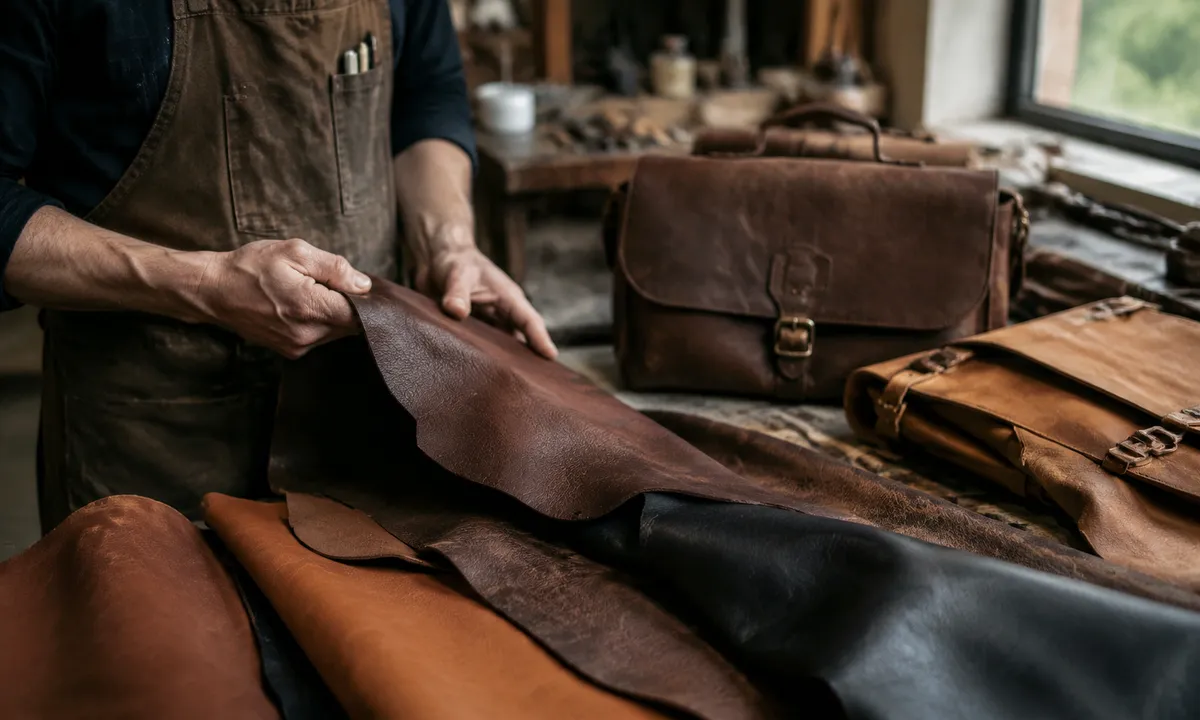
Full-grain, vegetable-tanned, hand-stitched: the language around leather bags in the 80 to 200 pound bracket is fluent and confident. The products carry it like a credential. Whether the leather itself earns those words is a different matter, and it is one that becomes obvious the moment you handle the materials with any kind of trained eye.
Spending time in a small workshop where bags and small leather goods are made and repaired gives a person a particular relationship with hide. Not reverence, exactly. More like a working familiarity with what leather does under stress, how it ages, what the surface tells you about what is underneath, and where the shortcuts tend to hide.
What follows is an account of that familiarity applied to mid-range bags, the ones sold on the promise of quality without the price of genuine craft.
What the Surface Hides
The first thing a craftsman checks is grain. On a good piece of full-grain leather, the surface is slightly uneven if you look closely, with the natural pore structure of the hide still intact. Scars, small variations in texture, the faint memory of the animal’s flank: these are present and unremarkable. They are signs of an untouched surface.
On the vast majority of mid-range bags, what you see is corrected grain or, more often, top-grain leather that has been buffed, sanded, and finished with a pigment coating thick enough to give a uniform colour and a smooth, almost plastic feel. Under good light you can press a fingernail lightly into the surface. On genuine full-grain leather the impression holds briefly and releases. On a heavily finished hide it barely registers, because the coating has more resilience than the fibre structure beneath it.
This matters for ageing. The patina that leather enthusiasts describe forms in the fibre itself, driven by the oils in a person’s hands and the slow oxidation of the tannins. A thick finish seals that process out. The bag will not patina in any meaningful sense. After three years it will look faded rather than lived-in.
Thickness and the Temptation of Splitting
A hide split into layers is weaker than the original. The top layer, sold as top-grain, keeps the surface. The lower layers become suede or, when bonded andcoated, the compressed fibre product sometimes labelled as genuine leather, which is a legal term and a confusing one. It describes the lowest grade of real leather, not a quality assurance.
Mid-range bags are rarely made from bonded leather at the 80 to 200 pound price point; that grade tends to appear lower down. What they do use, almost universally, is a split that has been heavily finished. The practical consequence is that the material feels thinner than it looks. Manufacturers compensate by laminating it to a stiff backing material, often a woven textile, which gives the bag structure but makes the leather component itself largely decorative. The bag holds its shape because of the liner, not the hide.
Cut into thestrap of one of these bags where it enters a buckle, and the cross-section tells the story plainly. The outer leather layer may be 0.8 to 1.2 mm. Below it is glue and cloth. Astrap cut from a single piece of 3 to 4 mm vegetable-tanned hide looks completely different: dense, fibrous, a consistent tan colour from surface to surface.
Hardware and Its Relationship with the Leather
It is possible to fit good hardware to poor leather, and poor hardware to good leather. Mid-range bags tend to get the combination wrong in both directions.
The hardware is often the more honest part of the product. Solid brass or solid zinc fittings have weight and a cool, slightly greasy feel. Plated steel is lighter, rings slightly hollow when tapped, and shows wear at the edges within months because the plating is thin. Most mid-range bags use plated components. This is not automatically a disaster for function, but it tells you something about where the budget went.
The stitching at hardware attachment points is where structural problems tend to live. A D-ring or swivel clip takes the full load of a bag in use. The leather at that point needs to be folded back on itself and either riveted through orstitched in a saddle-stitch pattern where each stitch is locked independently, so that one broken thread does not unravel the seam. Machine lock-stitch looks similar at a glance but is not equivalent under repeated stress. On the bags I have pulled apart, the attachment points are almost always machine-stitched, often without a rivet behind them. Some have a small rivet added as a visible detail that does not in fact pass through the structural fold.
Edge Finishing as a Quality Signal
Edge finishing is one of the cleaner indicators of leather quality and manufacturing care, because it is labour-intensive and difficult to fake convincingly.
A properly finished edge is bevelled, burnished, and sealed. The process requires multiple passes and the right tools. On good leather, the edge darkens and takes on a smooth, rounded profile that holds up to handling. On split leather with a coating, the edge reveals the cross-section: you can see the layers, the glue line, and the backing material. Manufacturers cover this with edge paint, a coloured liquid rubber that seals the layers. Applied well it is presentable. Applied quickly, as it generally is at volume, it cracks within a year where the bag flexes.
Run a thumbnail down the strap edge of any bag you are considering. If the surface lifts, bubbles, or shows a clean line where the paint ends and the leather begins, you are looking at edge paint over a split. On a burnished edge from solid leather, there is nothing to lift.
Where Price and Material Diverge
The honest version of the mid-range leather bag market is this: at 80 to 200 pounds, you are largely paying for design, branding, and hardware selection, with the leather itself contributing less to the price than the marketing implies. That is not a moral failing. It is a consequence of what good leather costs.
A shoulder bag made from a single hide of good quality vegetable-tanned leather, hand-stitched and edge-burnished, requires somewhere between ten and fifteen hours of skilled labour before hardware costs or overheads. The maths on a 150 pound retail price do not work. Something has to give, and it is always the material and the construction.
Some brands are transparent about this. A few describe their materials accurately as full-grain or top-grain without implying craft processes that are not there. Others use language that is technically accurate in a narrow sense but designed to suggest quality that the product does not carry. “Genuine leather”, “premium leather”, “rich leather”: none of these phrases has a regulated meaning beyond the first one, which means the lowest grade.
The Bags That Are Worth It at This Price
There are mid-range bags that represent a reasonable purchase, and they tend to share a few characteristics.
Canvas or waxed cotton bodies with leather trim: here the leather is used only at stress points and handles, where a smaller piece of better material can be used without running up the cost of covering the whole bag. The stitching at the attachment points is often better on these hybrid constructions than on all-leather bags at the same price, because the manufacturer is not trying to cover an entire surface in finished leather and can put more into the joins.
Bags made in countries with lower labour costs but a genuine tannery tradition can also offer good material at this price. Turkish, Indian, and some South American tanneries produce solid vegetable-tanned leather that reaches manufacturers at a price point that changes the economics. The construction may still be machine-stitched, but the hide underneath is often meaningfully better than what a comparable European or British brand is putting in at the same price.
The tell in all cases is thestrap. A strap cut from solid leather with a burnished edge and properly riveted hardware is a legitimate indicator of honest construction. A laminated strap with painted edges and plated rings, on a bag being sold as a premium leather product, is the reverse.
What Happens After Two Years of Daily Use
Bags come in for repair, and the ones in the 80 to 200 pound range that have been used every day for two years are instructive. The coated surfacecracks at flex points, most commonly at the fold where the bag body meets the base and where the straps enter the body. The edge paint peels. The stitching at load points, particularly the D-ring tabs and carry handles, breaks and then runs because it is lock-stitch rather than saddle-stitch.
These are repairable problems, mostly, but the repair cost can approach a significant fraction of the original purchase price. Replacing a strap on a laminated bag is complicated by the backing material, which does not hold thread the way solid leather does. Edge refinishing with paint is straightforward. Restitching a D-ring tab where the leather has also begun to delaminate is a different job.
A bag made from solid 3 mm hide at the same age looks different. The surface has darkened unevenly, lighter at the centre of the flap, darker at the edges where hands have touched it. The stitching is intact because each thread is locked individually. The edges are worn smooth rather than cracked. It needs conditioning, possibly re-stitching at one stress point if the owner was hard on it, but the leather itself is in better condition than it was new, in the sense that it has settled and tightened rather than degrading.
That is the difference a craftsman notices, and it is the one that a price tag cannot tell you.