


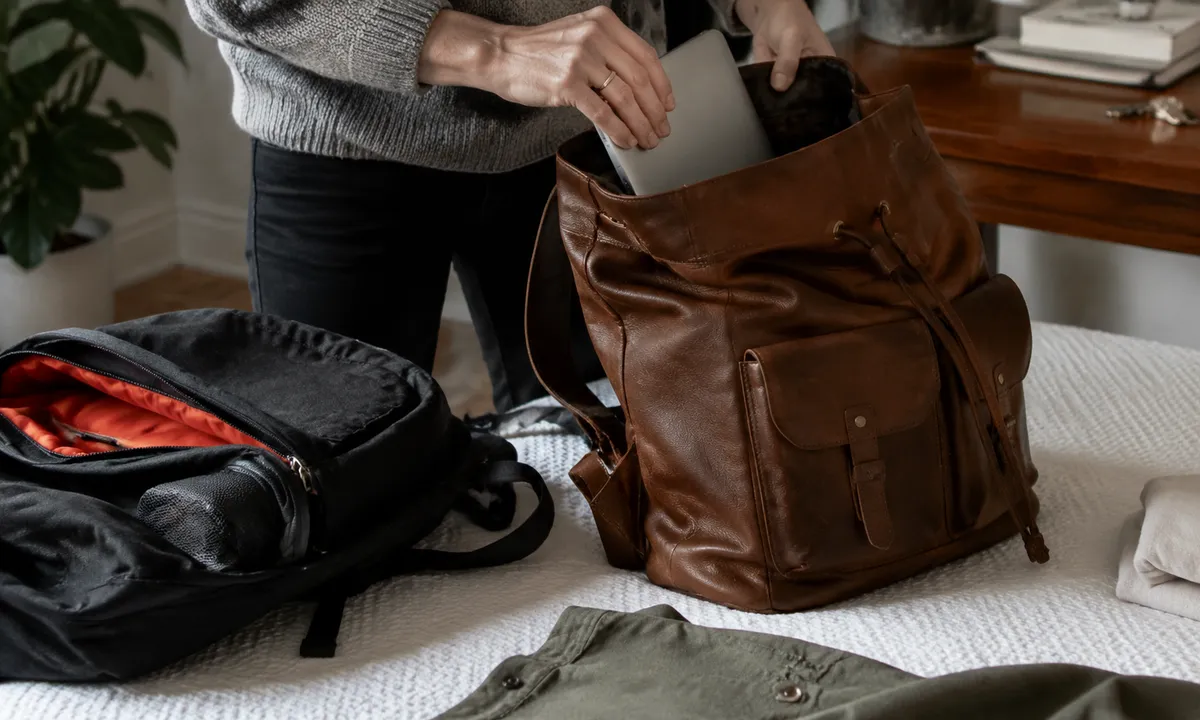
Leather backpacks have a reputation for being impractical. Heavy before you even load them, stiff in the shoulder straps, ruinously expensive if you get caught in a rainstorm without warning. For years that reputation kept a nylon bag on the writer’s back, the kind with the mesh water bottle pocket and the padded laptop sleeve and the bright orange interior lining that made finding keys easier. It was sensible. It was forgettable. It did its job the way a utility closet does its job.
The switch happened not because of any revelation but because of a specific Tuesday afternoon, a commute bag finally splitting at the zipper pull after three years of daily use. Standing in front of a store display, weighing the familiar nylon option against a full-grain leather backpack that cost roughly three times as much, the math felt absurd. It also felt like the only honest choice left to make.
What Three Years of Nylon Actually Taught
Nylon bags are engineered for lightness and volume. The good ones hold a lot, weigh almost nothing empty, and resist casual water exposure without any treatment at all. For a student hauling textbooks or a traveler moving between hostels, those qualities are real and worth having. Nobody should pretend otherwise.
But nylon bags also age in a specific and unavoidable way. The fabric itself stays intact while everything around it slowly fails: the zipper pulls loosen, the buckles crack at their plastic joints, the padded back panel develops a permanent faint smell from years of contact with clothing and sweat. The bag doesn’t fall apart dramatically. It just becomes gradually less pleasant to touch and carry, right up until one component finally breaks and makes the whole thing unusable. At that point it goes in the trash, structurally identical to the day it was purchased but cosmetically finished.
Three bags in three years. That’s a rough average for anyone using a commuter pack hard five days a week. The cost per year starts looking less favorable once you track it honestly.
The Weight Argument Is Real, and It’s Still Not the Point
A good full-grain leather backpack runs somewhere between 2 and 4 pounds before anything goes inside it. A comparable nylon pack sits closer to 1 to 1.5 pounds. That difference is not imaginary, and anyone with genuine back or shoulder strain needs to take it seriously. Leather’s density comes from the hide itself, and no amount of tanning or finishing eliminates it.
What shifts the calculation is what leather replaces. The nylon bags that compete in the same commuter category tend to compensate for their light shell by loading the interior with structural foam panels, aluminum frame stays, and thick padded straps with internal plastic guides. By the time a well-made nylon pack has all those elements, the weight gap narrows considerably. The leather bag carries its weight in the material itself. The nylon bag distributes it across a collection of components that will each fail on their own schedule.
After a few weeks the weight stops registering as a drawback. The bag settles onto the body differently because the leather panels gradually conform to pressure points rather than staying rigidly flat.
Rain, Scratches, and the Slow Construction of a Surface
The waterproofing anxiety is legitimate. Untreated full-grain leather will absorb water, darken temporarily, and dry stiff if left to air-dry without conditioning. This is a real maintenance requirement. A small tin of beeswax conditioner applied two or three times a year handles most of it, and a sudden downpour stops being a crisis once the leather has been properly treated. The bag gets wet, the rider gets somewhere covered, the leather dries and looks almost exactly as it did before.
Scratches are a different category entirely. The first scratch on a nylon bag is a small grief: a permanent white mark on a surface that has no capacity to repair itself. On full-grain leather, a scratch from a bike pedal or a rough concrete wall simply becomes part of the surface. Rub a little natural oil into it and the mark softens, settles, blends. Over months and years the bag develops a patina that records its use without looking damaged by it. The surface gets richer as it ages rather than merely more worn.
This is not a minor or cosmetic point. It changes how the object feels to own. A surface that absorbs and transforms wear is simply a different kind of object than one that resists wear until it can’t anymore.
Hardware as an Early Warning System
Leather backpacks built to last use brass or steel hardware throughout: solid bar buckles, strap rings with real heft, zipper pulls that don’t flex. Hold one of these pieces between two fingers and there’s an immediate physical clarity about how long it will function. The hardware on most nylon bags is injection-molded plastic chosen for weight savings and cost reduction. It works fine until the polymer fatigues, which happens on a timeline the manufacturer can’t fully predict and the buyer can’t inspect in advance.
The hardware is one of the first things worth examining when evaluating any leather bag. Thin plating over zinc alloy tarnishes fast and corrodes where the plating chips. Solid brass develops its own patina but stays structurally sound for decades. It’s a small thing to check, and it tells you most of what you need to know about how seriously the maker took the rest of the construction.
Interior Organization and the Trade-Offs That Come With It
Nylon’s structural flexibility makes it easy to add interior pockets, dividers, key clips, pen sleeves, and cable management channels at almost no cost. This is where leather bags often give ground. The interior of a well-made leather pack tends toward simpler organization: one padded laptop sleeve, one or two open compartments, a few small pockets at most. Elaborate internal organization in a leather bag usually means either a thinner hide than ideal or fabric lining doing the work instead of leather throughout.
This bothered the writer for about two weeks. Then it stopped. The discipline of carrying a simpler bag, one that forces actual decisions about what goes inside rather than accommodating everything through an endless system of pockets, turned out to be useful in a way that was impossible to anticipate from the outside. The bag doesn’t solve the organizational problem. It just makes the problem smaller by insisting on a smaller load.
Price Per Year Is the Only Number That Matters
A leather backpack worth buying runs between $200 and $500 depending on the maker and the leather grade. That is a serious upfront commitment for something that carries a laptop and a water bottle to work. Spread over five years of daily use, it costs somewhere between $40 and $100 per year. The nylon bag that preceded it cost $80 and lasted roughly 18 months under the same conditions, which works out to a similar per-year cost with none of the longevity upside.
A leather bag maintained reasonably well doesn’t have a predetermined end date. Thestitching can be repaired by a saddle maker or leather worker for a modest cost. The hardware can be replaced if a rivet loosens. The hide itself, treated occasionally and kept out of prolonged direct heat, will outlast the hardware twice over. At some point the math tips so far in one direction that the initial price stops being the relevant figure.
The Specific Leather Grade That Changes the Decision
Full-grain leather is the outer surface of the hide with the grain intact, untouched by sanding or buffing. It’s dense, develops patina, and takes conditioning well. Corrected-grain leather has had the surface buffed down to remove imperfections and then embossed with an artificial grain pattern. It looks similar in photographs and feels similar on a store shelf. It alsocracks along the embossed surface within a few years of hard use, and no amount of conditioning reverses that cracking once it starts.
Top-grain leather, which sits between the two, has been lightly sanded for uniformity but not embossed. It develops some patina, handles moisture better than corrected-grain, and costs less than full-grain. For a bag used daily, full-grain is worth the additional cost. For a bag used occasionally, top-grain is a reasonable middle ground. Corrected-grain leather in a bag marketed as a lifetime purchase is a warranty waiting to be tested.
The current bag is a full-grain dark tan, bought nearly two years ago. The bottom corners have developed a slightly deeper color from contact with floors and desks. The shoulder straps have softened and taken on a faint sheen where the hide meets the body most. It looks like something that has been used, which is different from looking like something that has been worn out. That distinction, small as it sounds, is what finally made the switch feel permanent.