


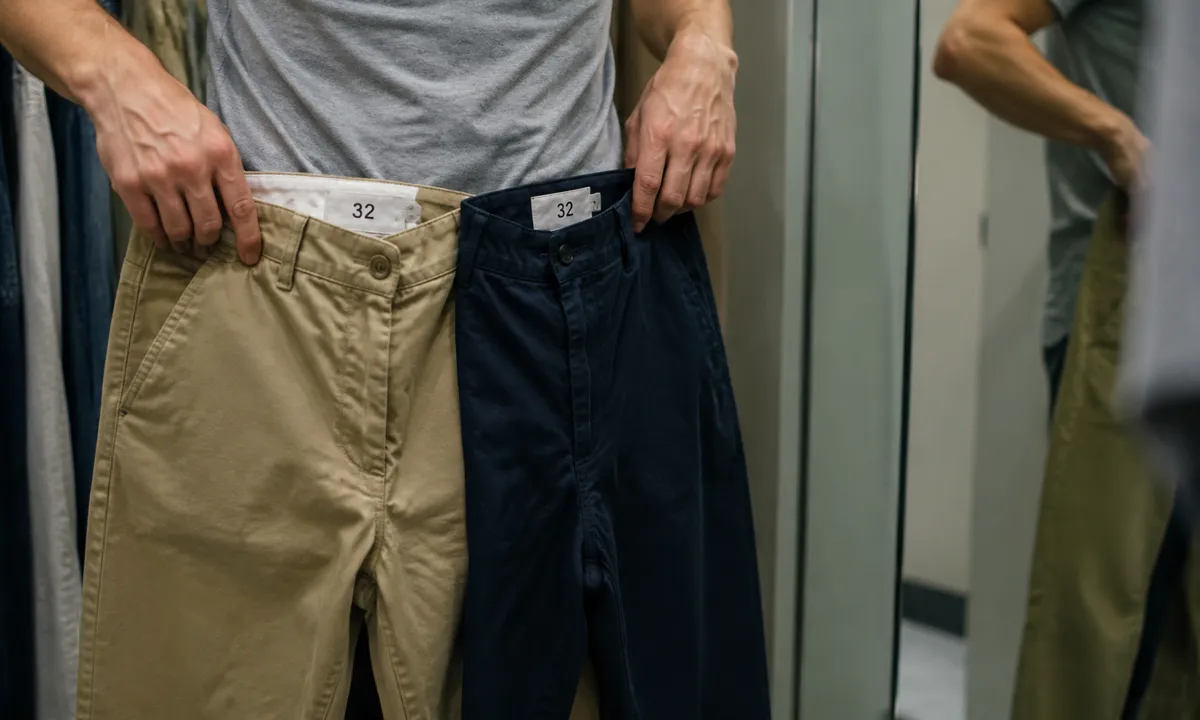
Clothing labels list size numbers, but those numbers describe almost nothing about how a garment will actually sit on a body. A size 32 waist from one brand can measure 33.5 inches at the tape; the same label from another can run 31. This is not a secret, exactly, but most people treat it as a minor nuisance rather than the central variable it actually is. The fit question gets deferred to the fitting room or ignored entirely when shopping online, and the result is a closet full of clothes that technically belong to the right size and technically do not fit.
The label comparison problem is really this: two shoppers buying the same labeled size from competing brands are often buying genuinely different garments, and the visible differences in quality, fabric, and finish tend to absorb all of the attention while the dimensional differences go unexamined. Someone will spend twenty minutes comparingstitching and another five reading about cotton weight, then accept on faith that fit is a wash because both garments carry the same number.
Where the Measurements Actually Diverge
Brands set their own graded measurements, and the deviations compound as sizes move away from the center of the range. Two labels might run almost identically at a medium, then diverge noticeably at the extremes of their size charts. A large from one house may have a chest measurement that a different house calls an extra-large, with a correspondingly different shoulder seam placement and sleeve pitch. Those structural differences do not wash out in wear; they change how the shoulder sits, how the armhole moves, and whether the chest pulls across or hangs loose.
Torso length is another dimension that rarely appears in marketing comparisons but matters enormously for how a shirt tucks or a jacket falls. A brand that cuts for a longer torso will bunch fabric at the hip on a shorter wearer; a brand cut for a compact frame will ride up constantly on someone taller. Neither is better in any absolute sense. They fit different bodies, and a comparison that ignores this is comparing incompatible objects.
Trousers add thigh and seat measurements to this list. Two pairs of pants with identical waist and inseam labels can differ by an inch or more across the thigh, and the seat shaping, whether higher and rounder or lower and flatter, is almost never specified anywhere on a label or in a standard product description. These are the dimensions most likely to make the difference between a garment that looks right from ten feet away and one that actually feels right in motion.
How Brands Encode Their Assumptions in the Cut
Every brand builds its patterns around a fit model with specific proportions, then grades outward from there. The proportional relationships in that original fit, the ratio of shoulder width to chest circumference, the drop from chest to waist, the hip-to-waist differential in womenswear, are baked into every garment that follows from it. Changing the labeled size does not change those ratios. It scales them.
This means someone with broader shoulders relative to their chest will find some labels consistently workable and others consistently problematic, not because of quality but because of whose body the original pattern was built around. A brand that has historically served a more athletic build will have a different shoulder-to-waist drop than one that built its sizing around a leaner, straighter silhouette. Neither is more accurate. They are just different assumptions about what a given size looks like in practice.
Womenswear complicates this further because cup size, hip curve, and waist definition are handled so differently across brands that two size 8 blazers might as well be cut for different species. A European brand entering the American market often maintains its original block proportions and simply relabels the numbers, producing a garment that technically carries a familiar size designation but fits according to entirely different underlying logic.
The Fabric Choice That Changes the Fit Equation
Fabric behavior intersects with cut in ways that make label-to-label comparisons harder still. A structured cotton canvas and a soft, drapey linen might share the same labeled dimensions coming off the cutting table, but the canvas holds its shape while the linen relaxes and drops. The linen shirt will feel looser at the shoulder, longer in the body, and generally more voluminous after a few wears, while the canvas version stays close to its original measurements. Comparing them purely by size label misses this entirely.
Stretch content adds another layer. A trouser with two percent elastane and one without may carry the same waist measurement at rest, but the one with stretch will accommodate a different range of movement and will recover differently after extended wear. Some people find stretch blends more forgiving; others find they exaggerate fit problems by clinging in the wrong places. The label says nothing about this. It just gives the static measurement.
And fabrics shrink unevenly. A garment that fits correctly on the rack may fit differently after the first wash, and whether it runs long or short of its labeled size after laundering depends on the fiber, the weave, the finishing treatment, and how closely the brand adhered to pre-shrinking protocols. Two competing labels at the same price point can behave completely differently in the wash, and this is one of the few ways that quality differences do genuinely affect fit over time.
What the Comparison Should Actually Involve
A more honest comparison between two competing labels starts with their published size charts rather than the label on the garment. Most brands now publish at least chest, waist, and hip measurements in centimeters or inches, and comparing those numbers directly reveals whether the garments are even in the same neighborhood before anything else is evaluated. If a brand’s published large measures 42 inches at the chest and a competitor’s measures 44, those are different garments, and everything else in the comparison, thestitching, the fabric, the hardware, sits on top of a fundamental dimensional mismatch.
Beyond the size charts, the most useful information comes from understanding a brand’s fit philosophy. Some brands state this explicitly: relaxed fit, slim fit, tailored fit. These descriptions are imprecise, but they signal intent. A slim-fit shirt from Label A and a relaxed-fit shirt from Label B are not being compared in any meaningful way by looking at their chest measurements alone. The waist suppression, the sleeve taper, the length all differ in ways the labels do not communicate.
Return rate data, when available, tells an honest story about how a brand’s sizing translates to actual bodies. A brand with a consistently high return rate in certain size ranges is probably running off from its stated measurements in those ranges, and that signal is more reliable than any official size chart. Customer reviews that mention specific fit issues, that a shirt runs short in the torso, that the thighs run narrow, or that the shoulders run wide, describe the real geometry of the garment in a way marketing copy never does.
The Expensive Garment That Still Does Not Fit
The most persistent version of this mistake happens at the upper end of the price range. A buyer compares a mid-range label to a premium one, finds the premium option superior on every visible axis, fabric quality, construction, finishing, and pays accordingly. The premium garment arrives and the shoulders are half an inch too wide. The shirt looks slightly wrong every time it is worn, not wrong in a way that reads as defective, just wrong in a way that registers as slightly off. A tailor could correct the shoulder seam for roughly what the buyer saved by not upgrading sooner, but it rarely happens because the cost feels like an admission of error.
That scenario happens because the comparison was conducted entirely on quality dimensions and not at all on fit dimensions. The premium label may well be the better garment for someone whose body aligns with the block it was cut around. For a body that does not match those proportions, the mid-range option might actually be the better buy, not because the fabric is finer or the stitching tighter, but because it was cut closer to the actual shape it needs to cover.
Fit alterations are part of how clothes are supposed to work at the higher end of the market, and a garment purchased with alteration in mind can be a reasonable choice. But the cost of alterations needs to enter the comparison from the beginning, not as an afterthought once the fit problem has revealed itself. A shirt that needs the sleeves shortened and the body taken in is a more expensive shirt than its price tag suggests, and that arithmetic changes which label looks like the better value.