


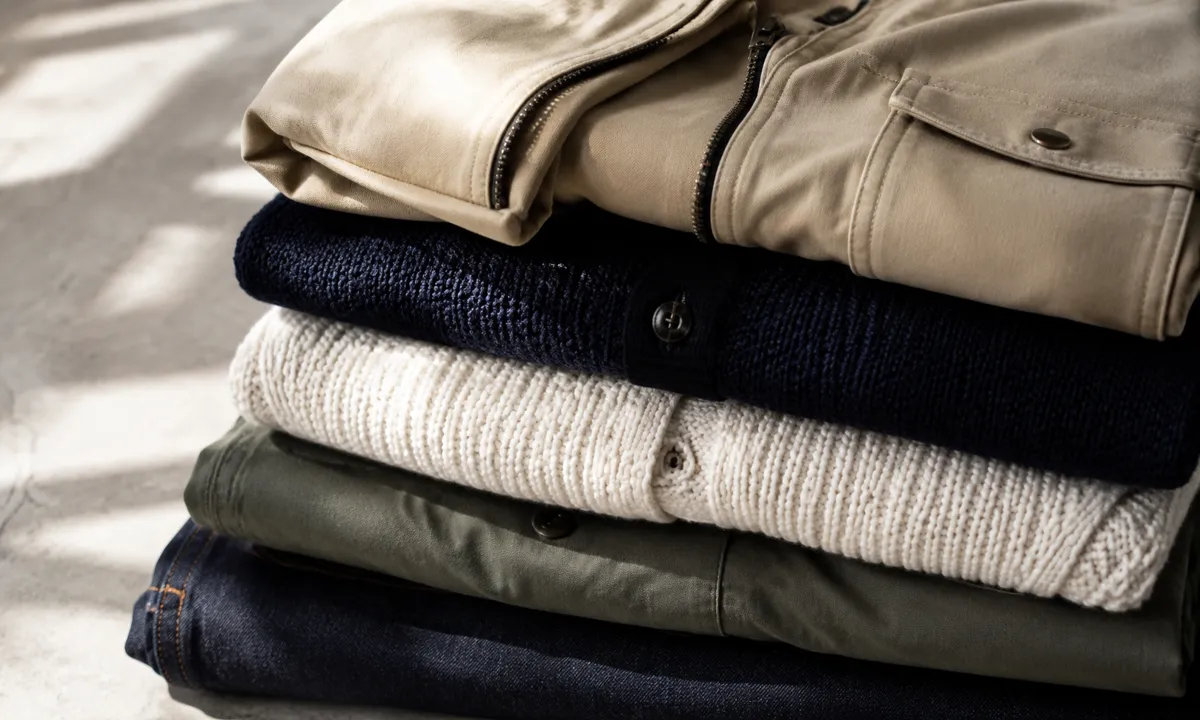
Smart money in fashion has always chased the same moving target. For decades the answer was either luxury or fast fashion, with not much territory in between. That gap has been closing, and a cluster of labels have stepped into it by doing something that still feels almost radical: treating a $200 jacket as an engineering problem rather than a branding exercise.
The labels worth knowing right now are not all the same kind of thing. Some are direct-to-consumer upstarts. Some are decades-old mills that finally built a retail presence. Some are small enough that their whole collection fits in a single room. What they share is a refusal to pad the price tag with wholesale margins and boutique markups, and a willingness to tell buyers exactly what they are paying for and why.
The Cost-Per-Wear Math That Actually Works
Cost-per-wear is one of those ideas that sounds like a justification for spending more than planned, and it often is. But the underlying logic is sound when the garment actually lasts. A $380 wool trouser worn twice a week for four years costs less per outing than a $90 pair that pills and bags out after eight months. The problem has always been knowing in advance which one you are buying.
A handful of labels have made that calculation legible. Wool and Prince, for instance, built its reputation around merino shirts designed to be worn for days at a stretch without washing, a claim the brand backs with enough material transparency that customers can actually evaluate it. The pitch is not luxury. It is efficiency. That distinction matters because it pulls in a different kind of buyer: someone who thinks about a wardrobe the way a good cook thinks about a kitchen, in terms of what gets used constantly and what just takes up space.
Efficiency-minded shoppers tend to converge on a short list of categories: outerwear, trousers, knitwear, and footwear. These are the items that either justify their price or embarrass the buyer who paid it. A coat is worn daily for five months a year. Its quality is tested in public every single day.
Outerwear: Where the Serious Labels Separate Themselves
Nau built a following among people who want technical outerwear without the mountaineering branding. Their bluesign-certified fabrics and merino-synthetic blends sit in a price range that looks steep at first and reasonable by the third winter of wearing the same coat. The styling is intentionally quiet, which is either a feature or a bug depending on what the buyer wants from a jacket.
At a slightly higher price point, Mackintosh remains one of the few labels where the production method is genuinely the product. The rubberized cotton process they use in Scotland is slow, labor-intensive, and produces a coat that ages into itself rather than degrading. Buying one is less like buying a coat and more like acquiring something that will need to be passed along eventually because throwing it away would feel wasteful. That is a specific kind of value proposition that very few labels can honestly make.
For buyers who want something between those two poles, Filson has quietly become a reference point. The brand dates back to the late 1800s, which means it has survived long enough to know what actually holds up. Their tin cloth and wool offerings are not stylish in a seasonal sense. They are functional in a way that outlasts trends.
The Direct-to-Consumer Labels That Delivered on the Promise
The early wave of direct-to-consumer fashion brands made a lot of promises about cutting out middlemen and passing savings to buyers. Most of them used the savings to fund aggressive marketing instead. A few actually held the line.
Everlane is the obvious example and also the most complicated one. The radical price transparency concept, which broke down the cost of each garment on its product pages, trained a generation of shoppers to ask questions that the rest of the industry hated. Whether Everlane itself has fully lived up to its original premise is contested, but the habit of mind it popularized has been genuinely useful. Buyers who learned to ask about fabric weight, factory location, and markup structure are better equipped across the board.
M.M. LaFleur has done something more specific and arguably more durable: it focused on the gap between corporate officewear that looks like a costume and casual clothing that reads as unprofessional. The result is a set of garments built for repeated wear in work contexts, with fabric choices oriented around wrinkle resistance and shape retention. The average price is not low, but the average number of times each piece gets worn justifies it.
Unbound Merino operates on a similar logic to Wool and Prince, with a slightly broader offering. The merino wool focus keeps the line tight, which is itself a form of smartcuration. A brand that makes fewer things well tends to be more reliable than one that expands into every category.
Heritage Mills and the Slow Return of Made-to-Last
Some of the sharpest value in fashion right now is not coming from startups. It is coming from manufacturers that have been making textiles for generations and recently decided to sell directly, either through their own retail presence or through carefully chosen stockists.
Harris Tweed is the clearest case. The fabric is protected by an Act of Parliament, which means every yard of genuine Harris Tweed is woven by hand in the Outer Hebrides from Scottish wool. A jacket made from it is not cheap, but the fabric itself is essentially impervious to normal wear. The cost is front-loaded. The ownership experience gets progressively cheaper as the years pass.
Abraham Moon, a Yorkshire mill operating since 1837, has expanded its direct consumer presence with a similar argument. Their British wool fabrics are used by many of the labels charging three or four times as much for finished garments. Buying from the mill, or from brands that use mill-grade fabric without the luxury markup, closes that gap considerably.
This is where sourcing knowledge pays off. A buyer who knows that a particular fabric is produced by a handful of mills can start to evaluate finished garments by the fabric rather than the label on the collar.
The Japan Factor and What It Actually Means for Buyers
Japanese manufacturing has developed a specific reputation in fashion: meticulous, expensive, slow, worth it. The reputation is largely earned. Japanese selvedge denim from mills like Kaihara or Kurabo, Japanese sashiko workwear, the output of smallerateliers in Tokyo and Osaka, these are made in a context where quality control functions as a cultural norm rather than a differentiating strategy.
The practical implication for buyers outside Japan is that labels sourcing from Japanese mills or manufacturing there tend to hold up to scrutiny. The challenge is that the pricing reflects the manufacturing costs honestly, which means entry points are higher. Brands like Engineered Garments, Kapital, and Orslow are not accessible at the low end. But for buyers who have been burned by cheaper alternatives enough times, the logic of paying more once starts to feel rational.
The more useful insight is about what to look for rather than which exact label to buy. Construction details like taped seams, bar-tack reinforcements at stress points, and selvedge edges on denim are not marketing language. They are indicators of decisions made at the production level, decisions that cost money and that most brands making cheaper goods simply skip.
Footwear Labels Where the Price Reflects Actual Construction
Goodyear welt construction is the dividing line in dress and casual footwear. A welted shoe can be resoled repeatedly, which means the upper, if it is good leather, can theoretically last decades. A cemented shoe cannot be resoled in any practical sense. The cemented sole fails and the shoe gets replaced. This is not a minor difference. It is the difference between a shoe as a consumable and a shoe as an asset.
Thursday Boots brought Goodyear welt construction to a price point around $200, which was genuinely new when they launched. The quality is not at the level of Tricker’s or Carmina, but it is welted, which means it can be repaired, and the leather is substantial enough to take a decent polish. For buyers stepping up from fast fashion footwear, it is a significant upgrade at a still-manageable price.
Quoddy makes something quieter and more specific: hand-sewn moccasin construction from a Maine workshop. The price is higher than Thursday and lower than the top English bootmakers. The shoes age visibly and well, developing patina in a way that signals use rather than wear.
Red Wing remains the reference point for work-derived footwear with serious construction. The Brogue Oxford and Iron Ranger have been in continuous production long enough that resale markets exist for worn pairs, which is one of the more reliable signals that something is genuinely built to last. When a used boot still commands $150, the new boot at $320 starts to look differently priced.
The Knitwear Question: Where Fiber Content Is Everything
Knitwear is where fast fashion does the most damage and where buying better shows up fastest. The difference between a sweater knit from acrylic and one knit from Shetland wool is apparent within a year of regular washing. The acrylic pills heavily and loses its shape. The Shetland, washed carefully, holds its structure and actually softens with use.
Scottish Shetland knitwear from producers like Jamieson and Smith, or finished sweaters from smaller makers using their yarns, represents one of the most direct value propositions in fashion. The fiber is inherently durable, the tradition of the craft is centuries old, and the price, relative to what luxury brands charge for inferior materials, is often startling. A heavy Fair Isle sweater from a traditional Shetland producer costs a fraction of what a fashion-house version with an Italian label costs, and the construction argument goes the other direction entirely.
Rowing Blazers has done something useful in the knitwear space by making traditional British and Irish patterns accessible without the dusty-shop-in-a-coastal-town distribution model. The result is that buyers who find the heritage context intimidating have an easier path in. The sweaters themselves draw on the same general tradition; the label just removed the friction from the buying experience.
The broader principle holds: in knitwear, the fiber content listed on the tag is the most important number on the garment. Everything else follows from that.