


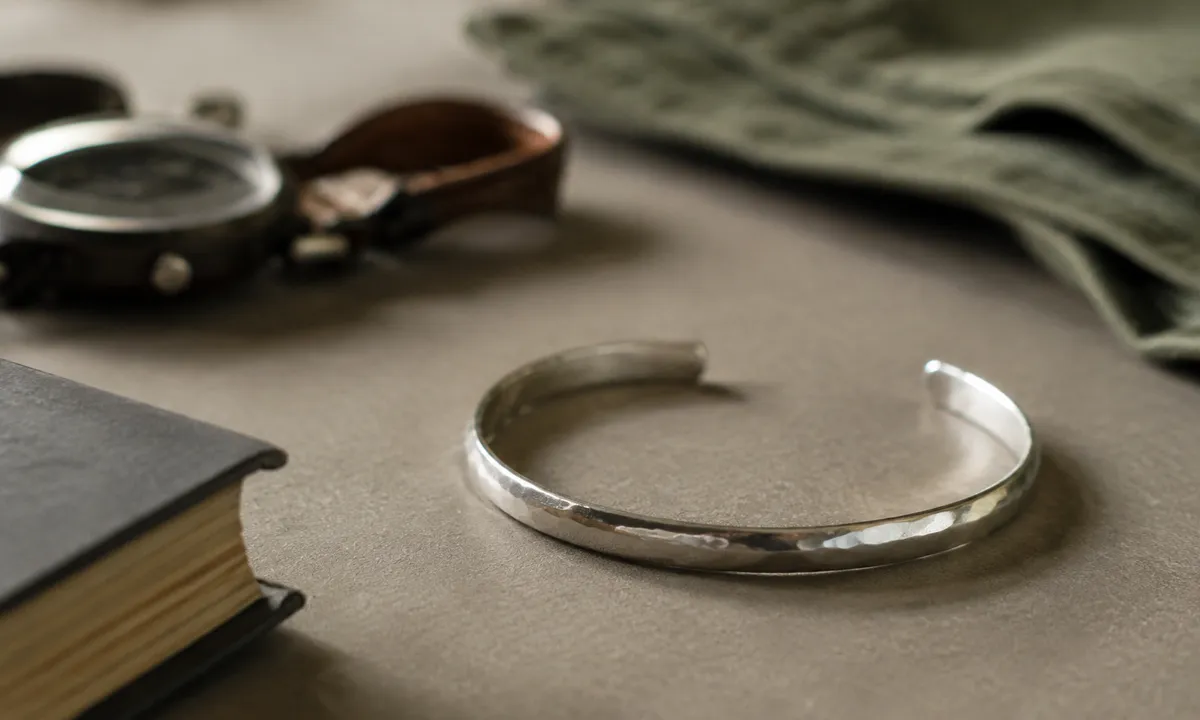
Somewhere around 2022, a quiet shift started showing up on wrists. Not on fashion runways or in trend reports, exactly, but in the kind of places where men make low-stakes decisions about themselves: the gym locker room, the work desk, the Sunday farmers market. Watches, which had been a near-universal accessory for men whocared about looking pulled together, started coming off. In their place: a single thin bangle, usually silver or matte gold, usually unadorned, sometimes just a hammered ring of metal that cost less than a tank of gas.
The question worth asking is not whether this is happening. It clearly is. The question is what it means about how men are thinking about themselves right now.
The Watch Was Always More Than a Watch
For about a century, a mechanical watch functioned as the one socially sanctioned piece of jewelry a man could wear without commentary. A Rolex Submariner communicated that you had arrived. A Seiko said you were sensible and probably knew what you were doing. Even a cheap fashion watch from the drugstore rack said something: that you were a person who tracked time, who had appointments, who was accountable to the world. The watch was a signal, a status object, and a practical tool bundled into one item you never had to justify wearing.
That last function died with the smartphone. Most men stopped needing a watch to know the time sometime in the mid-2000s, and the industry adapted by leaning harder into the other two functions, the signal and the status. Premium watchmakers had a solid decade of growth by selling timepieces as investments, heirlooms, and wearable engineering. The pitch worked for a certain kind of buyer and still does. But it quietly abandoned everyone else.
A man who does not want to spend four figures on an heirloom and does not care about displaying financial arrival was left, for a while, with very little. Cheap watches looked cheap. Smart watches looked like work had followed him to a dinner party. The wrist was, functionally, an unsolved problem.
What a Bangle Actually Offers
A minimalist bangle, the open-ended kind with no clasp or the simple closed ring that slides over the hand, solves the unsolved problem in the simplest possible way. It puts something on the wrist. It catches light. It adds a physical presence to the arm that reads, at a glance, as intentional. And it makes no claim beyond that.
That last part is doing a lot of work. A good watch, especially a recognizable one, speaks before you do. It names a brand, implies a price range, announces something about how you see yourself. A plain silver bangle says almost nothing specific. It says only: this person has some aesthetic awareness, and that awareness runs toward simplicity. There is a real freedom in that, especially for men who find the idea of broadcasting wealth or status through their clothing exhausting or slightly embarrassing.
The physical experience is also different in ways that matter. Most bangles weigh almost nothing. They slide and settle with movement. Worn alone, they disappear into the day the way a good pair of earrings does for someone who has worn them for years, present enough to notice when you catch your own reflection, quiet enough to forget about otherwise. A mechanical watch, even a light one, is always a little bit there: on the wrist, against the desk, generating a faint tick that announces its own existence.
Masculinity Made Room for This
The broader shift in how men are allowed to dress had to happen first. Skincare went mainstream for men sometime in the mid-2010s, and once that barrier fell, the downstream effects were significant. Men who started caring about moisturizer were also men who started caring about fit, texture, layering, and the small details that separate a put-together outfit from an accidental one. Jewelry was a natural next step, and the industry met them there with products calibrated for that sensibility: nothing ornate, nothing expensive-looking, nothing that required explanation.
The bangle fits cleanly into a certain kind of contemporary male wardrobe, the one built around neutral tones, quality basics, and a general preference for things that do not announce themselves. A thin silver or gold-tone bangle sits next to a clean white tee and straight-leg trousers the way a good watch sits next to a suit: it completes something without competing with anything. It reads as considered without reading as high-effort.
Age matters here too. Men in their twenties and early thirties right now were teenagers during an era when gender presentation was actively being renegotiated in popular culture, in music, in the spaces they moved through. The rules they inherited about what men wear are looser than the ones their fathers worked with. Wearing a bangle is, for a lot of these men, genuinely not a statement. It is just a thing they like.
The Role Social Media Played (and Keeps Playing)
Flat-lay photography on Instagram and TikTok “fit check” videos both have something in common: they reward wrist detail. In the context of a photograph, a bare wrist reads as missing something. A slim bangle, especially in silver against a light complexion or gold against a deeper one, photographs beautifully in a way that a bulkier watch sometimes does not. It does not interrupt a sleeve or create an awkward stack with acuff.
The aesthetics of a certain kind of lifestyle content, the kind organized around clean apartments, morning routines, and aspirational minimalism, created a visual grammar in which the bangle fits naturally. A smartwatch in that same frame often looks incongruous, too corporate or too gadgety for the softness of the image. The minimalist bangle solved a visual problem that men with cameras noticed, and then the aesthetic spread from the cameras back into actual behavior.
This is not cynicism. Style has always traveled from image to body. Men copied the watch-wearing habits of pilots and divers because those images had a certain appeal. The vector changed; the mechanism is the same.
Price, Access, and the Democratization of the Category
A simple sterling silver bangle from a small jewelry maker on Etsy or a minimalist brand running a direct-to-consumer operation will typically run somewhere between thirty and a hundred and fifty dollars. That price point is accessible in a way the watch world largely is not. The entry-level mechanical watch that actually looks good starts north of two hundred dollars and usually higher. The good ones that will last start at five hundred and climb fast from there.
The bangle category has almost no floor. A man can own three or four of them for the cost of a single modest watch, try different metals and widths, decide what he actually likes, and discard the experiments without financial pain. That accessibility does something for how the category feels: casual, low-commitment, playful in a way that expensive watches can never quite be.
Small independent jewelers have been the main beneficiaries. Large watch brands and major jewelry houses were slow to take men’s bangles seriously, which meant that when demand started building, it went largely to makers who were already creating that aesthetic: independent silversmiths, small-batch designers, the makers who were building pieces for the market that already existed among women and found men arriving as a new customer base with similar taste.
What Gets Lost When the Watch Comes Off
There is something worth acknowledging in the other direction. The mechanical watch, for all its signaling baggage, is one of the most impressive small objects humans make. A decent automatic movement contains over a hundred individual parts, some too small to see clearly without magnification, working together in a closed system that requires no battery and can outlast the person who bought it. Wearing one is a daily interaction with a miniature mechanical achievement, which is a real thing to give up for something that is, at its most basic, a ring made flat and open at one end.
The men who care about that level of craft have not abandoned watches. If anything, watch enthusiasm among men who are genuinely interested in horology has intensified, partly as a reaction to the broader casualization of wrist dressing. The collector market for vintage pieces and independent watchmakers continues to grow. Those men look at a bangle on another man’s wrist and feel, probably correctly, that something specific and interesting has been traded for something vague and easy.
Both positions are defensible. The bangle is not making a claim about mechanical sophistication, and the watch is not making a claim about visual restraint. They are doing different things, and treating one as a rebuke of the other misreads what either is actually for.
The Wrist as a Place to Make Small Decisions
What the bangle trend really reveals is that men, in larger numbers than before, are now treating the wrist as a space where low-stakes personal expression is possible and worth thinking about. That is genuinely new, at least at this scale. For most of the twentieth century, the wrist was functional real estate. It held a tool. The decision was which tool, not which aesthetic.
A man putting on a bangle in the morning is doing what women have done for generations: making a choice about proportion, metal, and mood that has no practical justification and requires none. He is treating adornment as adornment, without the cover story of utility or status that the watch always provided.
That shift is more interesting than any individual piece of jewelry. It lands quietly on the wrist and stays there, catching the light during a meeting, tapping against a coffee cup, going unnoticed for hours and then noticed all at once, which is exactly what a good piece of jewelry does.