


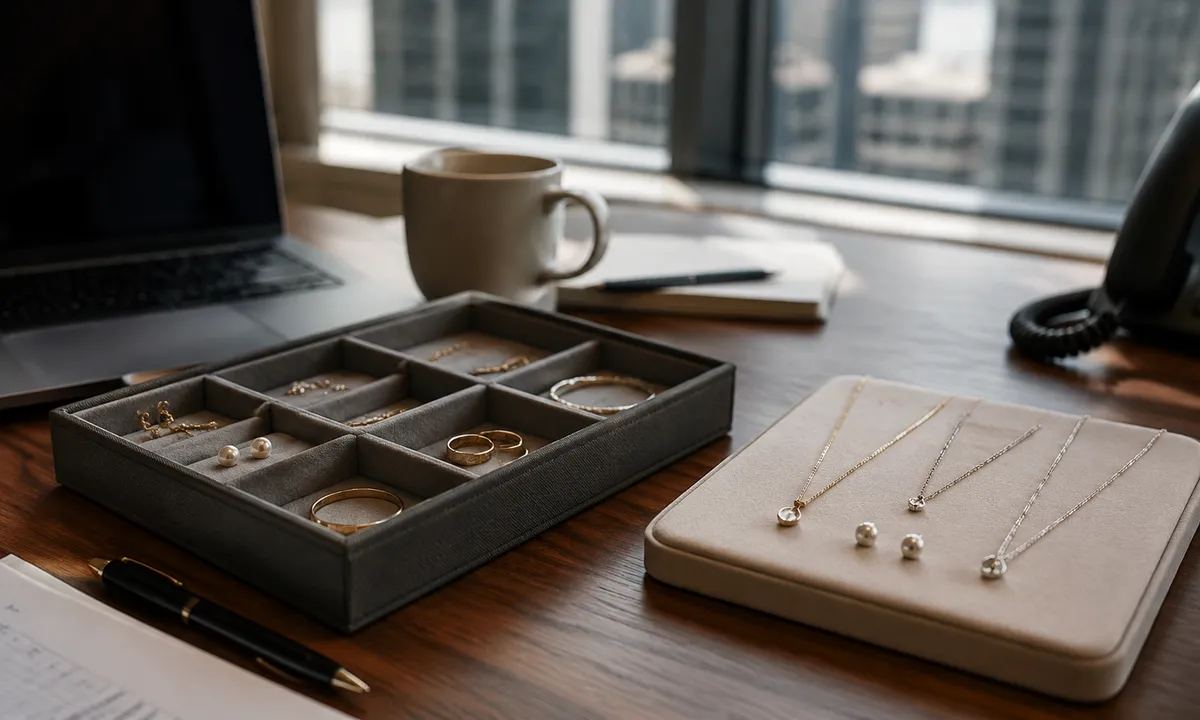
Fine jewelry and office settings have a complicated relationship. Too much glitter and the whole room notices; too little and a carefully assembled outfit looks unfinished. Getting the balance right takes more thought than most style advice acknowledges, because office wear is not one environment. A litigation attorney’s courtroom looks nothing like a creative director’s open-plan studio, and the jewelry rules that hold in one can backfire completely in the other.
Still, a few categories of pieces work reliably across most professional settings, and understanding why they work is more useful than a list of approved items.
Stud Earrings: The Most Consistently Useful Piece
Studs hold their position in professional wardrobes because they do nothing wrong. They are visible enough to count as intentional jewelry, quiet enough to stay out of the way during a meeting, and structurally simple enough that material and scale determine how dressed-up or casual they read. A small pearl stud in a traditional law firm reads as polished and appropriate. The same pearl stud in a marketing agency reads as quietly confident. A faceted stone or a geometric metal stud works in both places without shifting the register much either direction.
Scale matters more than most people adjust for. A stud with a face diameter under about 8 mm generally stays professional in most contexts. Once it reaches the size of a large pea or starts catching overhead light from a distance, it starts to feel like an evening piece that wandered in from somewhere else. The texture of the metal matters too: a brushed or satin finish reads more subdued than a highly polished one under fluorescent lighting.
Simple Chains and the Problem with Pendants
A plain chain worn at collarbone length is probably the most underrated office piece in existence. It adds presence to a blouse or a button-down without asking anyone to look at it. Thin chains in yellow gold, white gold, or silver all behave the same way: they complete a neckline rather than decorating one. That distinction matters in professional settings. The goal is to look finished, not accessorized.
Pendants are more conditional. A small, close-set pendant on a delicate chain continues to read quietly and works in most offices. The trouble starts when the pendant is large enough to move visibly, heavy enough to clink against a microphone on a video call, or thematic enough to invite conversation. A charm shaped like an animal, a zodiac symbol, or a meaningful object all communicate personality, which is fine in some cultures and a distraction in others. The pendant itself is not the problem; the size and how much it demands attention is.
Layered necklaces, which became prevalent in street style over the past decade, are genuinely tricky in formal office environments. Two delicate chains at slightly different lengths can work. Three or more starts to feel assembled for a specific aesthetic, and specific aesthetics read as casual in spaces that prize uniformity.
Rings: How Many, and Which Ones
A single ring, especially a band or a solitaire stone, is invisible in most professional settings in the best possible sense. It registers as normal. The signal changes when multiple rings stack on the same finger or when rings appear on most fingers of both hands. That combination reads more like a deliberate personal statement than background jewelry, which means it pulls attention the same way a large pendant does.
The cocktail ring, that wide-faced, oversized stone in a prominent setting, is the one ring category that regularly causes friction in conservative offices. Not because it is gaudy exactly, but because it sits outside the physical range of motion without comment. When someone gestures in a meeting or reaches across a table, a cocktail ring is impossible to ignore. In a relaxed creative environment, that visibility might be exactly the point. In a more formal setting, it competes with the person wearing it.
Midi rings, those thin bands worn above the knuckle, read as casual almost universally. They are tied closely enough to a streetwear aesthetic that they move the register of an outfit down regardless of what else is happening.
Bracelets and the Noise Question
A single thin bangle or a low-profile cuff bracelet does what good office jewelry should: it adds dimension to an outfit without performing. A single bangle in gold or silver, worn alone, barely registers on anyone else. It is there if you look for it and invisible otherwise.
Stacked bracelets introduce a problem that other jewelry categories mostly avoid: sound. Multiple bangles create noise when a wrist moves, and wrists move constantly during writing, typing, and gesturing. In a quiet conference room or on a call, the rhythmic clink of metal against metal becomes an ambient presence that other people register even when they do not consciously track it. This is not a strong argument against stacked bracelets in every context, but in settings where silence matters or where the impression of calm professionalism is important, the sound is a real consideration.
Charm bracelets have the same issue, compounded by the visual complexity of many small objects crowded together. They read well in personal time. In most office settings, the motion and noise work against them.
The Watch as Jewelry
A watch occupies a category by itself in professional settings because it reads as functional first and decorative second. That framing gives it unusual latitude. A watch that would be over-the-top as a bracelet reads as appropriate on a wrist because the rationale is time-keeping, not ornamentation. This logic holds even when the watch is obviously a luxury item. A fine mechanical watch in a conservative office draws admiration, not distraction, in a way that an equivalent amount of money in a statement bracelet would not.
The styles that tend to work most broadly in offices are clean-dialed watches with leather or metal bracelet straps, no larger than about 40 mm in case diameter. Oversized sporty cases, rubber straps, and heavily colorful dials start to read as weekend pieces past a certain threshold. The watch itself is almost always welcome; what changes is whether the specific version of it fits the setting’s expectations about dress.
Hoop Earrings: Where the Line Sits
Hoop earrings are worth addressing directly because their acceptable range in office settings is much narrower than their overall popularity suggests. A small hoop, inside about 25 mm in diameter, is professional in virtually any setting. It has enough presence to look intentional and enough simplicity to stay in the background.
Past that size, the calculus changes quickly. A 40 mm hoop in a traditionally conservative environment reads as fashion-forward in a way that can compete with professional credibility, fairly or not. A 60 mm or larger hoop belongs to a different category entirely: it is a style statement that announces itself before anything else does. In workplaces with a high tolerance for self-expression, that announcement is the point. In workplaces that value conformity or where first impressions carry particular weight, like client-facing roles or court appearances, the size works against the wearer’s ability to control how they are read.
The material and finish affect this too. A thin gold hoop in a polished finish reads differently than a wide, hammered, oxidized one. The second reads more as artisanal jewelry; the first reads as a classic. That distinction tracks across most professional environments consistently.
When Office Culture Rewrites These Rules
Every principle above assumes a moderately traditional professional setting, and many offices are not that. A senior creative at a fashion brand, a tattoo artist who also does client consultations, a professor in a fine arts department: all of these people operate in professional environments where conspicuous personal style is part of the credential. In those contexts, wearing a small stud and a plain chain might actually read as not having a point of view, which is its own kind of miscalibration.
Reading the specific culture matters more than following any external guide. The most reliable way to read it is to look at how people with authority and longevity in a given workplace dress, not interns or new hires who are still figuring out the room. If senior partners wear minimal jewelry, that signals something. If the most respected people in a creative department wear stacked rings and three-inch earrings, that signals something else. The jewelry that works best in an office is always calibrated to the specific office, not to an idealized abstract version of professional dress.
What remains true regardless of setting is that jewelry which calls more attention to itself than to the person wearing it tends to work against the wearer. The pieces that hold up best over time, the small stud, the plain chain, the clean hoop, the quiet bangle, share one quality: they are impossible to notice on their own and impossible to ignore as part of a whole. That combination is hard to manufacture and easy to buy, which is probably why it keeps working.