


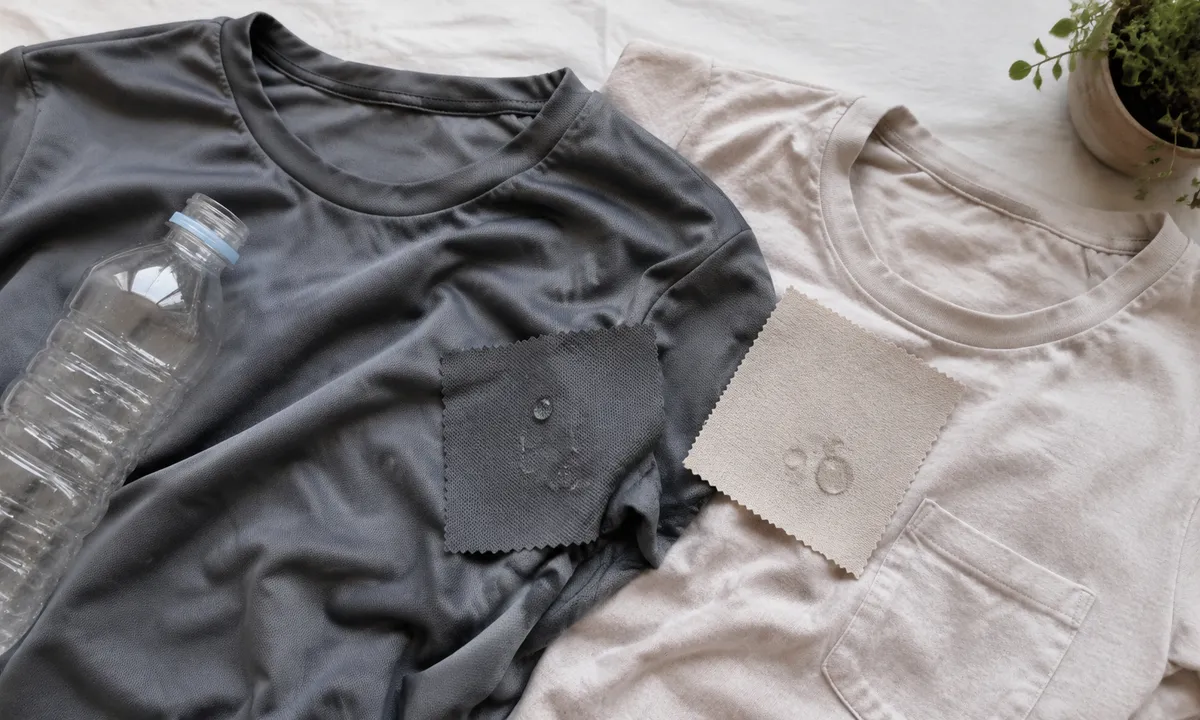
Polyester does not breathe. This is not a controversial claim or a matter of personal taste; it is simply what the fabric does. Yet every summer, clothes made almost entirely of polyester fill the rails of high-street shops under labels promising comfort, ease, and a certain kind of effortless cool. People buy them because they look right, hang well on a hanger, and resist creasing in a suitcase. Then they step outside in July and wonder why they feel damp before they have even reached the end of the street.
The confusion around summer fabrics usually starts with appearance rather than performance. A thin fabric looks cool. A light colour looks cool. A loosely draped silhouette looks cool. None of these things are wrong, exactly, but they address the visual problem of summer while ignoring the physical one, which is that the body needs to move moisture and heat away from the skin. A fabric that looks airy but traps vapour is worse than a heavier fabric that actually wicks. Appearances, in this particular domain, are consistently misleading.
The Synthetic Trap
Most performance fabrics used in sportswear are polyester or nylon-based blends. They are marketed using words like “moisture-wicking” and “quick-dry”, and in specific athletic contexts they earn those descriptions. During a run, sweat moves through the fabric and evaporates quickly because the body is generating so much heat that the process accelerates. But the same synthetic fibres worn during ordinary daily life, sitting in an office, walking around a market, eating lunch outdoors, tend to behave very differently. The evaporation process slows, the fabric holds odour, and the wearer ends up feeling sticky in a way that is qualitatively different from sweating through cotton.
Viscose and its relatives (rayon, modal) occupy an awkward middle ground that catches a lot of people out. These are semi-synthetic fibres derived from wood pulp, and they feel genuinely soft and cool to the touch in a shop. They drape beautifully. Many summer dresses and shirts are made from them. The problem is that viscose absorbs moisture readily but does not release it efficiently. In humid conditions it becomes heavy,clings to the body, and dries slowly. Anyone who has worn a viscose blouse through a warm and muggy afternoon has experienced this at first hand: what began as a pleasant, floaty feeling ends as a fabric plastered to the lower back.
What Linen Actually Does
Linen has an almost mythological reputation as the summer fabric, and it largely deserves it, though for reasons that are often poorly understood. The fibre comes from the flax plant and has a hollow, slightly irregular structure that creates small gaps in the weave. These gaps allow air to circulate close to the skin. Linen also absorbs moisture from the body and releases it into the air relatively quickly, which is why a linen shirt feels damp for a moment and then does not. The evaporation carries heat away with it.
The mistake most people make with linen is avoiding it because it creases. It does crease, aggressively and immediately, and anyone who finds that intolerable will be miserable in it. But the creasing is structural: it is a direct consequence of the same stiffness and openness of weave that makes linen comfortable in heat. A linen-cotton blend softens both the creasing and the breathability, landing somewhere in the middle. Pure linen, worn loose and accepted on its own terms, is genuinely one of the better solutions to a hot day.
The Weight Misunderstanding
Fabric weight is measured in grams per square metre, and the assumption that a lower number always means cooler is one of the most common errors in summer dressing. A 100 gsm polyester is lighter than a 160 gsm cotton, but the cotton will almost certainly feel cooler in practice because its fibre structure handles moisture and airflow more effectively. Weight tells you about density, not about how a fabric interacts with heat and sweat.
This matters practically when buying summer trousers or shirts. A very thin, tightly woven synthetic fabric can feel like wearing a second skin by mid-afternoon despite weighing almost nothing. A slightly heavier cotton or linen with a looser, open weave will feel more comfortable across the full day. The hand-feel test in the shop, holding the fabric up and checking for how much light passes through it and how much air moves through it when shaken gently, gives more useful information than the weight label alone.
Colour and Heat Absorption
White and light colours reflect radiant heat rather than absorbing it, which is why warm-climate dress traditions across many parts of the world converge on pale linens and cottons. This effect is real and measurable. A dark navy or black shirt in direct sun will absorb significantly more solar radiation than the same shirt in white or cream.
The caveat is that this only addresses external radiant heat. For the heat the body generates internally, colour is irrelevant; only the fibre and the weave structure matter. In shade or indoors, a black linen shirt and a white polyester shirt present a very different calculation than they would in direct sunlight. The colour rule applies most clearly at the extreme: standing in full sun on a hot afternoon, a dark synthetic is the worst possible combination, piling absorbed solar radiation on top of trapped body heat simultaneously.
Cotton Is Not Automatically the Answer
Cotton is broadly understood as the safe, breathable default, and for many purposes it is. But cotton has real weaknesses in heat that do not get enough attention. It absorbs moisture very effectively, which is part of why it feels comfortable initially, and then holds on to that moisture. A cotton T-shirt worn through a warm commute becomes damp and stays damp. In high humidity the problem compounds: the fabric takes longer to dry, continues to hold sweat against the skin, and can start to chafe.
The weave matters enormously with cotton. A dense cotton poplin, used in many formal summer shirts, is much less breathable than a loose cotton gauze or a seersucker, where the puckered, crinkled weave physically lifts the fabric away from the skin and creates tiny channels for air. Seersucker was developed specifically for wear in hot climates, and its slightly old-fashioned reputation has nothing to do with its technical merits. The weave solves the problem it was designed for.
Fit and Layering in the Heat
Even the right fabric in the wrong cut will fail. A slim-fit cotton shirt sits close to the body, reducing the air gap between fabric and skin to almost nothing. The fabric may breathe perfectly well in isolation, but the fit eliminates the microclimate that makes breathability useful. Loose, relaxed cuts allow a small column of air to circulate against the skin, which is thermally significant. Traditional warm-climate garments, the loose tunics, wide trousers, and full-cut shirts that appear across North Africa, South Asia, and the Gulf, are not loose by accident or for reasons purely of modesty.
Layering in summer sounds counterintuitive but is sometimes misapplied in the other direction. Removing a layer of natural fibre to feel cooler can expose the skin directly to radiant heat or leave the body without any wicking layer at all. A fine, loose linen over a cotton vest can, in direct sun, feel more comfortable than either garment alone because the outer layer handles the radiated heat and the inner layer manages perspiration. The mistake is layering synthetic over synthetic, or layering any tight garment over another tight garment, which simply stacks the problems.
Wool in Summer, Which Sounds Wrong
Fine merino wool in summer remains one of the more surprising practical choices, and it is largely dismissed because the word “wool” calls up heavy jumpers and wet walks in November. Merino at a low micron count (the finer the fibre diameter, the softer and less itchy the fabric) is genuinely comfortable in warm weather. It regulates temperature across a wide range, absorbs moisture without feeling wet, and resists odour far better than synthetics. A fine merino T-shirt worn on a long day of travel, moving between an air-conditioned train, a warm station, and a hot street, handles that range of conditions better than almost any cotton equivalent.
The cost is high. Quality fine merino garments are expensive, and the care instructions are less forgiving than cotton. For most people, this makes it a considered purchase rather than a wardrobe staple. But dismissing it because “wool is for winter” is the same category of error as buying a thin polyester blouse because it looks breezy on the hanger. The label on the product is not the same as the experience of wearing it at 28 degrees on a busy afternoon.