


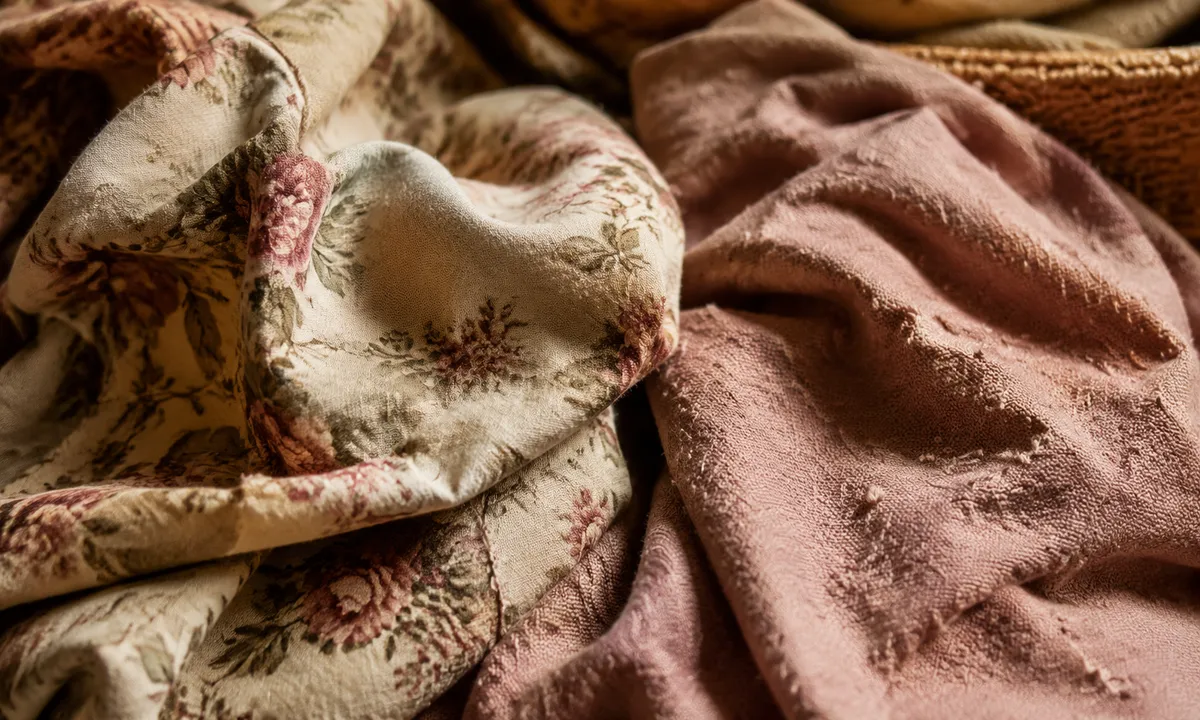
Fabric has a lifespan that shows up in the hand before it shows up anywhere else. A 1960s wool crepe dress, washed and worn for decades, still holds its shape at the seam. A polyester shift from five years ago pills and sags before the second season is out. The difference is not nostalgia or imagination. It is chemistry, construction, and the economics of how cloth has been made and sold across the last seventy years.
What Vintage Fabric Actually Was
From roughly the 1930s through the mid-1970s, the dominant dress fabrics were natural fibers: wool, cotton, silk, and linen, often in blends with early semi-synthetic rayon. These fibers have been refined by centuries of agricultural selection and processing. Wool, in particular, has a crimped microscopic structure that lets each fiber interlock and recover. That recovery is why a well-made wool dress can be hung overnight and return to its shape after a full day of wear. No synthetic fiber does that with the same consistency.
Rayon, which dominated mass-market dresses from the 1940s onward, gets a complicated reputation, but high-quality vintage rayon was often woven more densely than the cheap rayon found in contemporary fast-fashion pieces. Thread count and weave tightness matter enormously to durability. A tighter weave resists the friction that causes pilling, and it holds a seam with more integrity over time.
Cotton is the instructive case. Pre-1980s dress cotton, including broadcloths, piques, and fine lawn, came from longer staple fibers. Long-staple cotton, whether Egyptian or Pima, produces a smoother, stronger yarn. The shorter the staple, the fuzzier and weaker the yarn. Since the 1990s, the cotton in most mass-market garments has shifted toward shorter staple fibers grown and processed for volume rather than strength. The result is a fabric that softens quickly but also wears out quickly, sometimes within a year of regular washing.
The Molecular Case Against Modern Synthetics
Polyester, nylon, and acrylic dominate contemporary dress fabric at every price point below the luxury tier. They resist wrinkles, dry fast, and hold dye consistently. These are real advantages. But the fiber structure that gives synthetics their convenience also sets a ceiling on their durability.
Polyester is made from petroleum-derived polymers. On a molecular level, it is stable under many conditions, but it is susceptible to degradation from heat, UV light, and repeated mechanical stress. When a polyester dress is run through a hot dryer repeatedly, the fiber chains begin to break down at the surface. The fabric does not disintegrate, but it loses its surface integrity. Pills form. The weave loosens slightly. That sheen that looked sharp in the store becomes a different, duller sheen that reads as worn.
Acrylic is worse. It mimics the look and hand of wool but shares none of wool’s structural resilience. Acrylic fibers are sensitive to heat and prone to pilling from almost any friction. A vintage wool blend coat worn for thirty years still looks like a coat. An acrylic blend bought today may not survive five winters looking presentable.
There is also the question of blending ratios. A 1965 wool gabardine dress is almost entirely wool, perhaps with a small percentage of silk or fine cotton for the lining. A contemporary dress labeled “wool blend” might contain 30 percent wool and 70 percent polyester. That label is technically accurate and practically misleading. The durability properties of the wool are diluted well past the point where they carry the garment.
How Garment Construction Changed the Equation
Fabric is only part of the story. Construction practices changed alongside fiber choices, and the two shifts compounded each other.
Vintage dresses, especially from the 1940s through the 1970s, were typically constructed with seam allowances of five-eighths of an inch or more. That extra fabric at the seam is what allows alterations and, more importantly, what keeps seams from pulling apart under stress. Contemporary fast-fashion pieces often use narrower seam allowances cut to reduce fabric waste per unit. A quarter-inch seam allowance on a dress worn by someone who moves and bends and breathes is a seam that will eventually fail.
Interfacing, the internal stabilizer used at collars, waistbands, and facings, was traditionally made from woven fabric, sometimes canvas, sometimes cotton organdy. It moved with the garment and kept its structure over decades. Modern interfacing is almost universally non-woven and fusible, meaning it is bonded to the fashion fabric with heat. Fusible interfacing can delaminate with washing, particularly at higher temperatures, leaving bubbles and ripples in the outer fabric that cannot be fixed.
Thread tension, stitch length, and pressing are the invisible craft of garment construction. Pressing in vintage tailoring was done at multiple stages of assembly, setting each seam with steam and a clapper before the next seam was sewn. This technique fuses the fiber structure of the seam allowance into a flat, stable shape. A seam pressed properly at construction resists distortion for years. Mass production rarely allows time for this, and machine speed combined with synthetic fabrics means many contemporary garments are assembled but never truly pressed in the tailoring sense.
The Economic Logic That Drove the Shift
None of this happened by accident or indifference. The transition from natural fibers to synthetics in mass-market clothing was driven by clear economic incentives: synthetics are cheaper to produce, easier to care for, and more forgiving in the industrial manufacturing process. Polyester does not shrink unpredictably. It dyes evenly. It tolerates rough handling in cutting and sewing. From a production standpoint, it is an excellent material.
The fast fashion model, which accelerated sharply in the 1990s and reached full velocity by the 2010s, depends on rapid obsolescence as much as it depends on rapid production. A garment that lasts fifteen years is a garment that does not need to be replaced. The entire economic model requires garments that wear out, go out of style, or lose structural integrity on a cycle measured in seasons rather than decades. Durability, in this framework, is a liability.
Vintage dresses were made under different market assumptions. A dress from 1958 was priced, proportionally, at a higher share of a household’s disposable income than its contemporary equivalent. Customers expected it to last and adjusted their care accordingly. They dry-cleaned it, stored it properly, and repaired small damage before it became large damage. The fabric was made to reward that investment of attention.
Where the Exceptions Live
Vintage fabric is not uniformly superior. Cheap fabrics existed in every decade, and some of the most fragile garments ever made came out of the 1970s, when synthetic enthusiasm was at its peak and quality control in budget clothing was inconsistent. Poorly stored vintage fabric also deteriorates in ways no contemporary garment would: silk shatters (a genuine technical term for the way aged silk splits along the grain), cotton rots if stored damp, and moth damage is permanent.
And contemporary fabric is not without its strong representatives. Performance fabrics engineered for outdoor and athletic use are made to demanding specifications. High-end worsted wool suiting, even today, is produced to standards that would satisfy a 1960s cutter. Japanese selvedge denim is a modern product made with deliberate care for longevity. These things exist. They are simply not representative of what occupies most of the contemporary dress market.
The relevant comparison is between what was typical then and what is typical now, at comparable price points adjusted for inflation. On that comparison, the vintage garment almost always holds more structural integrity after equivalent years of wear. The fibers are simply more forgiving of time.
What a Fiber Does When It Fails
The way a fabric ages tells you a great deal about its character. Wool and cotton degrade gradually. The hand changes, the color shifts, the weave may thin, but the garment usually gives visible warning before it fails structurally. A thin spot appears at the elbow. A seam frays slowly. The damage is readable and, in many cases, repairable by someone with basic sewing skills.
Synthetic fabrics often fail more suddenly and less gracefully. Pilling concentrates in high-friction zones: underarms, inner thighs, collar edges. The fabric does not thin so much as it balls and roughens. Seams in cheap polyester can fail at the stitching line all at once when the load exceeds what the narrow allowance can hold. Fusible interfacing delamination has no fix that restores the original appearance. These are failures that leave a garment looking irretrievably cheap, not just worn.
A 1950s cotton shirtdress found in reasonable condition at an estate sale has already survived seventy years. If the seams are intact and the fiber has not rotted, it will likely survive seventy more with ordinary care. That is a specific, verifiable claim about what these materials do over time. The polyester shift hanging in a contemporary closet will not be making the same journey.