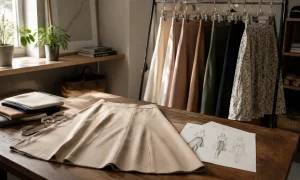
An A-line skirt is, in the most literal sense, a triangle. It sits close at the waist and hip, then flares gradually outward toward the hem, tracing the shape of the letter it is named for. That geometry is so simple it barely counts as a design decision. And yet it is almost universally considered the most forgiving silhouette in women’s clothing. The question worth asking is why a triangle should do so much work, and the answer turns out to be genuinely interesting.


What the Silhouette Is Actually Doing

The hip is the widest point on most bodies, and clothing tends to fail or succeed at exactly that point. Fitted trousers emphasise it. Pencil skirts map it precisely. Even wide-leg trousers sometimes draw attention to the hip simply by starting there. The A-line sidesteps the problem entirely by making the hip irrelevant to the silhouette’s outline. Because the fabric flares continuously from the waist down, the eye never locks onto the hip as the widest part of the shape. The widest part of the shape is always the hem, which is well below the body. The hip disappears into the line rather than defining it.

This is worth sitting with for a moment, because it explains why the skirt works across genuinely different body types. A person with narrow hips gets the same benefit as a person with wide ones: both are contained within an expanding triangle, and neither is made to look angular or broad. The skirt is doing the same job in both cases, which is to establish a controlled flare that begins at the narrowest point the wearer has and moves steadily outward from there.

The Waist as the Starting Point

A-line skirts are almost always waist-fitted, and that matters as much as the flare. The waist is the narrowest horizontal point on most torsos, and anchoring the silhouette there establishes a clear visual contrast: the body narrows, the fabric expands. That contrast is what gives the shape its sense of proportion. Remove the waist fit, and the skirt reads more like a tent than a triangle.

This is also why high-waisted A-line styles have remained popular rather than dating quickly. Sitting the waistband above the natural waist can lengthen the visual line of the leg and compress the distance between waist and hip, making the flare read as longer and more gradual. For anyone who carries weight or curves in the belly and lower abdomen, the high waist offers a specific additional benefit: the outward flare begins above the fullest point, so the fabric skims over rather than clings to that area.

Why Length Changes Everything

The flattering properties of an A-line depend heavily on where the hem lands, and this is the detail most often underestimated. A hem that hits at mid-thigh emphasises the upper leg and reads differently on different proportions. A hem at the knee is probably the most reliably proportionate cut because it ends at a point where the leg is already narrowing and creates a clean horizontal line without bisecting a wide part of the calf. A midi length, landing somewhere between the knee and mid-calf, elongates the leg but can shorten the apparent height if the wearer is petite and the fabric is heavy.

There is no universally correct length. But the principle holds: the hem needs to fall at a point where it creates a flattering horizontal cut across the leg, and a little experimentation at a rail of skirts tells a person more in ten minutes than any advice column can in ten pages.

Fabric Weight and How Much Flare Is Too Much

The same A-line cut in a stiff cotton twill and a fluid viscose jersey behaves so differently that it barely resembles the same garment. Stiff or structured fabrics hold the flare away from the body, maintaining the triangular silhouette even in movement. Softer, drapier fabrics fall closer to the body and produce a subtler, more relaxed version of the shape.

Both can work, but they suit different purposes and different body types. Structured fabrics are particularly good for anyone who wants the hip area to be completely obscured, because the stiffness holds the shape independently of what is underneath it. Drapier fabrics work better when the goal is softness over structure, and they tend to suit narrower hips proportionally because the fabric clings just enough to show the figure rather than swamping it.

Where A-line skirts become unflattering is at the extremes: a flare that is too dramatic for the fabric weight creates a silhouette closer to a circle skirt, which adds significant volume at the hem and can make a shorter figure look wider rather than longer. The best A-line is a restrained one, where the flare reads as gradual rather than abrupt.

Proportion and the Upper Half

An A-line skirt does not exist in isolation. The top that goes with it determines whether the overall proportions read as balanced or slightly off, and the classic pairing of a tucked-in or half-tucked shirt exists for a reason. A tuck, even a loose one, visually confirms the waist and reinforces the starting point of the A-line’s flare. Without it, a boxy or untucked top blurs the waistline and erodes the contrast that makes the silhouette work.

Cropped tops are perhaps even more effective, because they expose the high waist entirely and let the skirt’s silhouette read without any interruption. This combination became ubiquitous in the early 2000s, disappeared briefly, then returned with the high-waisted revival of the 2010s and has not really left since. Its durability as a pairing is precisely because it is geometrically logical: the top ends where the skirt begins, the two pieces form a single unbroken line.

Volume at the top needs more care. A heavily structured jacket or a wide-shouldered blazer worn with an A-line skirt creates two expanding shapes at once, which can read as competing rather than complementary. A fitted jacket or a slim-cut top keeps the visual weight in the skirt, where the A-line’s geometry is designed to carry it.

Colour Placement and the Eye’s Path

Darker colours at the hip and lighter at the hem reverse the flattening logic of the A-line, drawing the eye upward to the widest part of the body rather than downward and away. A single colour throughout is simpler and usually more effective. When a print is involved, a smaller, more evenly distributed pattern tends to preserve the silhouette, while a large bold print at the hip can add visual weight exactly where the A-line is designed to reduce it.

None of this means dark or patterned fabrics should be avoided. It means the placement matters. A dark skirt paired with a lighter top draws the eye up to the waist and face, which is a legitimate and flattering visual trick. The problem arises when the darker tones fall specifically over the widest point and the lighter tones sit above it, creating an inadvertent emphasis.

Why Tailoring Beats Sizing in This Skirt More Than Most

A-line skirts are one of the few garments where a minimal waist alteration produces a disproportionately large improvement in fit. Because the whole silhouette hinges on the waist being correctly fitted, even a centimetre or two of excess at the waistband loosens the anchor and lets the skirt shift and rotate throughout the day. Once it rotates, the seams are no longer at the sides where they belong, and the carefully considered flare sits at the front or back instead of evenly around the body.

A waist taken in by a tailor costs relatively little on most skirts and transforms how the whole thing wears. Buying one size down to get a tighter waist and then expecting the hip to accommodate is the wrong direction, because an A-line with too little room at the hip pulls the front flat and destroys the flare. The correct approach is to buy for the hip and alter at the waist.

That adjustment, small as it sounds, is what separates an A-line that looks considered from one that just looks present. The geometry is generous enough to accommodate a wide range of bodies without modification. But the geometry only works if the waist is actually doing its job as the fixed point from which everything else moves.

Leave a Reply

Your email address will not be published. Required fields are marked *