An hourglass figure is one of fashion’s more genuinely versatile starting points, and yet the advice written about it tends toward the useless. “Emphasise your waist” is repeated so often it has become a kind of mantra drained of meaning. What actually requires thought is how to do that across different garments, occasions, and proportions without every outfit collapsing into the same silhouette.

These seven rules are not about flattery in the abstract. They are about specific choices that work with the natural balance of equal shoulder and hip width, with a waist that draws inward, and with the particular fitting challenges that body type creates.
Define the Waist With Structure, Not Just a Belt

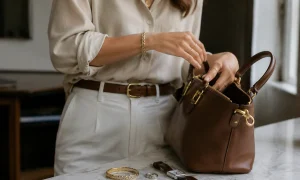
A belt is the instinctive answer and often a lazy one. It works, obviously, but a belt laid over a shapeless garment tends to create two ballooning sections above and below, which emphasises volume rather than line. The stronger approach is choosing garments that are already cut to follow the waist, then using a belt as a finishing detail when it genuinely adds something.

Tailored dresses and blazers with darting at the front and back panels do the structural work internally. A wrap dress achieves this through the diagonal of the wrap itself, which draws the eye across the body in a way a straight-cut dress with a cinched belt cannot replicate. When a belt is the right choice, a wide one in the 6 to 8 cm range at the natural waist tends to read more deliberately than a narrow one, which can look like an afterthought.

Match Fabric Weight to the Proportions Being Dressed

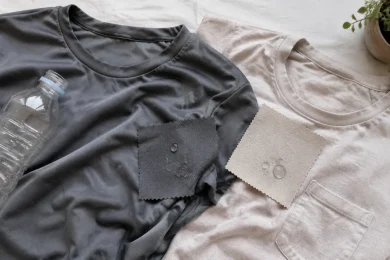
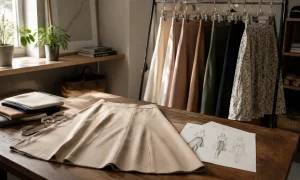
Heavy fabrics, particularly in a full skirt or wide trouser, add bulk in direct proportion to the volume of fabric used. On a figure where hips are already a strong presence, that bulk competes rather than complements. Lighter fabrics with some drape, jersey, crepe, fluid silk, fall closer to the body and move with it rather than projecting away from it.

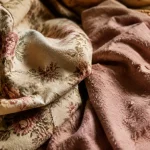
This matters most in skirts and trousers. A midi skirt in heavy brocade can overwhelm the lower half and make the whole silhouette read as bottom-heavy regardless of what is worn on top. The same skirt in a draped crepe maintains the sense of proportion. Stiff fabrics are not forbidden, but they work better in fitted cuts where they provide structure without adding volume.

Keep Top and Bottom Proportions in Balance

Because shoulder and hip measurements are roughly equal on an hourglass figure, garments that dramatically inflate one while leaving the other plain can pull the eye toward imbalance. A voluminous blouse tucked into a fitted skirt can make the torso read as larger than the lower half. A cropped fitted top over a full skirt achieves better visual parity.

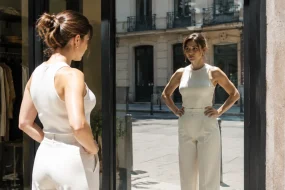
The aim is keeping a sense of equal visual weight across the whole figure. This does not mean everything must be fitted: a loose linen shirt left untucked over wide-leg trousers can work because both halves share the same relaxed energy. What tends not to work is a strong contrast in volume between top and bottom without something at the waist to anchor the transition.

Monochrome dressing, or at least tonal dressing across the full outfit, helps maintain this balance because it prevents the eye from stopping sharply at the waistline and comparing one half to the other.

Avoid Cutting the Figure at Its Widest Point

Hemlines that land exactly at the hip, whether on a jacket, a tunic, or a blouse, are genuinely problematic on this figure. The hem sits at the widest point and frames it rather than passing through it, which emphasises width in a way most people are not aiming for. A few centimetres either way changes things considerably: a hem that ends at the high hip, or one that extends well past the hip to mid-thigh or below, avoids the problem entirely.

This is the rule most frequently broken by accident. A fitted blazer that sits beautifully on a size 10 sample often has its hem at exactly the wrong place when worn by someone with a fuller hip. It is worth taking any jacket or overshirt to a tailor and asking whether shortening or lengthening it by three to five centimetres would improve the line. It often does.

Necklines That Open the Upper Body

V-necks and open necklines are standard advice and the reason they persist is that they work. A V-neck draws the eye vertically up the centre of the body, which creates a sense of elongation rather than width. On a figure where the chest is full, this matters: crew necks and high round necks close off the neckline and concentrate attention on the bust, while a V or a wide-set scoop redirects it upward toward the face.

Square necklines can be excellent because they echo the shoulder line and create a clean horizontal that feels deliberate. The necklines to approach with care are the ones that add structure directly at the bust, particulary boat necks with heavy fabric that sit wide across the chest, and turtlenecks in thick knit, which add visual mass at the very area where the figure needs least help.

Trousers: The Fit at the Hip Versus the Waist

Trousers are frequently the most difficult category. Ready-to-wear trousers are cut for a more linear figure, which means anything designed to fit at the hip will gap at the waist, sometimes by several centimetres. Buying to fit the hip and having the waist taken in is not an optional extra or a luxury alteration. It is the basic condition for trousers to look right rather than merely to stay up.

The leg shape matters independently. Straight-leg and wide-leg trousers work well because they create an unbroken vertical from hip to hem. Tapered trousers that narrow toward the ankle can emphasise the hip-to-leg contrast in a way that reads as awkward, particularly in stiffer fabric. Bootcut is reliable for the same reason as wide-leg: the slight flare at the hem creates balance rather than narrowing toward a point beneath a wider hip.

When Pattern and Print Enter the Equation

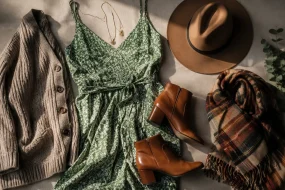
Print advice is often oversimplified into large prints bad, small prints good, or some variation of that. The actual principle is more specific. Busy, high-contrast prints worn across the whole figure scatter the eye and make it difficult to read the silhouette at all, which works against the natural advantage of a clearly defined shape. A bold print used strategically, confined to a top while the bottom stays plain, or reversed, can direct attention deliberately.

Vertical stripe is genuinely useful, particularly in separates. A vertically striped trouser worn with a plain fitted top extends the length of the leg visually without introducing any volume. Horizontal stripe is more contentious but not categorically wrong. A fine horizontal stripe in a fitted knit reads differently from a wide stripe in a boxy cut: the same pattern can read as elongating or widening depending on how tightly the garment follows the body.

The most reliable rule on pattern is simpler than most guides admit: one printed piece per outfit, chosen for where attention is wanted, and a plain counterpart for the rest. The figure itself already has strong lines. It rarely needs decoration competing with them on both halves simultaneously.

Leave a Reply

Your email address will not be published. Required fields are marked *