Oversized clothing works through a principle that has nothing to do with camouflage. The assumption, held widely, is that a baggy jumper hides things. Sometimes it does. But that is the lesser half of what is actually happening when a loose-cut garment makes a person look smaller, narrower, or more proportionate than they would in something fitted.

The more interesting mechanism is optical, and it operates on the eye rather than on the body underneath.

The Line the Eye Follows
When a fitted garment follows the body closely, every curve and contour is traced for the viewer. The eye has no choice but to read the full silhouette, because the fabric is supplying it directly. A close-cut dress or a pair of slim-fit trousers essentially draws an outline. Whatever shape the body holds, the clothing reproduces it faithfully and presents it at maximum resolution.
Oversized clothing introduces a second silhouette: the outline of the garment itself. That outer edge sits away from the body, and the space between them becomes visually ambiguous. The eye registers the outer line of the fabric and, crucially, stops there. It does not know with any certainty what lies between the outer hem and the skin beneath, and so it does not construct a detailed picture. The body becomes, in a perceptual sense, hypothetical.
This is why the effect works even on someone who is not actively trying to slim their appearance. The looseness creates uncertainty, and visual uncertainty reads as possibility. A viewer’s brain tends to resolve that uncertainty in the direction of the simplest readable shape, which is usually the outer line of the garment.
How Fabric Weight Changes the Equation
The effect is not guaranteed simply by choosing a larger size. Fabric behaviour under gravity matters enormously. A stiff or structured fabric, a heavy tweed or a thick cotton canvas, will hold its own shape as it hangs. The silhouette it creates is therefore relatively controlled, and the space between the body and the outer edge is clearly implied but not chaotic. That kind of oversized garment tends to produce a clean column effect, which is generally flattering regardless of the figure beneath.
A very lightweight, fluid fabric does something different. It clings intermittently, falling against the body at certain points and floating away at others depending on movement. The silhouette becomes unpredictable, and instead of producing the ambiguity that flatters, it can produce a kind of visual noise. Rippling fabric that attaches and detaches at irregular points can actually amplify the eye’s awareness of the underlying body rather than obscure it.
The most reliably slimming oversized garments tend to be mid-weight with enough structure to hang consistently. An oversized wool blazer, for instance, holds its shoulder line, tapers slightly at the hem, and drapes away from the torso in a predictable arc. The viewer reads one clean shape.
Where the Body is Anchored Matters
Loose clothing works differently depending on where it skims the body versus where it falls free. When a garment makes contact with the body at a narrow point, such as the shoulders, the clavicle, or the natural waist if it is defined, the eye uses that point of contact as a reference. Everything else in the garment is then read relative to that narrow anchor.
This is why an oversized shirt tucked loosely at the front, creating a small break at the waist without cinching it, can make the torso appear slimmer than either a tight shirt or a completely untucked oversized one. The loose fabric above and below the tuck reads as volume, but the waist implied by the tuck reads as narrower than the surrounding fabric. Contrast does the work.
The same principle explains why oversized tops paired with slim-cut trousers or fitted leggings tend to slim the overall figure more effectively than a fully voluminous outfit. The narrow leg provides a fixed reference point. The eye bounces between the fitted lower half and the loose upper half and averages the two, arriving at a mid-point silhouette that is typically slimmer than the broadest visible point of either garment alone.
The Vertical Column and Why Scale Matters
Proportion between the garment and the person wearing it is where oversized dressing either succeeds or collapses. A coat that swamps a figure entirely, reaching mid-calf on someone who is five foot three, does not create a slimming column. It creates a visual block, because the eye cannot distinguish a body from a bundle of fabric. The garment has to be oversized relative to the body, but it still has to read as a garment.
Vertical line is the mechanism most commonly cited, and it is correct. A long, loose cardigan worn open over a narrow top creates a continuous vertical band of negative space down the centre of the body, flanked by the hanging panels of the cardigan on either side. The eye is pulled downward along that central line, and vertical movement reads as height, and height reads as narrowness. It is elementary perspective: a tall thin rectangle and a short wide rectangle can occupy the same area, but the tall one reads as smaller.
The catch is that unbroken vertical lines require some discipline in the styling. An oversized coat belted tightly at the waist, for example, interrupts the vertical read completely. The wide lapels and the wide hem below the belt bracket a cinched mid-point, and the eye reads width at both ends. The slimming column is gone.
Why Certain Body Shapes Benefit More Than Others
Oversized clothing does not produce identical results across all figures, and pretending otherwise would be misleading. The effect is strongest where there is a meaningful contrast between the body’s widest point and the implied silhouette of the garment. For someone carrying most of their volume in the torso, a well-chosen oversized top replaces the torso’s actual outline with a smooth, hanging fabric line that sits beyond it. The substitution is clean and the slimming read is reliable.
For someone whose widest point is at the hip and whose torso is narrower, a voluminous top can actually reverse the intended effect. If the hem of an oversized top lands at the widest part of the hip, it draws the eye precisely to that point and holds it there, rather than moving past it. The garment has created a frame around the feature rather than diffusing attention away from it.
Length control is therefore more important for this body geometry. An oversized top that ends above the hip, or well below it at mid-thigh, will work more consistently than one that terminates at exactly the broadest horizontal point. The hem functions like a pointer; it indicates to the eye where to look.
Shoulders as the Structural Starting Point
Every discussion of oversized dressing eventually arrives at shoulders, because they are the single structural element that determines whether volume reads as intentional or simply ill-fitting. A garment whose shoulder seam sits correctly, even at the outer edge of the actual shoulder or slightly beyond it, will hang in a controlled way from that fixed point. The fabric below falls in a predictable, geometric descent. The whole thing looks considered.
When the shoulder seam slides down the upper arm, the garment loses its structural anchor. The fabric below the dropped shoulder bunches and shifts with movement rather than hanging clean. The shape collapses. This is the difference between an oversized fit and an incorrectly sized fit, and it is the single most important distinction in whether the optical tricks described above actually activate.
It is also why vintage and secondhand shopping for oversized pieces requires attention to that one measurement above almost all others. The waist can be loose, the hem can be long, the sleeves can be rolled. But if the shoulder is wrong, the garment cannot be rescued by any other styling decision.
Colour, Tone, and the Limits of Loose Fabric
The shape of the garment carries most of the optical work, but tone is not irrelevant. Deep, single-toned fabrics in an oversized cut reinforce the column illusion because they offer no internal contrast for the eye to map onto the body’s actual contours. A mid-grey oversized jumper in a flat ribbed knit presents no visual information about what is happening beneath it. A printed or heavily textured oversized garment in bright colours parcels the fabric into smaller visual units, and each unit gives the eye a new place to rest and read.
This is not an argument for uniformly dark wardrobes. A bold print in an oversized silhouette can absolutely be worn, and can still produce a broadly slimming effect if the other structural elements, shoulder placement, hem length, fabric weight, are correctly handled. But the print will compete with the silhouette rather than serve it, and the degree of slimming read will be moderated accordingly.
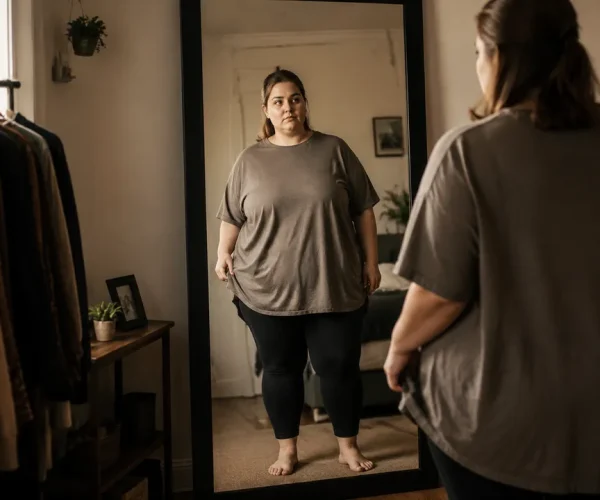
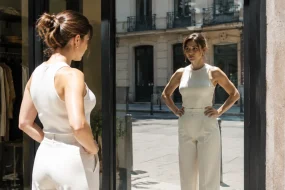
The person who understands these mechanisms will eventually reach a point where they stop asking whether oversized clothing makes them look slimmer and start asking something more specific: at which point on my body does the fabric break away from the skin, where does it land, and what is the eye being directed to do? Those three questions, answered honestly in a mirror with natural light, will tell a person more about their next clothing purchase than any general rule about size labels ever could.