Midsize bodies occupy a particular fashion purgatory. The advice aimed at straight sizes often misses, the plus-size guidance sometimes overshoots, and the styling tips floating around social media were clearly written with a size 8 body double in mind. Crop tops and tuck-in shirts are two of the most reliably discussed options for women in roughly a size 12 to 18 range, and the conversation around them tends to collapse into vague reassurance. “Both can work!” is technically true and practically useless.


What actually matters is understanding what each style does to proportion, and being honest about where those effects land on a real body rather than a styling mood board.

What a Crop Top Actually Does to the Silhouette

A crop top ends somewhere above the natural waist, pulling the eye to the midriff. For a midsize body carrying weight in the stomach, that is not automatically a problem, despite what decades of fashion messaging might suggest. The real variable is the waistband of whatever is worn on the bottom. If high-waisted trousers or a skirt sit at or just above the navel, the crop top meeting that waistband creates a defined junction. The torso reads as two balanced sections rather than one long uninterrupted column.

The length of the crop matters considerably more than the word “crop” itself implies. A micro crop ending just below the bra line is a genuinely different garment from a cropped tee finishing two inches below the navel. The second length is where midsize bodies often find a workable sweet spot: enough exposure to register the waist, not so much that the stomach becomes the focal point rather than the waistline.

Fabric weight plays into this too. A flimsy jersey crop in a pale colourclings differently from a structured cotton or ribbed knit. The structure of the garment does some of the work that a taut stomach might otherwise do, which is worth keeping in mind when scrolling past a trend that looks sharp on an influencer and then mysteriously flat in the fitting room mirror.

The Tuck-In Shirt: Where It Earns Its Reputation

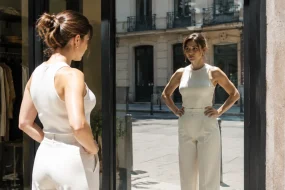
The tuck-in shirt, done properly, is one of the more reliable tools for creating the impression of a waist without any actual structural garment doing the work. The tuck pulls fabric down and into the waistband, compressing any billow at the front and signalling a narrower midsection by contrast. When a linen shirt or an Oxford gets tucked into tailored wide-leg trousers, the combination borrows from menswear in a way that reads as deliberate rather than draped.

The French tuck, where only the front portion gets tucked while the sides and back hang loose, tends to suit midsize bodies particularly well. It avoids the stiffness of a full tuck, keeps the back and hip area free, and still delivers the waist-defining effect at the front. The caveat is that it requires a shirt with enough length to hang without bunching, and the untucked portion needs to fall at a flattering angle, which typically means just grazing the widest part of the hip rather than ending awkwardly mid-thigh.

Where tuck-in shirts genuinely excel over crop tops is versatility across context. A cropped top in a boardroom or at a family Sunday lunch carries a charge of casual exposure that not everyone wants to manage. A tucked shirt reads as put-together in almost any setting while doing the same waist-defining work.

The Belly Problem That Both Styles Navigate Differently

The stomach sits at the centre of this comparison, because a midsize body very often carries weight there, and both styles interact with it in opposite ways.

A crop top, because it ends above or at the natural waist, keeps the stomach largely below the hemline and framed by whatever high-waisted bottom is paired with it. The midriff might be visible in a small strip, but the stomach itself sits within the bottom garment. This is counterintuitive to anyone whose instinct is to cover the midsection entirely, but the logic holds in practice: tucking a midsection inside a waistband actually conceals it more cleanly than draping a long, untucked top over it.

A tuck-in shirt, by contrast, gathers fabric directly against the stomach before the waistband takes over. If the shirt is too fine or too tight, it will emphasise any forward projection in the belly. This is where fabric choice becomes critical. A slightly heavier weave, or a shirt cut with a small amount of ease through the torso, gives the tuck enough volume to skim rather than cling. The trick is choosing a shirt that is neither oversized (because an excess of bunched fabric inside a waistband creates a lumpy ridge) nor body-con (because there is nowhere for the tuck to breathe).

How Bottom Halves Change the Calculation

Both styles depend heavily on the lower half of the outfit, and this is often where styling advice skips too quickly past the details.

With crop tops, high-waisted bottoms are close to mandatory. Low-rise or mid-rise jeans paired with a crop leave a band of exposed skin that breaks the silhouette in an unflattering way for most midsize frames, because the eye lands on the widest part of the stomach without any visual anchor pulling inward. A high-waisted wide-leg trouser, a midi skirt in a heavy fabric, or high-waisted straight-cut jeans all give the crop top the context it needs. The waistband does the structural work; the crop top simply announces it.

Tuck-in shirts are more forgiving of waist placement in the bottom garment, but they still perform best with a defined waistband. A fluid tuck into a high-waisted skirt creates obvious contrast between the nipped-in waist and the fuller skirt below. In straight or relaxed trousers, the tuck reads more casual but still signals intention. The one pairing that tends to undermine the tuck is a low-slung bottom with a baggy tuck: the effect reads as accidental rather than considered.

Bust and Shoulder Considerations That the Conversation Often Skips

Midsize bodies frequently come with a fuller bust and broader shoulders than the standard fashion template, and both styles interact with this part of the body in ways worth addressing directly.

A crop top with a tight or narrow neckline can read as straining across a fuller chest. The same crop in a V-neck or with a slightly more relaxed cut through the chest and shoulders reads as intentional and proportionate. Structured fabrics with a little give are more reliable than jersey that has to stretch to accommodate the chest, then pulls up at the hem.

Tuck-in shirts carry their own complication for fuller busts: the gap. Button-up shirts, tucked in, have a tendency to pull open between the buttons at chest level on a fuller-busted frame. A slightly oversized shirt tucked in will often solve this, but it introduces a different challenge in that too much extra fabric through the chest and torso can read as shapeless rather than relaxed. Stretch-blend fabrics in poplin or chambray move with the body in a way that pure cotton does not, which helps avoid the gap without needing a different shirt size.

The Occasion Variable and What It Actually Rules Out

Styling choices exist in context, and context is where crop tops lose ground on a practical level.

A tuck-in shirt can be dressed up or down across a wide range of settings without drawing attention to itself. A crop top in a workplace, a formal occasion, or a setting where the dress code skews conservative requires a deliberate decision about visibility and exposure. This is entirely a personal calculation, and there is no objectively correct answer. But the midsize woman who wants to look put-together without spending mental energy managing perceptions about her exposed midriff will generally find the tuck-in shirt an easier daily choice.

For casual and social settings, the crop top often wins on ease. It requires no shirt to stay tucked through a long day, no fabric to readjust after sitting, and no bulk inside a waistband. Anyone who has spent an afternoon repeatedly re-tucking a slippery shirt into high-waisted trousers knows that a well-fitting crop top sidesteps the whole mechanical inconvenience.

Where the Comparison Actually Lands

The case for the tuck-in shirt rests on adaptability and the precision with which it defines a waist when the pairing is right. The case for the crop top rests on silhouette logic that is more straightforward than most people expect: by ending above the widest point of the stomach and letting a high waistband do the work below, it creates a cleaner line than a long floaty top that tries to hide the midsection and usually just blurs it.

The real dividing line between the two styles for midsize bodies is not which one flatters more in the abstract. It is this: a crop top asks the wearer to commit to a specific silhouette built from the waist up, while a tuck-in shirt offers more room to improvise within an outfit. Someone dressing quickly, dressing for unpredictable occasions, or dressing through temperature changes in a single day will likely find the tuck-in shirt more liveable. Someone building a deliberate outfit from a strong high-waisted bottom upward may find the crop top gives them exactly what a longer top never quite manages: a waist that registers without any tricks at all.

Leave a Reply

Your email address will not be published. Required fields are marked *