Silhouette is the first thing a stylist sees and the last thing most people think about when they get dressed. Before colour, fabric, pattern, or price tag, the outline of a garment against the body is doing more structural work than anything else in the wardrobe. A skilled stylist can walk into a consultation, glance at someone standing in their street clothes, and within two or three minutes have a clear instinct about which cuts will carry them and which will fight them. That speed looks like intuition. It is mostly geometry.


Reading the Body as a Set of Proportions
The first thing a stylist actually measures, even if only with their eyes, is the relationship between shoulders, waist, and hip. These three points form a structural triangle, and every silhouette either reinforces that triangle, disrupts it, or creates a new one. Someone with broad shoulders and narrow hips reads differently in a full A-line skirt than someone whose proportions run the other way. The question a stylist asks is never “what does this person look like?” but “what is the ratio, and what will shift it?”
Length is the second axis. The vertical distance between the waist and the hip, and between the hip and the knee, varies considerably from person to person. A mid-length midi dress that cuts a 5’4″ woman at the widest part of her calf will sit entirely differently on a 5’9″ woman with longer legs. Experienced stylists carry this calibration silently. They see the body in sections, not as a whole.
Torso length is the measurement that surprises people most. Two women can be the same overall height and dress size and still need completely different approaches to a fitted jacket or a high-waisted trouser, simply because one carries more of her height in her legs and the other in her upper body. A belted coat that falls beautifully on the first will look strangely short-waisted on the second. Stylists check for this almost immediately, usually by noting where the natural waist sits relative to the hips during that first standing assessment.
What Stillness Reveals That a Mirror Does Not
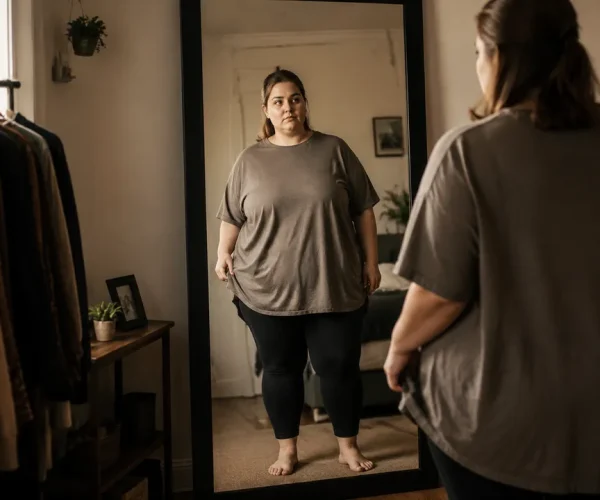
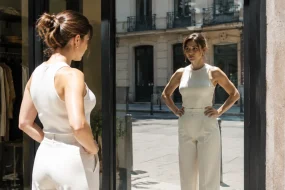
Most people assess their own bodies in motion: turning, tugging, pulling something on over their head. A stylist tends to watch a client simply standing still, often before any clothes have changed, because stillness is where posture, weight distribution, and skeletal structure become readable. Rounded shoulders, a forward head position, one hip sitting higher than the other: these are the details that determine whether a structured shoulder in a blazer will enhance or exaggerate.
Posture is not a separate concern from silhouette. It is part of the same calculation. A draped silk blouse that looks effortlessly elegant on someone who stands upright will collapse and pool at someone who carries tension in their upper back. A stiff, boxy jacket that seems severe on a hanger can give a person with soft posture exactly the structure they need. The garment and the body are working as a single form, and a good stylist treats them as one.
The Role of Fabric Weight and Fall
Silhouette is not purely a matter of cut. Fabric weight and how it falls against the body changes the silhouette of an identical pattern dramatically. A pair of wide-leg trousers in a heavy crepe will drape straight from the hip with a clean column effect. The same cut in a lightweight linen will shift, billow slightly, and cling differently depending on how the wearer moves. Stylists who work quickly tend to factor fabric behaviour into their initial read without separating it out as a distinct step.
This is where many people go wrong in changing rooms. They hold a garment flat against themselves and assume that is a reliable preview. It rarely is. A bias-cut dress shows almost nothing on a hanger. A structured shift that appears boxy as a flat garment can become something else entirely when its fabric is interacting with the body underneath it. Part of what a stylist does is translate between how a garment presents in static form and what it will actually do when worn.
Anchoring Points: Where a Garment Starts and Stops
Every garment has what a stylist might call anchoring points: the places where it grips or rests on the body. The shoulder seam, the waistband, the hem. Where these points land relative to the body’s natural structure determines whether something looks intentional or accidental. A shoulder seam that sits a centimetre too far down the arm does not just affect the shoulder; it alters the apparent width of the chest, the length of the arm, and the overall proportion of the upper body in one move.
Hem length is the anchoring point most people spend time on, often at the expense of the others. Stylists tend to reverse this priority. A hem can be altered. A shoulder seam is a much more expensive fix. So the first check on any fitted garment is whether the shoulder sits correctly, because if it does not, no amount of hem adjustment will rescue the silhouette.
The waistband anchor matters differently depending on body shape. For someone with a clearly defined waist, the waistband is a natural anchor point that the silhouette can hinge on. For someone with a longer, less defined torso, a waistband placed at the anatomical waist can look uncomfortable, and a slightly dropped or elasticated waist may let the garment fall more naturally. A good stylist decides quite quickly which category applies and pulls accordingly.
Contrast, Balance, and the Eye’s Natural Movement
Silhouette works partly through contrast. A fitted top and a full skirt create a silhouette with movement because there is a distinct shift in volume between the two halves of the body. An oversized jacket over wide trousers creates a different kind of visual mass, one that reads as a deliberate block. Stylists are constantly working with how the eye moves across an outfit, where it pauses, what it emphasises.
Dark and light interact with this. A light coloured trouser and a dark top will draw the eye downward differently than the reverse. But this is a secondary layer of the silhouette calculation, one a stylist layers on top of the structural read rather than leading with. The shape comes first, and then colour confirms or complicates it.
Volume balance is where many outfits fail quietly. Two items of extreme volume worn simultaneously rarely resolve into a coherent silhouette; they compete. A pleated wide-leg trouser in a heavy fabric already carries significant visual weight. Pairing it with a dramatic puff-sleeve top means the eye has no place to rest. A stylist who spots this will often swap out one of the two items for something with less structural presence, not because either garment is wrong individually, but because they are both asking for too much attention at once.
The Decade of Pattern Recognition
The speed with which a skilled stylist makes these assessments comes from repetition rather than special perception. Over years of dressing different bodies, a stylist builds something close to a visual database: a recalled store of thousands of instances in which a particular cut met a particular proportion and produced a specific outcome. When they look at someone and immediately reach for a particular silhouette, they are pattern-matching against that store at speed.
This is genuinely learnable, which matters because it changes how someone might approach their own wardrobe. Understanding that a stylist is doing geometric proportion work, not passing aesthetic judgements on bodies, reframes the whole exercise. A waist that appears shorter than average is not a flaw to work around; it is a data point that rules in some silhouettes and rules out others. Wide hips are not a problem to minimise; they are a structural feature that certain cuts will use well and others will not.
The shift in thinking, from “this looks bad on me” to “this cut is doing the wrong thing with my specific proportions”, is probably the most useful thing a stylist ever transfers to a client. It removes the personal charge from what is essentially a technical question, and it is what separates someone who keeps buying clothes they do not wear from someone who has worked out their own silhouette logic for good.
When the Body Changes
Silhouette reading is not a fixed science applied to a static object. Bodies change across a lifetime, and a silhouette that served someone well for years can stop working after a significant weight change, pregnancy, or simply the gradual shift in how the body holds itself after forty. Stylists who work with the same clients over time recalibrate regularly. The proportional relationships shift, and so does the cut that makes sense.
This is where the instinct of a long-practised stylist becomes most visible: not in identifying the right silhouette for a body at its most straightforward, but in reading one that has changed recently and working out which of the old rules still apply and which have been overtaken. A woman who has always relied on a fitted waist to define a silhouette may find, after a change in her midsection, that drape does that work better now. The geometric logic is the same. The specific solution is different.