Splitting accessories between wrists is one of those choices that looks considered from across a room. Watch on the left, bracelet on the right, or the reverse: the visual weight balances, neither wrist crowds the other, and there is something quietly deliberate about it. For certain people, in certain contexts, it works beautifully. But the reasoning behind it matters as much as the outcome, and the opposite-wrist rule gets followed by a lot of people who have never stopped to ask whether it actually applies to them.


Why the Convention Exists in the First Place
The dominant rule in watch styling has always been simple: wear the watch on the non-dominant wrist. Right-handed people wear it on the left. The practical logic goes back to pocket watch culture and early wristwatches, when the crown needed to be wound frequently and you wanted your dominant hand free to do it without removing the watch. The movement was also less likely to take a knock during work. That reasoning has softened considerably since quartz and automatic movements became standard, but the convention held, and now left-wrist placement reads as default for most of the world.
Bracelets arrived on the wrist without any functional rulebook at all. Worn for centuries on either side depending on culture, symbolism, or pure preference, a bracelet carries none of the mechanical heritage that locked the watch into its position. The result is that when someone wears both, the watch tends to anchor on the left, and the bracelet gravitates to the right almost by process of elimination. Symmetry provides the justification after the fact.
What Separating Them Actually Does to a Look
Distributed across two wrists, accessories create a frame. The eye moves from one side to the other instead of landing on a single, potentially crowded wrist. When both pieces are substantial, this distribution genuinely helps: a 42 mm steel sport watch stacked against a thick beaded bracelet reads as restless, even a little anxious. Give each piece its own wrist and both breathe.
There is also a practical dimension that gets underplayed. Metal bracelets, particularly those with rigid links or hard stones, can scratch a watch crystal or mar a case surface over time. Keeping them separated removes that risk entirely. For anyone wearing a dress watch with a soft-finished case or an exhibition caseback that sits flush against the wrist, this alone makes opposite wrists worth considering.
The downside is just as real, though. Two separately dressed wrists can look like two separate outfits competing for attention rather than one considered whole. This tends to happen when the pieces have nothing in common: a very formal watch paired with a casual, heavily textured bracelet on the other side does not create balance so much as contrast, and contrast without logic just reads as confusion.
The Case for Wearing Both on the Same Wrist
Stacking, which means wearing the watch and one or more bracelets together on the same wrist, has been a documented part of both men’s and women’s styling for decades. In women’s fashion, the stacked arm, layering thin bangles alongside a watch, has deep roots and shows no sign of leaving. In men’s styling, it moved from fringe to mainstream somewhere around the mid-2010s and has stayed there, especially in streetwear and casual contexts.
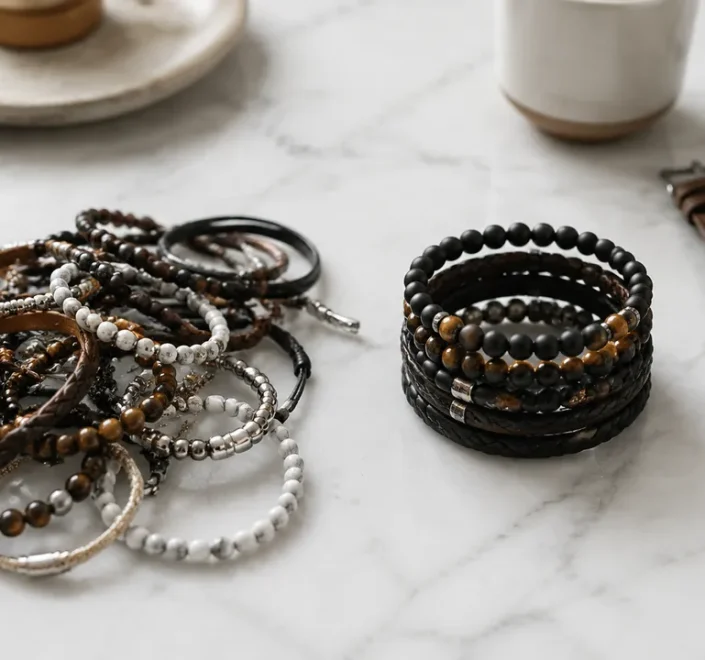
Done well, stacking creates a focal point. All the attention concentrates on one wrist, which can be striking if the pieces are chosen with some coherence: similar metals, a shared color story, or a deliberate contrast in texture, say smooth steel against rough cord. The pieces talk to each other instead of existing in isolation on opposite sides of the body.
Done poorly, it is just clutter. A watch with a thick rubber sportstrap does not stack cleanly with anything; the profile is too bulky and the materials too distinct. Thinner straps, NATO weaves, leather, or fine mesh sit alongside bracelets much more naturally. Scale matters too: a 44 mm dive watch with a chunky bezel leaves almost no real estate for a bracelet on the same wrist without the whole thing feeling like a hardware store.
When Opposite Wrists Is Clearly the Right Answer
A few situations make the split approach the stronger choice almost regardless of personal preference.
Formal dress is one. A slim dress watch in yellow gold or polished steel sits in an entirely different register from most bracelets, and putting a bracelet on the same wrist tends to dilute the watch’s quietness. Moving the bracelet to the opposite wrist preserves the watch as a clean, intentional statement and gives the bracelet room to register as its own piece rather than an afterthought beside something more serious.
Professional environments are another. In contexts where any visible accessories carry scrutiny, having a watch on one wrist and a single, simple bracelet on the other reads as restrained and deliberate. The same accessories stacked together might read as excessive. The visual difference between the two arrangements is subtle, but the social reading of them is not always the same.
And for anyone who works with their hands, even in a low-stakes way, the comfort argument is real. Keyboard work, writing, drawing, any activity where the wrist moves repeatedly against a surface: one accessory per wrist reduces the physical awareness of both. Two things on one wrist create a combined mass that some people find distracting and others barely notice. Worth knowing which category applies before committing to a stack.
The Question of Visual Weight and Proportion
The piece that tends to get ignored in this conversation is proportion. Most advice about opposite-wrist placement assumes that both accessories are substantial, that there is actual visual mass to distribute. When one piece is minimal, such as a very thin chain bracelet or a small, delicate watch, the distribution argument weakens considerably.
A thin bracelet on the opposite wrist from a watch can look intentional, but it can also look like an afterthought, as if the second wrist needed something on it and the smallest available option was pressed into service. The eye registers the disproportion even if the viewer cannot name it. If the bracelet is light enough that it nearly disappears on its own wrist, the better move may be to bring it to the watch wrist, where the watch provides the visual anchor and the bracelet plays a supporting role.
The reverse also holds. A very large bracelet, something with real presence, a thickcuff, a statement piece in carved wood or layered metal, can overwhelm the opposite wrist when a watch sits alone on the other side. The bracelet dominates, the watch looks stranded, and the balance the split was supposed to create never materializes. Opposite wrists works best when both pieces carry roughly comparable weight.
Material Relationships That Change the Calculus
Whether the accessories share or contrast materials is, in practice, more important than which wrist they end up on. A yellow gold watch and a yellow gold bracelet can work beautifully on opposite wrists, where the matching metal reads as a system, or together on the same wrist, where the shared material creates cohesion. A yellow gold watch next to a silver-toned bracelet on opposite wrists, though, creates a split that the eye keeps trying to resolve. The wrist separation does not resolve mixed metals; it just puts them farther apart.
Texture tells a similar story. A rubber-strap sports watch on one side and a polished gemstone bracelet on the other creates a tonal mismatch that distance cannot fix. Bringing the pieces into a shared material conversation matters more than the architectural question of same wrist versus different wrists. That sequence, material first, placement second, tends to produce better results than starting from the wrist-splitting rule and working backwards.
The Specific Combination That Tends to Succeed
A mid-size watch, something in the 38 to 42 mm range, on a leather or fabric strap, paired with a single bracelet of moderate weight on the opposite wrist: this is the configuration where the opposite-wrist approach reliably earns its place. Both pieces have enough presence to stand alone. Neither competes with the other. The overall silhouette reads as assembled rather than accidental.
Push outside those parameters in any direction and the formula starts to need more thought. A very large watch, a very delicate bracelet, a heavycuff, a stack of thin bangles on one side: each of these shifts the balance in ways that opposite-wrist placement alone cannot correct. The wrist assignment is one variable in a system that includes scale, material, formality, and the weight each piece carries on its own.
What the opposite-wrist arrangement does best is create space. It keeps pieces from competing, it protects both from physical damage, and it gives the eye a path across the body rather than a single dense focal point. Whether that serves any particular combination depends entirely on what the pieces are and what they are being asked to do together. The split is a tool, not a rule, and knowing the difference is what separates a look that feels finished from one that just followed instructions.