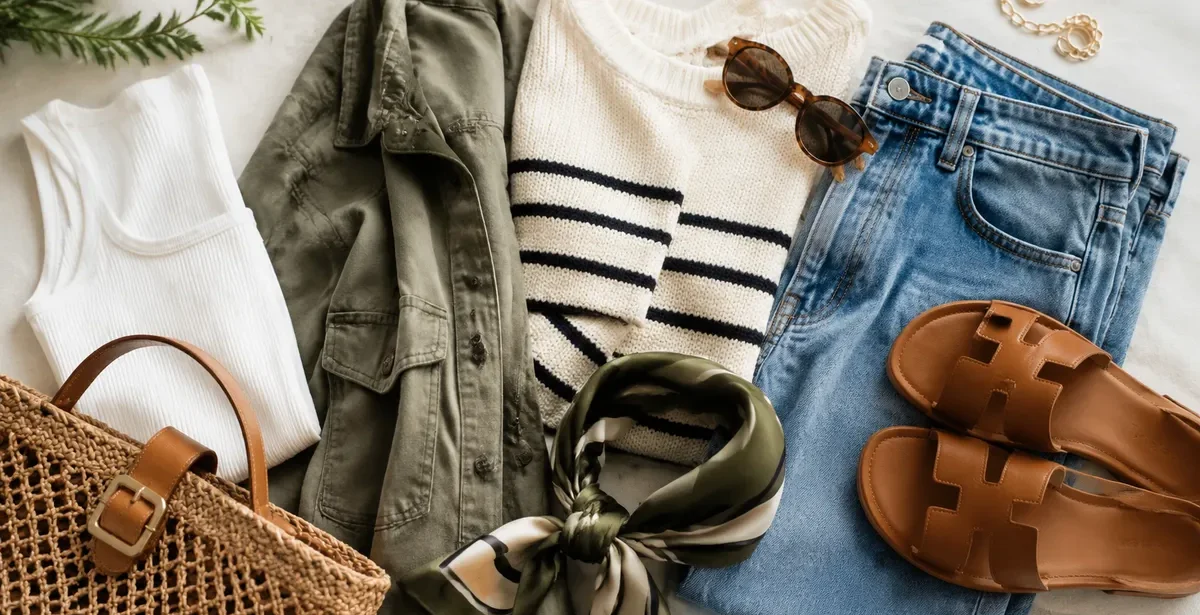
Plain white tee, dark jeans, clean sneakers. It is the uniform of millions of people who have stopped pretending that getting dressed in the morning deserves more than five minutes. The outfit is perfectly decent. It is also, on its own, completely forgettable.


What separates the person who looks casually polished from the one who just looks casual is almost always something small and metal or woven or beaded, chosen well and worn without overthinking it. Jewelry does this more efficiently than any other category of accessory. A bag changes the practicality of an outfit. Shoes change the formality. A single piece of jewelry changes the whole register of what a person seems to be about.

Five pieces do this job better than any others for the plain t-shirt specifically. Not because they are expensive or rare, but because of what they bring to fabric that has no collar, no pattern, no structure, and no built-in detail.

A Thin Gold Chain at the Right Length

The operative word is thin. A chain between 1.2 mm and 1.8 mm wide sits against a t-shirt neckline the way a fine line drawing sits against a blank page: it adds definition without competing. Anything heavier starts to feel like it belongs on a different outfit entirely.

Length matters just as much as weight. A chain that hits right at the collarbone, typically around 16 to 18 inches depending on neck size, does the most work on a crew neck tee. It fills the visual gap between the neckline and the chin, which is otherwise just a blank slab of fabric. On a V-neck, dropping to 18 or 20 inches extends the line of the V and looks intentional rather than accidental.

Gold specifically (whether solid, filled, or vermeil) reads warmer against skin than silver in most daylight conditions, which gives the whole outfit a slightly finished, slightly sun-touched quality that a white tee can otherwise strip out. Sterling silver works too, especially in cooler months or against deeper skin tones. The rule is that the chain should look like it belongs to a person, not like it was added as an afterthought. A chain worn consistently every day, the kind that gets a little scratched and develops its own minor kinks, carries more presence than a pristine one worn twice a year.

A Pendant That Earns Its Real Estate

A pendant gives the chain something to anchor. More importantly, it gives the eye a place to land. On a plain t-shirt, which offers the eye absolutely nothing, that landing point matters.

The best everyday pendants are small and specific. A hammered oval. A small coin. A single freshwater pearl on a short drop. A tiny charm from a place that actually means something. The specificity is the point: a piece that looks like it could have been bought by anyone at any mall feels like decoration. A piece that looks chosen, even if it cost twelve dollars, reads as personality.

Size matters here. A pendant wider than about 25 mm on a thin everyday chain starts to look costume-y against a casual tee unless the pendant is itself extremely thin and flat. Small and flat is the formula that travels best from a morning coffee run to an evening glass of wine without requiring a change of anything else.

Stud Earrings with Some Real Presence

Hoops get most of the attention in jewelry conversations, but a well-chosen stud does something hoops cannot: it keeps everything still. There is a particular quality to a person who looks put-together precisely because nothing is moving or jangling. A good stud earring is almost invisible until someone gets close, and then it is clearly right.

The studs that do the most for a plain tee are the ones with a little dimension. Not flat discs, but something with facets, texture, or shape: a small bezel-set stone, a pavé sphere, a twisted knot in gold wire, a rough-cut turquoise cab. The texture catches light at different angles as a person moves through a day. Flat, high-polish studs tend to disappear.

Size range worth staying inside: roughly 6 mm to 12 mm in diameter. Below 6 mm and the earring becomes invisible at normal conversational distance. Above 12 mm or so and it stops reading as a stud and starts competing with the simplicity of the outfit.

One more thing about studs: wearing one in each ear is the obvious choice, but a single stud in one ear with a smaller stud or a plain huggie in the other is a detail that reads as considered without being loud. It is the kind of choice that people notice without knowing exactly what they noticed.

A Cuff or Single Bangle Worth the Noise

Wrist jewelry and a t-shirt exist in a natural relationship. The sleeve of a tee ends at the wrist, which means the transition from sleeve to arm is one of the most visible parts of the whole outfit. A bare wrist at that transition feels unfinished. A cuff or a bangle makes it feel deliberate.

The distinction between a cuff and a bangle is worth keeping in mind. A cuff is an open-back bracelet that adjusts to the wrist, usually with some width to it. A bangle is a closed circle that slides over the hand. Both work well with a plain tee, but they project differently. A cuff, especially a hammered metal one in brass or oxidized silver, reads artisanal and individual. A bangle, particularly a simple round one in gold, reads clean and modern.

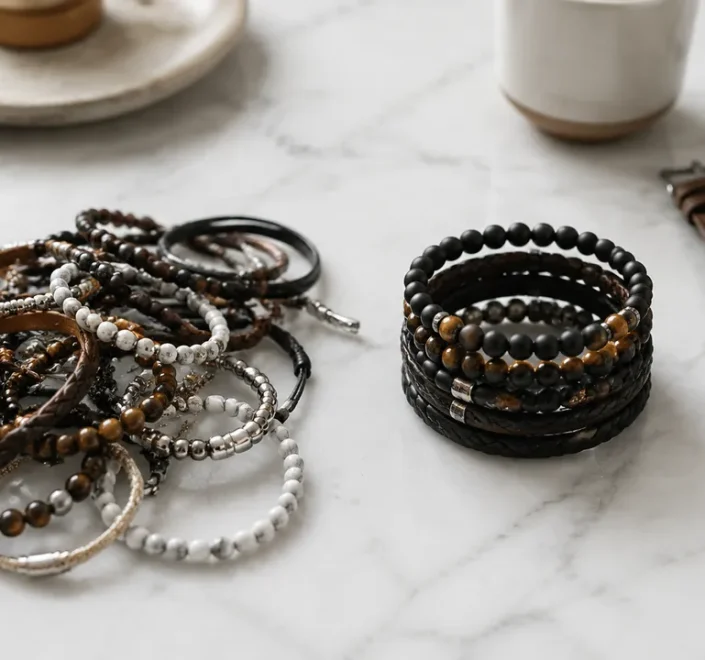
The key to wearing either with a t-shirt is restraint at the neighboring wrist. Onecuff on the right wrist, nothing or a simple watch on the left. Two or three bangles stacked on one wrist can work if they are all the same metal and similar in weight, but past three the look starts to say something specific about the person’s style, which may or may not be the intention on a Tuesday morning.

The noise argument is real. A bangle taps on desks and doorframes. That is either something to embrace or something to avoid, and it is worth knowing which one applies before buying.

A Layered Necklace Set That Acts as One Unit

The case for layering necklaces over a plain tee is that it solves the blank-canvas problem decisively. The case against is that layering done badly looks chaotic and takes longer to put on than the outfit itself. The answer is to stop treating layering as something assembled every morning and start treating it as a single piece of jewelry that happens to be three chains.

Pre-layered sets, sold as a unit at varying lengths designed to work together, exist specifically for this reason. They clip onto the same clasp or sit on adjacent clasps very close together, and they hang at three distinct lengths, usually around 15 inches, 17 inches, and 19 inches, so each chain stays in its own lane. The visual result looks like someone made a deliberate aesthetic choice in the morning. The actual result is that it took fifteen seconds.

What makes a layered set land well on a t-shirt is variety in texture across the layers. A delicate cable chain at the top, a slightly chunkier chain in the middle, a chain with a small pendant at the bottom. Three identical chains at three lengths look less intentional than three different chains at three lengths, even when the three chains are all the same metal.

Against a crew neck tee, a layered set works better on a woman with a longer neck, where there is enough real estate between the neckline and the chin for three chains to differentiate themselves. Against a V-neck, the layering effect is visible all the way down and works on any neck length. The V does the structural work that the crew neck does not.

How These Five Work Together Without Overloading

The point of having a short list of everyday pieces is that on most days, only one or two of them are right. A layered necklace set is already a full statement at the neck. Add a thin stud and leave the wrists bare and the whole outfit is done. A single thin chain with a pendant and a hammered cuff is quieter but just as complete. The reflex to add more, to also do the earrings and the bangle and the layers, is the impulse that breaks the whole thing.

These five pieces earn their place in an everyday rotation because each one does a specific job: the chain fills the collarbone zone, the pendant gives the eye a destination, the stud earrings keep the face framed without noise, the cuff or bangle closes off the wrist, and the layered set handles the whole upper body at once when time or energy is short. None of them require an occasion. None of them require the outfit to change first.

A plain t-shirt is already a decision, just a stripped-down one. What jewelry does is confirm that the simplicity was chosen, not defaulted into. One thin chain against a white tee on a Tuesday morning communicates something that the same tee worn bare does not, and it costs about thirty seconds to put on.

Leave a Reply

Your email address will not be published. Required fields are marked *