Leather bags do not lose their shape all at once. They sag in stages, over months, until the structure that made the bag worth owning is gone and the leather is creased in ways that cannot be undone. Most of that damage happens not during use but during storage, in closets and on shelves where bags are piled on top of one another, hung from straps that were never meant to bear dead weight, or simply left empty and folded in half.

Getting storage right is mostly about understanding two things: what leather does when nothing supports it, and what causes the internal structure of a bag to take a permanent set. Once those two ideas are clear, the practical steps follow naturally.

What Leather Actually Does in Storage

Leather is a tanned hide, which means it is a fibrous material with a memory. Under pressure or under its own weight, it conforms. Leave a full tote slumped against a wall for six months and the base will bow outward. Leave a structured satchel balanced on one corner and the bottom panel will develop a permanent lean. The leather remembers the position it held longest, especially when it also absorbs a little humidity.

Most modern bags also have some kind of internal architecture: cardboard or plastic base inserts, interfacing in the side panels, piping along the edges. These materials are even more susceptible to compression and moisture than the outer leather. A cardboard base insert that gets slightly damp and then dries under pressure will curl. That curl will eventually transfer to the leather above it, and no amount of stuffing the bag later will reverse the warp in the base panel.

Heat accelerates all of this. Attic storage in summer, the top shelf of a car’s trunk, a spot near a radiator: these environments dry out the leather’s natural oils faster than normal use would, making the material more brittle and less able to hold its own weight without cracking at fold lines.

Stuffing: The One Step That Changes Everything

The single most effective thing anyone can do for a stored leather bag is stuff it. A bag that holds its own shape does not crease, does not slump, and does not develop those deep horizontal wrinkles across the front panel that signal a bag spent a year compressed under another bag’s weight.

Acid-free tissue paper is the standard recommendation and it earns that status. It is light, breathable, and will not transfer dyes or chemicals to the leather’s interior lining. Crumpled into loose balls and packed in until the bag holds its intended silhouette, it keeps the walls fromcaving inward. The keyword is loose: packed tissue gives structure without applying outward pressure that could stretch seams or distort the shape in the other direction.

Bubble wrap is a poor substitute. It does not breathe, and in a slightly humid closet it can trap moisture against the lining. Old T-shirts work in a pinch but tend to compress over time, leaving the bag unsupported by midwinter. Dedicated bag shapers, the kind sold for structured handbags, are worth it for bags with very specific architectural shapes, like a rigid-bottomed doctor’s bag or a box-shaped crossbody where the corners are meant to stay sharp.

For flat or envelope-style clutches, a single sheet of stiff cardboard cut to size and slipped inside is usually enough. The goal is simply to prevent the front and back panels from meeting and taking a crease along the fold line.

Hanging Versus Shelving

Hanging a leather bag from its straps is one of the more common storage mistakes. A structured bag hanging by a single top handle puts all of its weight on that attachment point continuously. Over months, this stresses the stitching at the handle base and, more subtly, allows the bag’s body to elongate slightly under gravity. The effect is most visible in bags with a front pocket or flap: the pocket starts to pull away from the body at the bottom edge.

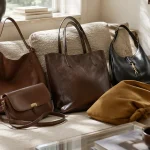
Shelving is better for almost every bag except very soft, unstructured styles like a suede hobo or a deconstructed tote where the shape is meant to be fluid anyway. A shelf lets the bag sit on its base, which is generally the most load-bearing part of the construction. The stuffing inside holds the walls vertical, and gravity works with the bag rather than against it.

The one caveat with shelving: keep bags upright. A bag laid on its side with another bag stacked on top of it is under continuous lateral pressure across its broadest panel, which is exactly where creasing and warping are most noticeable. If shelf space is limited and bags must be stored close together, stand them upright and use padded dividers or simply stuff each one firmly enough that the walls hold their shape without support from a neighbor.

What to Do with the Straps and Hardware

Straps left dangling can develop kinks at the point where they hang. For detachable straps, the cleanest approach is to remove them, roll them loosely, tuck them in tissue paper, and store them inside the bag. For fixed straps, draping them over the top of the bag and covering them with a layer of tissue keeps them from pressing against the leather body and leaving a ridge.

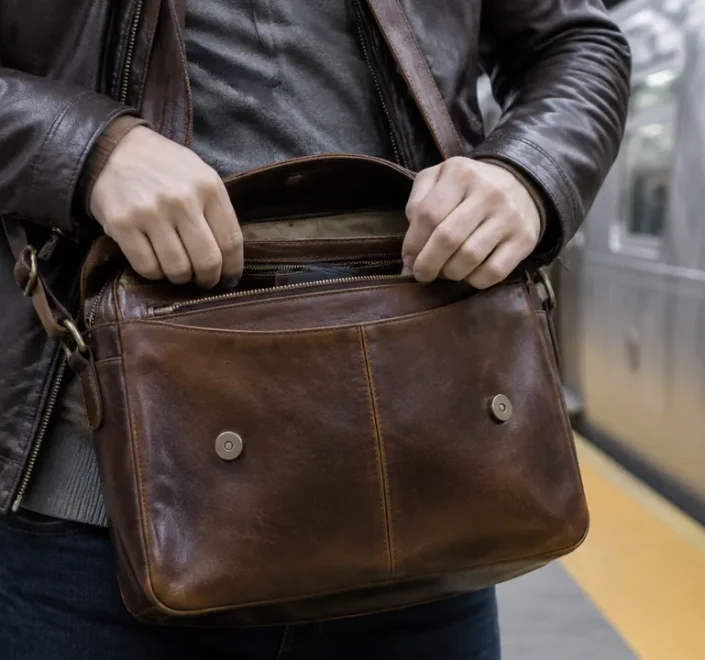
Metal hardware deserves attention too. Clasps, buckles, and chain handles left in direct contact with leather for an extended period can leave impressions, and in conditions of any humidity they can transfer oxidation marks. A layer of tissue paper between hardware and leather during storage is an easy precaution. Tarnishing on brass hardware is mostly a cosmetic issue and polishes out, but the green or brown marks it can leave on undyed leather edges are much harder to address.

The Dust Bag Problem

Luxury bags come with dust bags for a reason, and the reason is not just branding. A cloth dust bag buffers the leather against humidity fluctuations, keeps the surface from picking up dye transfer from adjacent items (a dark fabric shelf liner, another bag in a saturated color), and protects the hardware from friction with surrounding objects. For bags stored for more than a few weeks, using the dust bag is worth the small effort of getting the bag in and out of it.

Plastic garment bags or sealed plastic bins are a different matter. Leather needs to breathe, which is a slightly vague phrase that means something specific: leather that cannot exchange moisture with the surrounding air will eventually dry out unevenly, or in more humid environments, develop a surface mold. A sealed plastic bin might protect against dust but it creates a microclimate that is often warmer and more humid than the room outside, particularly if the bin is on a floor where temperatures fluctuate.

Cloth dust bags, open-weave cotton pillowcases, or simply a shelf with good air circulation are all better choices than sealed plastic. If long-term protection is the goal and plastic seems like the only option, leaving the lid cracked is better than sealing it.

Conditioning Before Storage

A bag going into storage for more than two or three months should be conditioned first. This is not a complicated process: a small amount of leather conditioner (a neutral, wax-based cream works for most finished leathers) applied with a soft cloth, buffed off, and allowed to dry fully before the bag goes into its dust bag. The purpose is to make sure the leather enters storage with its oils reasonably balanced rather than already depleted from daily use, sun exposure, or cleaning.

Conditioning after storage is also worthwhile. Leather that has been in a closet for months, even in good conditions, is often slightly drier than leather that has been regularly handled and exposed to normal ambient humidity. A quick conditioning when the bag comes back into rotation prevents the surface from looking chalky or feeling stiff the first few times it is used.

Suede and nubuck are different. Both require specific suede-safe products and a suede brush rather than a standard conditioner. Applying a smooth-leather conditioner to nubuck will darken it permanently and flatten the nap. The surface texture is what makes the material, and a mistake here is visible every time the bag is carried.

Where in the Room Actually Matters

Closets are not all alike from a leather’s perspective. A closet on an exterior wall in a cold climate is significantly cooler and potentially damper than one on an interior wall. A top shelf near heating ducts is dry and warm, which accelerates the loss of oils. A closet floor collects humidity from the room and is the first place mold takes hold if anything in the room becomes damp.

The middle of an interior closet, on a shelf at roughly chest height, is the most consistently stable environment in most homes. Not the floor, not the very top, not squeezed against an outside wall. Bags that represent real investment, in money or in sentiment, belong in the most stable part of the storage space, which is usually closer to the center of the house than the edges.

Attics and basements are genuinely risky for leather. The temperature swings in an attic across a single year are wide enough to be meaningfully damaging over time. Basements frequently run at higher relative humidity than the main living space, which creates exactly the conditions that allow mold to colonize the interior lining or the underside of a base panel. A bag stored in a basement for two years and retrieved looking perfect on the outside may have a lining that peels away when touched, orstitching along the bottom seam that has already begun to rot.

Leave a Reply

Your email address will not be published. Required fields are marked *