Two closure types have split the leather bag market down the middle, and the split is messier than most buying guides acknowledge. Zipper closures and magnetic snaps each have a long track record, real trade-offs, and a specific kind of daily use they genuinely suit. Getting the choice wrong means a bag that either slows you down or wears out before it should.
The case for the zipper is mostly a case for security. A zipper seals the full width of the bag opening. Nothing migrates out of a side pocket on a crowded subway. Nothing gets lifted. A good metal zipper on a quality leather bag, something like a YKK from the heavier end of their catalog, can open and close tens of thousands of times before it fails. That kind of longevity is not theoretical; it is the reason luggage makers stake their warranties on zippers rather than on any other closure. For a bag that rides the commute every day, thatcount matters.
Zippers also protect against rain. Not waterproof in any meaningful sense, since leather itself breathes and seams are not sealed, but a zipped bag keeps a sudden downpour from running straight down into the main compartment. That quiet protection tends to be invisible until the one afternoon it is needed.


What a Magnetic Snap Actually Does Well
The magnetic snap’s advantage is tactile and instant. One hand, a half-second, the flap falls open. For anyone moving through a day with their hands full, running between meetings, pulling out a phone or wallet every twenty minutes, that friction reduction is real. It does not sound like much until the alternative is unzipping a bag while holding a coffee, a tote, and a laptop sleeve.
Magnetic snaps also let bag designers work with structured flap styles that zippers make difficult or impossible. The boxy, architectural silhouettes common in work totes and structured satchels generally rely on a snap or turn-lock to keep the flap clean and flat against the front of the bag. A zipper running along the top of a stiff flap would either buckle the leather or require a gusset that changes the whole profile. So for a certain look, the snap is not a compromise. It is the only closure that works.
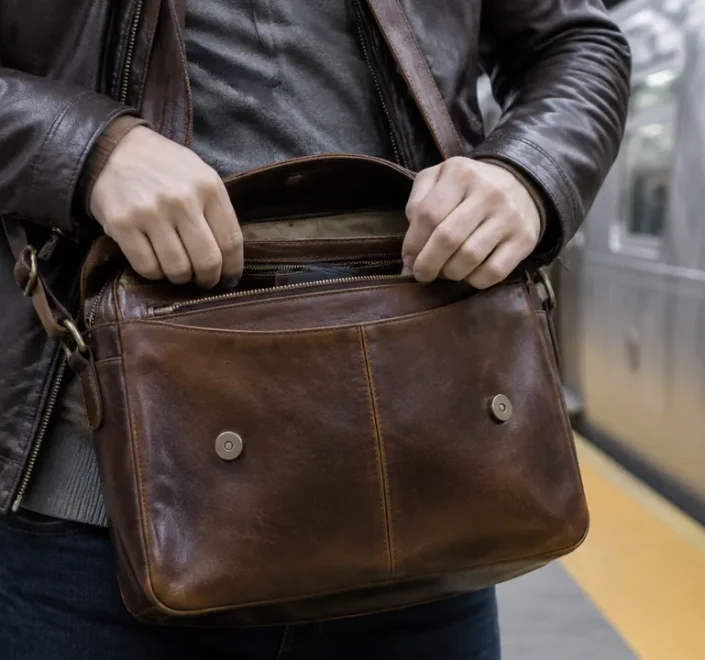
The honest downside is openness. A magnetic snap holds a flap shut but does not seal it. The gap at the sides of a flap closure is real, and in a bag sitting open on a bus seat or an office floor, small items do find their way out. Phones rarely fall out, but earbuds, lip balm, and receipts are another story.
How Each Closure Ages on Leather
This is where the comparison gets specific in ways most buying guides skip.
A zipper creates a fixed stress point along both edges of the leather panel it is sewn into. Over years, that panel can develop a slight ripple along the zipper track, particularly on soft full-grain hides that stretch gradually with use. A skilled leather worker can compensate for this in the bag’s construction, but it requires some intentionality in the design. Bags where the zipper was clearly an afterthought show it.
Magnetic snaps create a different kind of wear. The snap hardware is usually set with two prongs that fold into the leather and a backing plate on the inside. On thinner leather, especially chrome-tanned hides under about 2 mm, those prongs can eventually work loose, tearing small holes that spread over time. On thicker vegetable-tanned leather, the risk is lower, but the snap itself can wear a subtle indentation into the flap over years of repeated contact. Neither failure is dramatic, and both are repairable by a cobbler, but they happen on different timelines and in different spots.
Zipper sliders also wear. The pull tab can fatigue and snap off on cheaper hardware. Thecoil itself can separate. But these failures are usually replaceable without touching the leather. A cobbler or a zipper repair shop can swap a slider in minutes. Replacing a magnetic snap that has torn through a leather flap is a more involved job.
The Electronics Question
Magnetic snaps near electronics deserve more attention than they usually get in bag reviews. The field strength of a typical bag snap is low, and for most modern devices, a smartphone, a laptop, a tablet, proximity is not a practical concern. Flash storage and modern phone components are not at meaningful risk from the weak magnets used in bag hardware.
The exception is older magnetic stripe cards. A snap positioned directly against a wallet or card slot can degrade the stripe on a hotel key or an older credit card after repeated exposure. This is a minor inconvenience rather than a serious hazard, but it is worth keeping in mind for bags with interior snap pockets positioned right against a card wallet.
Which Bags Actually Pair With Each Closure
Crossbody bags and small daily bags that get opened dozens of times a day are the clearest case for magnetic snaps. The access speed matters here in a way it simply does not matter for a bag opened twice.
Briefcases and larger work bags where contents need to stay put through a commute, where the bag might be jostled standing up on a train or slung over a bike rack, are stronger zipper territory. The sealed perimeter earns its keep when the bag is moving through a crowded environment with no one watching it.
Totes with structured flaps are genuinely served by snaps, and fighting that instinct to insist on a zipper is usually a mistake. The flap is doing aesthetic and structural work, and a zipper undermines both. Accepting the slight openness at the sides is part of choosing that bag style.
Backpacks are almost always better with zippers, not because backpacks are used carelessly, but because a bag worn on the back is specifically the context where unseen access by someone else is a real possibility. A magnetic snap on a backpack main compartment is a design choice that prioritizes looks over function in the one scenario where that trade-off is hardest to justify.
Hardware Quality Changes the Calculus
The zipper versus snap debate assumes the hardware is at least decent, and that assumption is often unwarranted at lower price points. A cheap zipper with a light aluminum slider and thincoil teeth will fail faster than a well-set magnetic snap, possibly within a year of daily use. Conversely, a flimsy snap with thin prongs and a weak backing plate is not delivering the effortless access that makes snaps worth choosing; it is just a closure that does not quite hold and will not hold for long.
On a leather bag above a certain price, around the point where the leather itself is full-grain and the construction is hand-stitched, hardware quality tends to rise in parallel. Below that threshold, both closure types are compromised, and the choice matters less than simply finding a bag that is not cutting corners on its hardware.
Brass and solid zinc alloy are better snap materials than pot metal. YKK, Riri, and Lampo are the zipper names that indicate actual durability investment. A bag that specifies its hardware is usually a bag that cared about this decision. A bag that says only “metal hardware” in the description almost certainly did not.
Bags That Use Both, and When That Makes Sense
Some of the most functional leather bags resolve the debate by declining to pick a side. A flap bag with a magnetic snap on the exterior and a zipper on an interior pocket is a sensible layered approach: fast access at the top for what gets reached for constantly, secured storage inside for what must not disappear. This pairing shows up on a number of mid-range and higher work bags, and when it is done well, it earns every millimeter of the added hardware weight.
A top-zip tote with a secondary magnetic snap tab to hold the top closed when the zipper is down is a similar logic applied differently. The snap functions as a stay, not a seal, and the zipper takes over when actual security is needed. Neither closure is asked to do a job it is bad at.
The worst version of this is two magnetic snaps on a bag that should have had a zipper. Doubling up on the same closure does not compensate for its limitations. It just makes the bag heavier to open and gives the impression of security without the substance of it. A commuter standing on a platform with a bag held shut by two snaps and a gap down each side has made an aesthetic choice dressed up as a practical one.