Polyester does not breathe. That is not a metaphor or a marketing disclaimer tucked into fine print. It is a structural fact about how the fiber is made, what it will and will not let pass through it, and why a shirt made from it can become genuinely unpleasant to wear after twenty minutes of moderate exertion.
Most synthetic fabrics sold at mass-market prices, the kind filling fast-fashion racks and budget athletic wear bins, are petroleum-derived polymers spun into thread. Polyester, nylon, acrylic. These materials were developed in the mid-twentieth century primarily because they were cheap to produce, durable, and easy to dye. What they were never designed to do was manage the microclimate between skin and fabric. That problem was considered secondary, or simply ignored.


Why Synthetic Fibers Hold Heat Close to the Skin
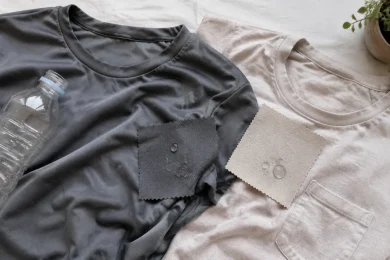
A natural fiber like cotton or linen is built from cellulose, which has a structure full of tiny channels and gaps that move moisture vapor outward. Wool goes further: its fiber surface is slightly scaly, and those scales create capillary action that wicks liquid away from the body while the fiber itself can absorb a meaningful amount of moisture before it starts to feel wet. Synthetic fibers have no comparable absorption. They are, at the molecular level, hydrophobic. Water does not enter them. It sits on their surface instead.
The practical consequence is that sweat generated during ordinary activity, even the low-level perspiration that happens sitting at a desk or walking to a parking lot, accumulates against the skin. A thin layer of warm, humid air builds up between the fabric and the body. That layer acts as an insulator. Rather than letting excess heat escape, the garment holds it in place. In warm weather, this produces a feedback loop: the body heats up, generates more sweat, the sweat has nowhere to go, and the discomfort compounds.
The physics here is not complicated. Fabrics dissipate body heat through two main pathways: radiation and evaporative cooling. Radiation matters less once a garment is in contact with the skin. Evaporation does most of the work. For evaporation to happen efficiently, moisture vapor has to be able to move through the fabric to the outside air, where it disperses. Dense synthetic weaves slow or block that movement. The moisture stagnates.
The Odor Problem Is a Chemistry Problem
Sweat itself is largely odorless when it leaves the body. The smell comes from bacterial activity on the skin surface. Bacteria consume compounds in sweat and produce volatile byproducts, including short-chain fatty acids and thioalcohols, which have strong, sharp, or sour odors even in very small concentrations.
Where synthetic fabrics make this worse is in their tendency to absorb and retain the oily, nonpolar byproducts of that bacterial process. Because polyester is hydrophobic, water-based washing with standard detergent struggles to remove the hydrophobic odor compounds that have bonded to the fiber surface. A cotton shirt washed at normal temperatures will come out of the machine genuinely clean. A polyester shirt that has been worn heavily may still carry a faint sour smell even immediately out of the dryer, because the odor molecules have embedded themselves in the fiber in a way that water alone cannot dislodge.
This is not anecdotal. Anyone who has worn athletic polyester gear regularly has likely noticed it: a shirt that smells fine when dry but revives its odor the moment warmth and humidity return. The compounds are still there, reactivated by moisture. They never fully left.
The bacterial situation is also worsened by the heat retention described earlier. Bacteria that cause odor thrive in warm, moist environments. A synthetic garment that holds humidity against the skin is, in effect, a more hospitable environment for bacterial growth than a fabric that wicks moisture away quickly. The garment is not merely failing to prevent odor. It is actively encouraging the conditions that produce it.
Tight Weaves and Finishing Treatments Add to the Problem
Budget synthetic garments often use very tight weaves or knit constructions that maximize the amount of fiber packed into a given area. This improves durability and reduces manufacturing costs, since denser fabric uses less finishing treatment to achieve a smooth surface. The tradeoff is reduced air permeability.
There is also a category of chemical finishing treatments applied to cheap synthetics to improve their appearance or hand feel. Softeners, anti-static coatings, optical brighteners. Some of these treatments partially fill the microscopic spaces between fibers, further reducing the fabric’s ability to pass air and moisture vapor. After several wash cycles, the treatments break down unevenly, and the garment’s already-limited breathability can degrade further.
Premium athletic wear brands have invested in engineering around these problems. Moisture-wicking fabrics use hydrophilic surface treatments or blended fiber constructions to pull sweat outward more efficiently. Some fabrics incorporate mechanical textures that create small channels directing moisture to the garment’s exterior. These solutions work reasonably well, but they require both design intent and manufacturing cost that budget producers typically skip.
Heat Retention in Non-Athletic Contexts
The heat-trapping issue is most obvious during exercise, but it extends into ordinary daily wear in ways that go unexamined. A cheap polyester dress shirt worn in an office, a synthetic-blend sweater layered under a coat, an acrylic scarf. None of these involve intense physical activity, but all of them create a microclimate against the skin that is slightly warmer and more humid than it would be with a natural fiber equivalent.
Over the course of a long day, that small difference in thermal comfort accumulates. The body works harder to regulate its temperature. In hot weather or in buildings with unreliable climate control, the effect can become genuinely fatiguing. This is why the same office worker might feel physically drained on a day when they are wearing a polyester button-down and perfectly comfortable on a day when they wear linen or cotton, even if the ambient temperature in both cases is identical.
The garment is changing the sensory environment the body is navigating, not dramatically, but persistently.
The Low Price Makes the Problem Invisible
Part of why this conversation rarely happens at the retail level is that the discomfort synthetic fabrics cause is gradual and deniable. A shirt that costs twelve dollars does not invite scrutiny. If it becomes uncomfortable after an hour of wear, the instinct is to attribute that to the heat, to the day, to personal variation. The garment is not examined as the variable.
Fast fashion operates at a price point and a replacement cycle that discourages this kind of long-term thinking. If a shirt is worn a dozen times before being discarded or replaced, the cumulative discomfort of wearing it never gets weighed against any alternative. The problem stays invisible because the comparison never gets made.
There is also a fitness and athletic wear category that has done an unusually good job of branding breathability as a premium feature, which has the side effect of implying that breathability matters only during exercise. Casual and workwear have not made the same argument. A linen blazer is sold on style grounds, not on the grounds that it will not make a person smell like a locker room by three in the afternoon. The relevant information is present in the fabric, but the market does not particularly want to surface it.
What the Fiber Content Label Actually Tells You
The fiber content label sewn into every garment is the clearest indicator of its thermal and odor behavior. A label reading 100% polyester means zero capacity for moisture absorption and high likelihood of heat retention in anything but very light, open-knit constructions. Acrylic behaves similarly. Nylon is slightly better in some constructions but shares the fundamental hydrophobic problem.
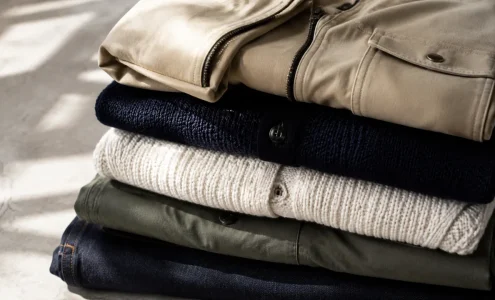
Blends matter. A 60-40 cotton-polyester blend behaves meaningfully differently from pure polyester. The cotton component adds some absorptive capacity, and the resulting fabric is usually softer and somewhat more breathable, though still inferior to pure cotton for moisture management. Blends above 50% synthetic tend to inherit more of the synthetic’s characteristics than the natural fiber’s.
Merino wool is the outlier on the natural fiber side. It manages moisture and odor better than cotton in active conditions, absorbs a notable percentage of its weight in moisture before feeling wet, and resists odor because the wool fiber itself has antimicrobial properties. It is also the most expensive option by a significant margin, which is exactly why it does not appear in budget garments.
A person who switches from a daily wardrobe of cheap synthetics to one built primarily around linen in summer, cotton or cotton blends in transitional seasons, and merino or wool for cooler weather will notice the change within a week, possibly within a day. The body’s thermal regulation becomes less effortful. End-of-day odor is reduced. The skin environment is simply different, and the difference is not subtle.