European street style has a reputation that precedes itself, and after enough time spent looking at the actual clothes, a pattern becomes clear: it is less about what people are wearing and more about what they have decided not to wear.

That sounds abstract, so here is a concrete version. A woman walking through Copenhagen in September is wearing straight-leg trousers, a tucked linen shirt, and leather loafers that have clearly been owned long enough to crease at the toe. No statement bag. No visible logo. No outfit-completing accessory that announces the whole thing was assembled on purpose. The effect reads as casual, almost careless, and that is exactly the result of a very specific set of choices.


The Constraint That Does the Work

In American fashion culture, more has historically signified more. A blazer gets a pocket square. A good pair of boots gets an interesting belt. The logic is additive: each piece elevates the one before it. European dressing, particularly in cities like Paris, Copenhagen, Milan, and Amsterdam, tends to operate in reverse. The restraint is the style. One thing is allowed to be the focal point, and everything else recedes.

This is partly cultural and partly practical. European cities are dense and walkable in a way that most American cities are not. People are not dressing to be seen from a car or across a parking lot. They are dressing for close proximity, cobblestones, and weather that changes by noon. That functional pressure pushes toward clothes that work rather than clothes that perform.

There is also a longer relationship with specific garments. A French woman who has worn the same cut of trouser for eight years is not making a fashion statement. She has simply found the cut that works for her body and stopped reconsidering it. That kind of settled confidence registers as effortlessness because it genuinely is, at this point, effortless. The decision was made years ago.

Fit as the Quiet Variable

Tailoring is the part that rarely gets mentioned in pieces about European style because it is less photogenic than a specific coat or shoe. But fit is doing the heaviest lifting in almost every outfit that looks right.

European brands, especially at mid-price and above, tend to cut for a slimmer, slightly shorter silhouette than their American counterparts. A pair of Arket trousers and a pair of Gap trousers at similar price points are cut for different bodies and different aesthetics. The European version typically sits higher at the waist, tapers more through the leg, and breaks at the ankle rather than pooling. That precise break point, where the trouser hem meets the shoe, changes the whole proportion of the lower body.

This also explains why the same basic items, a white shirt, dark jeans, a wool coat, look markedly different depending on where they were bought and whether they have been altered. The difference between an outfit that looks thrown together and one that looks deliberately casual is often a centimeter at the shoulder seam or two centimeters at the sleeve hem. A tailor charges less than a new piece of clothing, and Europeans, particularly in cities with strong craft traditions, have tended to use tailors as a matter of habit rather than occasion.

Color Minimalism and What It Signals

Walk through any major European city on a weekday and the palette of what people are wearing tends to cluster around neutrals: navy, camel, olive, gray, cream, black. This is not a recent trend. It reflects both climate (northern European light does not flatter neons the way bright southern sun does) and a buying philosophy built around pieces that work together across seasons.

When everything in a wardrobe sits in the same tonal range, getting dressed becomes genuinely easier. There is less decision fatigue, and the resulting outfit reads as cohesive without any extra effort. The effort happened at the point of purchase, not the point of dressing. An outfit built from three pieces in compatible neutrals will always look more considered than an outfit built from three trend pieces in three different color stories, regardless of how much money was spent.

Color, when it does appear, tends to be concentrated in one place: a terracotta bag against a gray outfit, a cobalt knit worn with off-white trousers. The single-color-moment rule gives the eye somewhere to land, which paradoxically makes the whole thing feel more relaxed. The outfit has a logic to it, even if no one articulates what that logic is.

The Role of Fabric Weight and Quality

Cheap fabric moves wrong. It pulls, puckers, bags at the knee by noon, and photographs with a plasticky sheen. This is not a snobbery point; it is a physical one. The drape of a garment, how it falls and responds to movement, is determined almost entirely by what it is made of.

European fast fashion and mid-market brands are not uniformly better than American ones, but there is a regional tendency, visible in brands like Cos, Arket, Mango at its better end, and a range of Italian and French labels, toward natural fibers and heavier fabric weights even at accessible prices. A wool-blend coat at 600 grams per meter behaves like clothing that was designed to be worn rather than photographed and returned. It keeps its shape across a full day. The shoulders sit correctly even after being carried in a bag on the commute.

Linen wrinkles, and in European street style that wrinkle is accepted rather than fought. The willingness to wear a fabric that shows the evidence of being lived in is itself a posture, an implicit statement that the clothing is for the person wearing it, not for an audience.

Shopping as a Different Habit

The American retail environment has long encouraged volume. Sales cycles, trend seasons, haul culture, and the sheer square footage of American malls all push toward buying more and buying often. European shopping habits, shaped by smaller living spaces, fewer mega-retailers, and a longer tradition of secondhand and vintage markets, tend toward fewer purchases and longer ownership.

This matters for style because a wardrobe built over years from considered purchases develops a coherence that a wardrobe assembled in a shopping spree does not. The pieces have been road-tested. The shoes have been walked in enough to know they are worth keeping. The jacket that still gets reached for after four winters has clearly earned its space.

Paris flea markets, Berlin vintage shops, Copenhagen consignment stores: these are not just economical options but part of a regular shopping rotation for a significant number of people who dress well in those cities. A vintage find that has been worn and adjusted and worn again carries a different kind of presence than something brand new and slightly too large from an online cart.

Shoes That Have Actually Been Worn

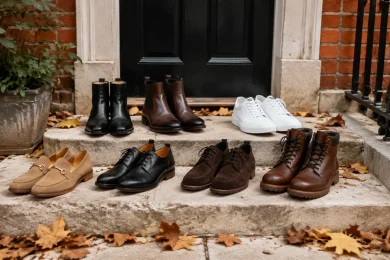
The shoe detail is worth its own paragraph because it is the most reliable indicator of whether an outfit has actually lived in or been assembled for the photo. Pristine white sneakers, especially in a city where people walk several miles a day, signal effort in a way that slightly worn leather loafers or scuffed white sneakers do not.

European street style tends toward footwear that reads as used: Birkenstock straps loosened from regular wear, leather that has developed a patina, sneakers that have clearly been through actual weather. The shoe tells a story about the person wearing it, which is a very different effect from a shoe that arrived two days ago in a box.

The specific shoes that recur most often in European urban dressing are not exotic: loafers, leather sneakers in white or off-white, ankle boots with a modest heel, the occasionalclog. The shapes are simple. The materials are natural. The wear is visible. The combination of those three qualities, simple, natural, worn, produces exactly the casualness that looks impossible to replicate when someone sets out specifically to replicate it.

What the Mirror Cannot Teach

The underlying reason European street style looks effortless is that a significant portion of it actually is. The effortlessness is not a technique. It is the residue of having resolved the basic wardrobe questions years ago and stopped reopening them every season. The person who has worn the same silhouette for a decade is not performing ease. They have simply moved past the phase of the process where dressing requires decisions.

That resolution comes from knowing what works for a specific body, what holds up over time, and what the person actually reaches for rather than what seemed compelling in a store. It requires enough wrong purchases to know what right looks like, and enough time with the right pieces to wear them without thinking about them.

The Copenhagen woman with the creased loafers is not trying to look like she is not trying. The loafers are just her shoes. She put them on that morning the same way she put them on the morning before. The outfit looks the way it looks because everything in it was figured out long before she left the apartment, and the figuring out happened gradually, over years, one bad purchase and one good one at a time.

Leave a Reply

Your email address will not be published. Required fields are marked *