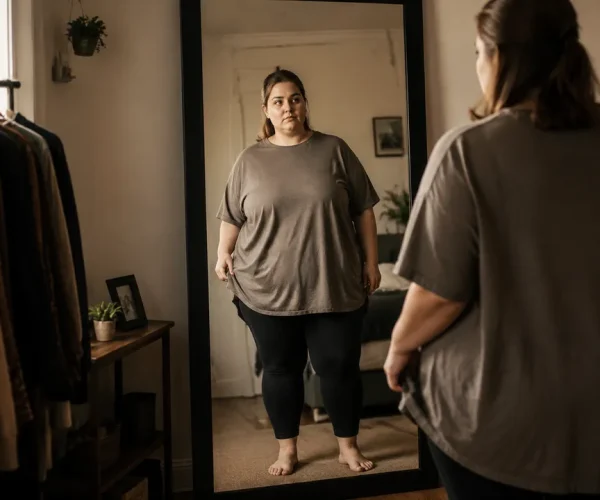
Oversized hoodies were not designed with a 5’2″ frame in mind. They were designed for comfort, for that generous swath of fabric that drapes past the hips and swallows the wrists. On taller frames, that drape reads as intentional. On shorter ones, conventional wisdom has long held that it reads as borrowed, as though the wearer raided someone else’s closet and forgot to give the thing back.


Conventional wisdom is wrong here, but only if the petite person wearing the hoodie actually understands what they’re working with.

What “Oversized” Actually Means on a Short Frame

The word “oversized” is relative in a way that causes real confusion. A hoodie labeled oversized in a standard size chart was built around an average height of roughly 5’6″ to 5’8″. When that garment lands on someone four or five inches shorter, oversized becomes something else entirely: the sleeves extend past the knuckles, the hem drops below mid-thigh, and the shoulder seams slide toward the elbow. That is not the same silhouette the designer intended. It is a different garment with a different visual effect.

This distinction matters because there are two totally separate looks available here, and they require different choices. One is a controlled oversized look: still clearly large, still roomy, but proportion-managed. The other is a deliberately exaggerated look: the pooling sleeves, the swamped silhouette, the oversized hoodie as the whole point. Both are legitimate. Wearing the wrong one by accident is where things fall apart.

Proportion Is the Only Variable That Actually Matters

The most common mistake petite people make with oversized hoodies is treating the bottom half as an afterthought. A long, boxy hoodie hem hitting at mid-thigh needs something underneath that creates a clear visual line. High-waisted leggings, biker shorts, or slim straight jeans tucked into ankle boots all do this. They give the eye somewhere to stop. Without that anchor, the silhouette becomes one continuous vertical blob, which is not an oversized look so much as a shapeless one.

Inseam length matters more than most people realize. If a hoodie’s hem falls at the same point where pants end, the legs visually disappear. Petite people can reclaim leg length by showing more of it: bike shorts, cropped leggings, or simply rolling orcuffing jeans to reveal a little ankle. Two or three inches of visible leg between the hem and the shoe can shift the entire proportion of the outfit.

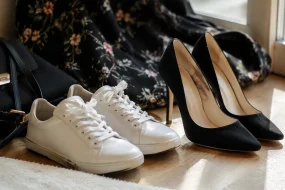
Shoes carry more weight than anyone in a fashion article ever wants to admit out loud. A chunky platform sneaker or a slightly elevated boot adds height at the base and prevents the look from feeling grounded in a bad way, like the person is sinking into the floor. Flat slides under a long oversized hoodie can work, but only when everything else in the outfit is tight and minimal. When the rest is already loose and large, the flat shoe removes the last remaining anchor.

Sleeve Length: The Easiest Fix Nobody Uses

Sleeve length is often the detail that makes an oversized hoodie on a petite frame look sloppy rather than intentional. Sleeves that fall past the fingertips on a taller person will fall to the second knuckle on someone shorter, and that two-inch difference reads as ill-fitting rather than relaxed.

A single fold at the cuff solves this almost completely. Roll the sleeve once, creating a folded cuff of about two inches, and the hand appears. The wrist appears. The oversized silhouette of the body stays intact, but the sleeve now communicates that this was a choice. It sounds like a minor adjustment. The visual difference is not minor.

Alternatively, many petite shoppers have had success sizing down. An oversized hoodie in a small, on a person who might typically wear a large, often hits the proportions that a true oversized hoodie hits on a taller person. The hem lands at the hip, the shoulders sit a little closer to where they belong, and the sleeves stop at the wrist. It still reads as roomy and relaxed. It just reads as intentionally roomy, rather than accidentally enormous.

Color and Print Do Specific Things to Scale

A large graphic across the chest of an oversized hoodie on a petite frame can work beautifully, especially a centered graphic that draws the eye upward toward the face. What tends to cause trouble is an all-over print on a large swath of fabric, particularly anything with a busy horizontal pattern. Horizontal repetition across a wide, boxy garment reads wider still. The eye follows the pattern outward rather than upward.

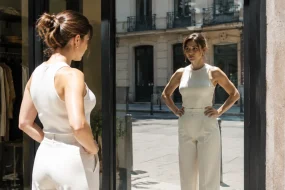
Solid neutrals and tonal outfits create the most forgiving proportions. A cream oversized hoodie over white biker shorts creates a long uninterrupted line from shoulder to calf. The monochrome reads as intentional minimalism, and the eye travels vertically through the outfit rather than stopping to measure sections of it against each other.

This is not a rule to follow rigidly. Plenty of petite people pull off loud, graphic, colorful oversized hoodies. The point is to know what a choice is doing visually so it can be made on purpose.

The Half-Tuck and the Knot

The Hem Options Worth Knowing

Two small styling techniques do a lot of work on an oversized hoodie that is hitting too low or making the silhouette feel heavy at the bottom. The first is the half-tuck: pulling one corner of the front hem up slightly and tucking it loosely into the waistband of whatever is underneath. This creates a visible waistline on one side without committing to a full tuck, which can look strained on a thick hoodie fabric. The asymmetry is casual, and it lifts the visual weight of the hem off the hips.

The second is the front knot: gathering a small section of the front hem and tying it once, creating a soft knot just above the waistband. This is a more committed look, slightly more deliberate in its styling, but it works well with high-waisted bottoms and immediately signals that the proportions were considered. Both techniques are reversible in about four seconds, which matters when standing in front of a mirror trying to figure out what is wrong with an outfit.

When the Swamped Look Is Actually the Goal

Not everything needs to be proportion-corrected. The deeply swamped silhouette, a huge hoodie clearly many sizes too large, hanging off one shoulder or pulled over the hands, the hem somewhere near the knee, has its own visual logic. It reads as cozy and unbothered, and on petite frames it can actually be more striking than on taller ones because the scale contrast is so obvious. The garment is clearly doing something intentional with size.

This look requires leaning into it rather than hedging. Tiny sneakers, oversized hoodie, nothing else visible. Flat shoes and an absence of fuss. The outfit communicates ease by being entirely committed to ease. What kills it is trying to manage the proportions at the same time: the knot at the hem, the cuffed sleeves, the platform shoes. Those moves belong to the controlled look. On the intentionally swamped silhouette, they just create visual noise.

Fabric Weight and How It Falls

Heavyweight fleece and French terry hoodies keep their structure when oversized. They hold a shape, sit away from the body slightly, and drape in defined folds. This is generally more flattering on a petite frame than a very thin, lightweight fabric, which tends to cling in unflattering places when the garment is too large and collapses flat rather than draping with any body.

Mid-weight cotton blends, the kind that feel substantial without being stiff, are the most versatile. They drape enough to look relaxed but hold enough structure to read as a garment with shape. A 400 to 500 gram fleece weight hits this range for most brands, though labeling is inconsistent. The tactile test is useful: if the fabric holds a fold when you grip it and shake, it will hold its shape on the body. If it immediately flops flat, it will do the same when worn.

Hood Proportions on a Smaller Head and Neck

The hood itself is a proportion element that often goes unexamined. On a standard oversized hoodie, the hood is built wide and deep to accommodate a larger head and taller neck. When that hood sits on a petite person’s shoulders without being worn up, it can create a visual mass at the back of the neck that pushes forward around the face, framing it in a way that looks engulfed rather than framed.

Adjusting the drawstrings to gather the hood slightly, even when not wearing it up, can reduce this. Pulling the drawstrings snugs the hood fabric closer to the back of the head, reducing the visual width at the shoulders and creating a cleaner neckline. It takes about ten seconds and meaningfully changes the silhouette from the front.

Some brands cut their hoods in a more fitted, tailored shape regardless of the garment’s overall oversized dimensions. These tend to photograph better on smaller frames and feel less like the hood is the dominant feature of the whole outfit. It is worth paying attention to during shopping rather than treating the hood as an afterthought.

A Petite-Specific Cut That Actually Exists

Several brands have started producing petite-specific oversized hoodies in the last few years. These keep the wide, boxy body and the relaxed oversized silhouette but shorten the hem, tighten the sleeve length, and adjust the shoulder drop so it sits closer to the actual shoulder. The result is an oversized hoodie that hits the same proportional marks on a 5’2″ frame that a standard oversized hoodie hits on a 5’7″ one.

It is a surprisingly useful category, and it sidesteps most of the manual adjustments described above. The cuffed sleeve, the half-tuck, the size-down: these are all workarounds for a garment that was not built for the wearer. A petite-cut oversized hoodie does not need workarounds. It just fits the way it is supposed to, and the whole question of whether petite people can pull off the look becomes less fraught. The answer becomes yes by default, which is how it should have been stated from the beginning.

Leave a Reply

Your email address will not be published. Required fields are marked *