Luxury fashion has two distinct languages, and they have been arguing with each other for about forty years. One speaks in logos: the interlocked C’s, the overlapping LV, the GG belt buckle readable from across a parking lot. The other speaks in construction: a seam you feel before you see, a lapel that rolls instead of bends, a sole that actually flexes. Both cost serious money. Both attract serious buyers. But pull a piece from a closet after fifteen years and the difference between them becomes something you can measure rather than argue about.


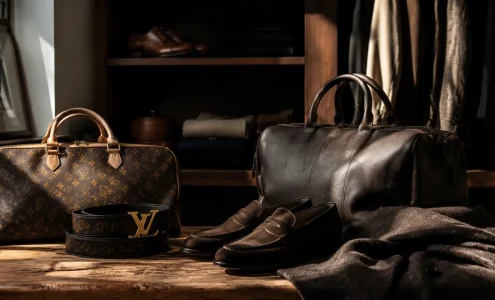
The logo era, as a cultural force, peaked somewhere in the early 2000s. Logomania had been building since the 1980s when Vuitton’s monogram canvas moved from luggage to everything, and by 2003 or so you could walk a shopping district in any major city and read brand names on every other body. The appeal was legible to anyone paying attention: the logo was social proof you could wear. It did not require the other person to know the difference between a well-cut shoulder and a mediocre one. It just required them to be able to read.

That readability is precisely what makes logos age the way they do.

When the Logo Is the Point

A logo garment derives its value almost entirely from cultural currency, and cultural currency inflates and deflates on a schedule no one controls. The Fendi baguette bag, smothered in double-F print, was an object of serious desire in 1999. By 2007 it read as costume. By 2019 it was back, beloved again by a generation young enough to find it ironic and then earnest in roughly equal measure. That is a complete cycle in under twenty years, and it will cycle again.

This is not a moral judgment. Trend cycles are genuinely fun to inhabit when you are young and have the energy to keep up with them. But it does mean that a logo-heavy piece is essentially a time-stamped document. It carries the cultural coordinates of the moment it was made and the moment you bought it, and those coordinates may or may not align with where the culture sits when you pull it out of storage.

There is also the saturation problem. The more visible a logo becomes, the more it gets reproduced. Counterfeits accelerate this, but so does licensing and the brand’s own expansion strategy. When a logo appears at every price tier, from the flagship boutique down to the airport duty-free, it loses the exclusivity signal it was carrying. The customer who paid full price finds themselves visually indistinguishable from someone who paid a fraction of it. Some brands have managed this more carefully than others, but the gravitational pull toward oversaturation is constant.

What Understated Craft Actually Means in Practice

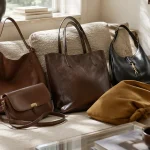
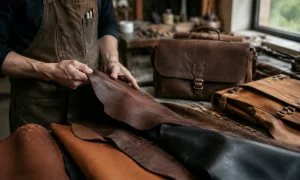
Understated craft is a phrase that gets misused as a synonym for “expensive minimalism,” which is its own kind of branding. What it actually describes is clothing and accessories where the design decisions serve the object’s function and form rather than its legibility as a status signal. A Bridle leather briefcase from a small English maker. A coat from a Japanese atelier whose lining is cut on the bias so it moves with the body. A pair of trousers with a waistband that sits exactly where a waistband should sit, constructed so it stays there through a full day without rolling or gaping.

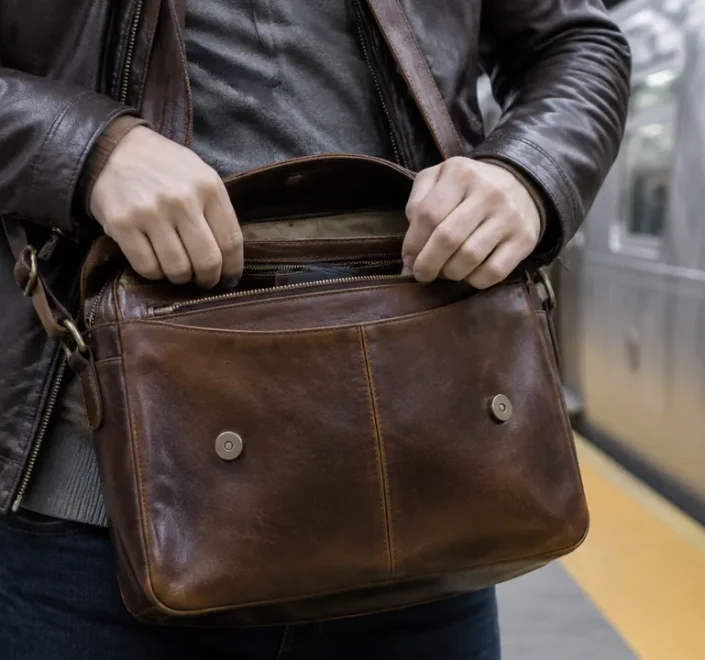
These things tend to be quieter on the surface. Often they carry no exterior mark at all, or a small one you have to look for. The quality is expressed in behavior rather than in display: the way the leather develops a patina specific to its owner’s hands, the way a well-structured jacket holds its shape through years of dry cleaning that would destroy a fused canvas alternative.

The difficulty is that this kind of quality is nearly invisible at a glance. A person who does not know what canvassed construction feels like will not notice it. Someone unfamiliar with the grades of English wool cannot see the difference between a 14-ounce tweed and a lighter, weaker knock-off from across a room. The communication is entirely to people who already know, which is either a feature or a failure depending on what the buyer actually wants from the piece.

The Physics of Aging Cloth

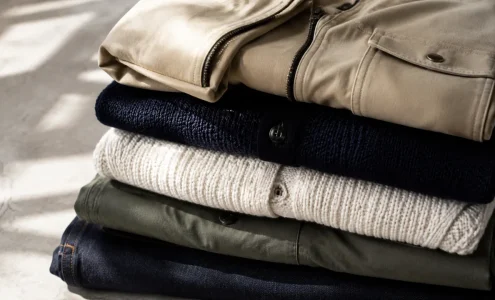
A well-made garment ages differently than a poorly made one, and the gap between them only grows with time. A jacket built on a full canvas, where a layer of horsehair and wool has been hand-padded to the chest, will soften and mold to the wearer’s body over years. It becomes more itself, in a sense. The same jacket in fused construction, where an adhesive layer does the work instead, tends to bubble and separate, usually around the chest and lapels, after repeated cleaning. The aging is not neutral. One gets better; the other gets worse.

Hardware on bags follows a similar logic. Cast zinc alloy hardware, polished to a convincing shine, will pit and flake after a few years of regular use. Solid brass hardware gets scratched but does not lose its integrity. The scratch is just another mark of use; the pit is structural failure. These are different categories of aging, and only one of them is graceful.

Logo prints and applied monograms have their own aging problem. Coated canvas, if the coating is good, holds reasonably well. But screen-printed logos on fabric fade. Embossed leather logos eventually flatten. Heat-applied graphics crack. These are fast declines relative to the piece underneath, which can mean that a physically intact bag starts reading as worn-out because its signature detail has degraded while the structure remains fine.

The Twenty-Year Test

Imagine opening a box in 2026 that was packed in 2006 and pulling out two jackets. One is a logoed bomber from a major luxury house, purchased at the height of that house’s cultural moment. The other is a plain but well-constructed wool overcoat from a maker that never courted hype. The overcoat probably brushes clean. Its silhouette, if it was cut in a classic shape rather than a trend shape, reads as current enough. It has no signifiers to decode. It just looks like a good coat.

The bomber requires a decision. It is not just an object now. It is an artifact, and wearing it means wearing the artifact knowingly. That can be done with skill and intention, but it requires active management that the overcoat does not.

This is the clearest version of the aging argument: understated craft has no cultural timestamp to expire. A plain object in excellent materials with excellent construction simply exists. It does not need to be rehabilitated by a trend cycle or worn with ironic distance. It just needs to still fit.

Where Logo Pieces Actually Hold

Honest accounting requires acknowledging where the logo argument has genuine force. Certain iconic pieces from houses with very long histories have demonstrated real staying power, in both cultural resonance and secondary market value. The Vuitton Speedy, the Chanel 2.55, the Hermes Kelly: these are objects that have been continuously readable as aspirational across several generations. The logos on them are old enough to have become classics rather than trends. They have outlasted the trend cycle and become something closer to cultural monuments.

For these specific pieces, the logo is the craft, in a way. The construction matters, but the recognition carries decades of accumulated meaning that a plain bag from a lesser-known maker cannot replicate regardless of its leather grade. Someone buying a Kelly is buying the entire weight of that object’s history, and that history is inseparable from its markings.

The honest buyer knows which category they are in. Buying from a heritage house at the very top of the market, for a piece with sixty years of cultural consistency, is different from buying a heavily logoed piece from a brand whose cultural moment is current and unproven. The mistake is not buying logos. The mistake is treating all logos as equally durable, which most are not.

The Buyer Decides What Aging Means

None of this resolves cleanly, because aging well is not one thing. A piece ages well relative to what the buyer wanted from it. If the goal was to inhabit a cultural moment fully and then move on, a logo piece can do that honestly and the owner got fair value from a temporary signal. If the goal was an object to own for thirty years that never requires justification, well-made and unmarked is the cleaner path.

What causes trouble is buying a logo piece as though it were in the second category. Spending on a heavily logoed bag with the expectation that it will remain as culturally neutral and wearable as a plain leather one is a category error. The logo is doing real work in the purchase, and that work will not last at the same rate as the stitching.

A coat bought for its construction rather than its markings will still be a coat in 2046. A coat bought because its logo said something in 2026 will require you to decide, every time you reach for it, whether the thing it once said is still worth saying.

Leave a Reply

Your email address will not be published. Required fields are marked *