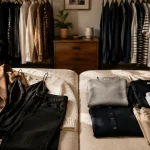
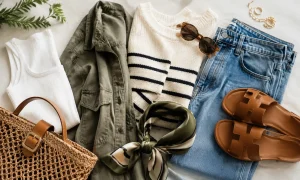
Somewhere between the third unworn blouse and the skirt bought for a season that already passed, a drawer stops closing properly. This is a mundane fact of modern wardrobing, unremarkable because it is so common. The drawer is full. The person who owns it does not feel particularly well-dressed.

That gap, between volume and satisfaction, is where the real cost of trend-chasing lives. It is rarely discussed in those terms, because it does not show up on a credit card statement as a single line. It accumulates in increments: twelve dollars here, thirty-five there, a jacket that seemed necessary in October and by January looked like a costume.


What Fast Trends Actually Cost Per Wear

The useful unit for clothing value is cost-per-wear, a figure the fashion industry discusses openly and consumers rarely calculate. A well-made linen shirt bought for ninety dollars and worn twice a week across four summers costs less per wearing than a fifteen-dollar version worn six times before it pills, fades, or simply stops feeling like something worth putting on. The math is not complicated. What makes it hard is that the cheap shirt is right there, physical and appealing, while the four summers of the expensive one are entirely hypothetical at the moment of purchase.

Short-lived trends compress this timeline even further. A color declared essential in February is visually dated by the following February, not because the garment has worn out but because the cultural signal it carries has flipped. The physical object is fine. The wearer’s willingness to reach for it is gone.

This is not a moral failure. It is a predictable response to an industry that has become extraordinarily good at manufacturing that feeling of datedness on a schedule.

The Machinery Behind the Shelf Life

The fast fashion model, in its current form, moved from two seasons a year to somewhere between fifty and one hundred micro-collections annually for the largest retailers. Each drop creates a small wave of desire and a small wave of obsolescence for whatever came before it. The structural effect of this pace is that consumers are trained, gradually, to see clothing as disposable at a psychological level even when it remains wearable at a physical one.

Trend cycles used to take long enough that a style could travel from runway to street, saturate, and recede over several years. A woman who bought a good trench coat in 1995 could wear it in 2001 without apology because the cycle had not yet looped back hard enough to make it feel retro. The coat was simply a coat. That same temporal generosity does not exist for a neon cargo pant that has been declared “the look” for a specific three-month window. It arrives pre-dated.

Influencer culture accelerated this further by fragmenting the reference points. Rather than one or two dominant aesthetics per season, there are now hundreds of named micro-trends running in parallel, each with its own peak and decline. “Coastal grandmother” and “quiet luxury” and “balletcore” are not descriptions of durable style directions. They are content categories with an expected lifespan of roughly one editorial cycle.

The Storage Problem Nobody Budgets For

Physical space has a cost, and most people do not assign it to their wardrobe. When a closet fills with pieces bought for trends that passed, those items occupy space that cannot be reclaimed until the owner does something about them, donates, sells, discards. That work has a time cost. The decision fatigue of standing in front of too many options, most of them not quite right, is real. Studies on decision-making and choice overload document this effect broadly, and a stuffed wardrobe is a textbook case: more choices, paradoxically, leading to more difficulty choosing and less confidence in the result.

The resale option is frequently invoked as a counterweight. Sell what you no longer wear; recoup some value. In practice, trend-specific pieces are the hardest items to resell at any meaningful price because the window during which someone else wants them is narrow and usually already closed. The sequined mini that was everywhere in November is listed on resale platforms in February by the dozens, competing with identical listings, selling for three or four dollars if it sells at all.

Dressed for the Algorithm, Not the Mirror

There is a particular quality of purchase that happens after extended time on social media: the item bought not because it fills an actual gap in a wardrobe but because it would photograph well, or because the specific combination seen in a reel looked compelling for thirty seconds. These are not irrational purchases exactly. The pleasure of assembling an image is real. But the garment is being bought for a context, a post, a moment, and once that context passes, it has no second use case. It hangs there, having served its function as content prop, waiting for a day when the owner might feel something different about it.

The quiet irony is that dressing well in a lasting sense and dressing for social media performance have almost entirely opposite logics. Lasting style is built on fit, proportion, and neutral versatility. Algorithmic dressing rewards novelty, maximalism, and recognizable trend markers. Chasing the second produces closets that serve neither goal particularly well.

What Gets Crowded Out

Budget is finite, and so is attention. Every fifteen-dollar trend piece bought on impulse is fifteen dollars not available for something more considered. Over a year of moderate trend-chasing, that figure compounds into a number that would cover one genuinely good coat, or a pair of shoes built to last a decade. People often feel this as a vague sense that they never have anything to wear despite spending a fair amount on clothes. The spending is real. The result is a wardrobe full of near-misses.

Beyond money, there is the attention spent tracking trends in the first place. Following micro-trend cycles requires ongoing engagement with a content ecosystem specifically designed to generate desire and dissatisfaction in alternating waves. This is not neutral entertainment. It shapes expectation about what clothing is for and what a wardrobe should feel like, and it shapes it in directions that serve the retailer more than the person getting dressed in the morning.

The Garment That Outlives Its Season

A well-cut navy blazer from 1987 is still wearable in 2026 without irony. A pair of raw-denim jeans bought in 2005 will be, at worst, slightly wide in the leg and easily convincing as a considered aesthetic choice rather than a relic. These are not exotic examples. They are ordinary garments that escaped the trend cycle because their value was never primarily about trend signaling in the first place.

Durability, in this context, is partly physical and partly conceptual. A garment made from quality materials will hold its structure for years. A garment whose entire identity rests on being the silhouette of a specific moment will feel worn out before it frays, simply because its meaning has expired.

The counterargument, that some people genuinely love the churn, that dressing in trend cycles is a form of self-expression that a quieter wardrobe cannot replicate, is worth taking seriously. For a specific kind of fashion-engaged person, the impermanence is the point. But that engagement comes with a real cost, and the cost is usually discussed only in the most cheerful terms: “clearing out to make room for new things.” What does not get discussed is the steady accumulation of money and space and mental energy spent on objects whose useful life, by design, was always brief.

The Drawer That Does Not Close

Resale price data tells one part of this story cleanly. Trend-specific pieces, highly searchable in their moment, crater in resale value within a single season. A micro-trend top that moved briskly on a resale app in October is listed without offers by March, priced at four dollars, with free shipping thrown in. The original buyer paid twenty-two. The physical object has not changed. Everything around its perceived value has.

That is the quiet cost named in no accounting: the gap between what was paid and what remains. Multiplied across a closet full of short-lived choices, it is not a rounding error. It is the real price of dressing for cycles that were never designed to slow down.

Leave a Reply

Your email address will not be published. Required fields are marked *