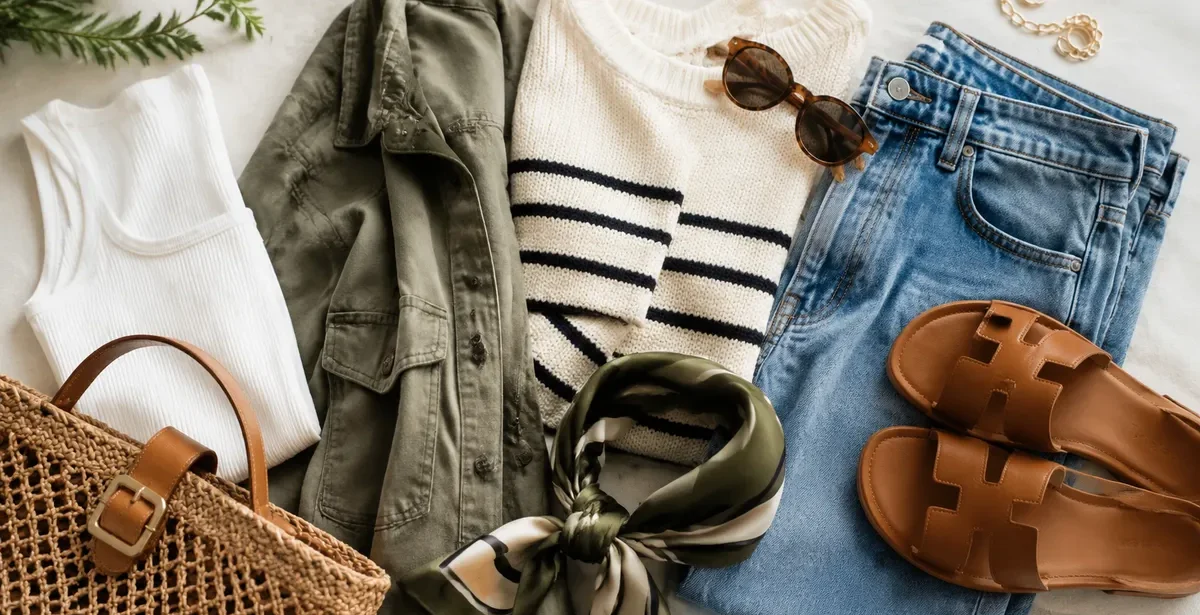
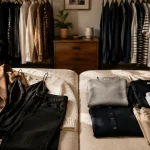
Four brands dominate the casual American wardrobe right now, and each one has quietly staked out a different kind of life. Gap, Levi’s, Ralph Lauren, and Everlane don’t just sell different aesthetics. They sell different assumptions about who the person wearing their clothes actually is, where that person goes in a given week, and what they want the morning routine to feel like. Matching a brand to a real life is less about taste than about friction: which brand requires the least adjustment, the fewest exceptions, the least mental overhead when standing in front of the closet at 7 a.m.


The Commuter Who Rotates Through Meetings and Errands

Gap occupies a strange middle position. It’s not trying to be aspirational and it’s not trying to be utilitarian. A pair of Gap straight-leg chinos in dark navy reads as intentional without reading as dressed up, which is exactly the sweet spot for someone who walks into a midsize office at 9, picks up a child at 4, and wants to feel like an adult throughout all of it without performing effort at either end of the day.

The fabrics are soft enough that they don’t feel stiff, and the cuts have finally settled down after a few years of awkward fits. The brand’s real strength is its shirts: a solid-color Oxford button-down from Gap is the closest thing the American casual market has to a neutral gear. It doesn’t say anything too specific, which is exactly what a person who lives across multiple social registers needs.

The gap in Gap, if there is one, is durability. The cotton thins faster than the price point suggests it should, and after 18 months of regular wear theelbows on those Oxfords start to look tired. So this is a brand that fits the life of someone who replaces things on a reasonable schedule, who doesn’t need their clothes to last a decade, and who values the ease of walking into any Gap in the country and finding exactly what they already own.

The Person Whose Clothes Have to Work on a Job Site and at a Bar

Levi’s is the easiest brand to underestimate because the flagship product is so familiar it has become invisible. A 501 jean has been in continuous production since 1873. That kind of longevity means the fit, the weight of the denim, and the way the leg opens slightly at the hem have all been stress-tested by generations of real use. The jean knows what it is.

Levi’s fits best for someone whose life involves actual physical activity, whether that means working with their hands, hiking on weekends, or simply moving through a city on foot for hours at a time. The denim is structured enough to hold shape during real movement. The brand’s trucker jacket in a mid-wash blue is one of the best-priced layering pieces available, substantial enough to feel like outerwear but slim enough to wear inside without looking like someone who forgot to take their coat off.

Where Levi’s struggles is occasion range. A great pair of 501s and a white T-shirt is a complete outfit, but it is a complete outfit for a specific kind of day. A client dinner, a wedding reception, a school board meeting: Levi’s doesn’t have real answers for those moments unless the wearer is already the kind of person whose social credibility survives showing up in denim everywhere. Some people are. Most aren’t.

The Life That Moves Between Suburbs and Somewhere That Feels Coastal

Ralph Lauren is doing something the other brands aren’t: selling a complete world and letting the clothes be the ticket in. That world has a consistent visual logic, a kind of permanent late summer in a place with a sailboat and a gravel driveway, and whether or not the wearer has ever been within fifty miles of that world, the clothes carry the signal. This is the brand’s power and its limitation at the same time.

The Polo line specifically has earned a place in a remarkably wide range of American lives, from prep school hallways to Southern Baptist Sunday mornings to streetwear layering. A pique polo in a deep green or a rich burgundy is one of the few garments that can cross those registers without looking out of place in any of them. The embroidered polo player on the chest is small enough to read as a detail rather than a logo, which matters.

Ralph Lauren’s fit is for someone who needs their clothes to carry occasion weight without requiring them to change outfits entirely. A chino and a Polo polo can go from a suburban backyard to a decent restaurant without a second thought. The brand also rewards long ownership. The shirts hold color and shape well, and a five-year-old Ralph Lauren Oxford still looks like a shirt someone chose rather than a shirt someone settled for.

The cost is real. Even at outlet pricing, dressing primarily in Ralph Lauren adds up in ways that Gap simply doesn’t. This is a brand that makes financial sense as a foundation layer, a few pieces bought carefully rather than a whole wardrobe rotated seasonally.

The Wardrobe Built as an Argument About Consumption

Everlane started as a transparency experiment. The company published its cost breakdowns, cost of materials, labor, shipping, markup, and asked customers to decide for themselves whether the prices were fair. That original pitch has evolved and the brand has faced criticism for not always living up to its stated values, but the clothes themselves have developed a coherent identity separate from the marketing story.

The aesthetic is quiet to the point of near-erasure. An Everlane box-cut cotton T-shirt is thick, slightly stiff when new, and designed to say almost nothing. That’s a genuine design choice and it appeals to a specific person: someone who has decided that visible branding is a form of noise, who wants to get dressed without sending any particular signal, and who is willing to pay a bit more upfront for something that will last long enough to feel like a genuine alternative to fast fashion.

The Everlane customer tends to live in a city, works in a field where clothing is informal but studied (tech, media, a certain kind of nonprofit), and would rather spend two hours reading product reviews than walk into a mall. The jeans are excellent, particularly the original cheeky jean cut, which manages to be flattering without being the kind of flattering that requires constant adjustment. The sneakers hold their shape for years. The coats are clean-lined and heavy enough for actual cold weather.

What Everlane can’t do is warmth. The brand’s visual temperature runs cold. A wardrobe built entirely from Everlane pieces looks precise but rarely looks inviting, which matters depending on the life being lived in those clothes. A pediatric nurse, a preschool teacher, a small-town real estate agent: professions where approachability is part of the job description call for something with more color, more texture, more visible willingness to be liked.

Where the Brands Actually Overlap and Where They Don’t

The interesting test is the three-outfit week. Imagine a Monday that involves a work presentation, a Wednesday that involves helping a friend move apartments, and a Friday that involves a date at a mid-range restaurant. Levi’s can handle Wednesday beautifully and Friday passably, but Monday requires some creative thinking. Everlane can handle all three, but the restaurant outfit will look more boardroom than relaxed. Ralph Lauren handles all three with the least effort and the most consistent impression, but at a price that assumes a certain stability of budget. Gap handles all three adequately without handling any of them memorably.

Adequately and memorably are different things depending on what the clothes are for. A person who wants to stop thinking about clothes entirely would rather have adequate and frictionless than distinctive and demanding. A person who wants their appearance to be part of how they communicate who they are will find adequate exhausting.

The Wardrobe That Actually Gets Worn

Every stylist and personal shopper eventually lands on the same observation: the most expensive item in the wardrobe is the one that sits on the hanger. A Ralph Lauren blazer that gets worn three times a year costs more per wear than five Gap Oxfords that get rotated weekly. This isn’t an argument against Ralph Lauren. It’s an argument for being specific about which life is actually being lived before deciding which brand fits it.

A twenty-two-year-old in their first post-college apartment, doing three different jobs and spending evenings at bars and weekend mornings at farmers markets, is going to get more use out of a Levi’s trucker jacket and two pairs of well-chosen jeans than out of a capsule wardrobe that looks coherent on a mood board but never quite matches the actual day. A forty-year-old parent driving carpool and attending school fundraisers and occasionally traveling for work is going to find Ralph Lauren’s occasion range quietly useful in a way that Levi’s simply cannot replicate.

The honest answer is that most people end up mixing, a pair of Levi’s, a Ralph Lauren polo, an Everlane T-shirt, a Gap coat, and calling it a wardrobe. That works fine. But when money is the constraint and choices have to be made, the question is which brand’s core strengths map most closely onto the actual recurring demands of a given week. Not the ideal week, the imagined life, the version where everything is considered and color-coordinated. The real one: the commute, the errand, the unexpected invitation, the Tuesday when nothing is going right and getting dressed is the smallest possible victory.

Leave a Reply

Your email address will not be published. Required fields are marked *