Denim jackets occupy a strange position in the wardrobe. They are everywhere, they cost anywhere from twenty dollars to several hundred, and the expensive ones do not always look it. The cheap ones, treated right, often pass. The difference between a jacket that reads as considered and one that reads as an afterthought usually comes down to a handful of very specific details, most of which have nothing to do with the original price tag.


Start with fit, because fit is where the money actually hides. A denim jacket that fits well across the shoulders and tapers slightly through the torso looks deliberate. One that balloons at the back or hangs off the shoulder seams looks like it belongs to someone else. On a budget jacket, fit is almost always the first casualty, and almost always the easiest to fix. A tailor charging thirty or forty dollars to take in the side seams and shorten the body by an inch or two is not an extravagance. It is what separates the jacket from the pile.
The shoulder seam should sit exactly at the edge of the shoulder bone. If it droops onto the upper arm, the whole jacket looks borrowed. This single measurement does more visual work than almost any other detail on the garment.
The Wash That Reads as Deliberate
Cheap denim jackets tend to come in one of two problematic washes: a harsh, chemical-blue that looks flat and plastic in sunlight, or an over-distressed version with factory whiskers and artificially bleached patches that telegraph exactly how much they cost. Both finishes telegraph the price. The washes that read as expensive share a quality of being harder to immediately categorize: a medium indigo that has some variation in depth, or a clean, dark raw denim that has not yet been faded at all.
If the jacket already has an unpleasant wash, there are ways to alter it at home. A cold-water wash with a cup of white vinegar and no detergent will strip some of the chemical brightness from an overly saturated blue. Sun-fading, simply leaving the jacket damp and spread flat in direct sun for a few hours, produces a more organic, uneven fade than any factory process. Neither technique costs anything, and both move the jacket away from that tell-tale budget brightness toward something that looks like it developed over time.
The one wash to avoid entirely is heavy pre-distressing. Artificial wear at the elbows, around the pockets, and along the chest seams reads as exactly what it is. Real distressing happens in specific, logical places from actual use, and it accumulates slowly. The factory version gets it roughly right but slightly wrong in a way that is hard to articulate and impossible to ignore.
Hardware as a Giveaway
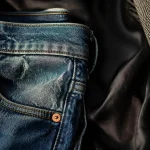
The buttons and rivets on a budget denim jacket are often the most obvious tell. They come in a thin, bright gold or a lightweight silver that catches the light in a tinny way. On better jackets, the hardware is heavier, the plating is thicker, and the color is more muted: an aged brass, a dark gunmetal, or a burnished copper. On a budget jacket, none of that is original equipment.
Replacing the buttons is straightforward and inexpensive. Jean buttons, which set with a hammer rather than a needle and thread, run well under a dollar apiece and come in hardware stores or sewing supply shops in brass, antique silver, and copper tones. Pulling the original buttons, setting a set of heavier, darker replacements, and suddenly the jacket reads differently. The eye goes to hardware more than most people realize.
Rivets are harder to swap and usually not worth the effort unless they are visibly cheap and central to the design. If they are small and mostly hidden at pocket corners, leave them. If they are prominent and flimsy, a small dab of dark shoe polish or brass patina solution from a craft store will dull their brightness and make them look older and heavier than they are.
What Collar and Cuff Treatment Actually Does
Budget denim jackets often have collars and cuffs that either curl aggressively or lie completely flat in an unnatural way. The collar on a well-made denim jacket has some structure without being stiff; it breaks gently at the lapel and lies flat against the back of the neck without flipping up on its own. On a cheap jacket, the collar frequently does neither, flopping in whatever direction it dried last.
A medium-heat iron with a damp cloth will coax most denim collars into a more settled position. The trick is to press the underside of the collar rather than the top, shaping it gently into a slight curve rather than forcing it flat. Done once and repeated after washing, it becomes habitual and takes about ninety seconds. Few things age a jacket faster than a collar that will not lie correctly.
Cuffs are worth folding rather than buttoning. A single clean fold of about two inches, kept consistent, adds structure to the sleeve and shows a bit of the interior fabric, which on most denim jackets is lighter in color and creates a subtle layering effect that reads as intention rather than accident.
The Interior Is More Visible Than Expected
Most people think of jacket lining as a purely functional layer that no one sees. On a denim jacket, that is not quite true. Because denim jackets are often worn open and the interior is regularly visible at the lapels and front panels, the inside fabric gets seen. Budget jackets frequently use a thin, shiny polyester lining in a generic gray or beige that immediately looks like what it is. Some have no lining at all, just raw inner seams.
An unlined jacket with clean inner seams looks intentional and casual. An unlined jacket with fraying, uncovered seams looks unfinished. A quick pass with pinking shears or a small amount of fray-check liquid (under five dollars at any fabric store) along the inner seam allowances costs almost nothing and eliminates that interior scrappiness entirely.
For jackets with a thin synthetic lining that looks cheap, the honest answer is that replacing the lining is probably not worth the cost of tailoring unless the jacket has other qualities that justify it. The better move is to wear the jacket open and let the visible interior be as minimal as possible, avoiding situations where someone is going to see several inches of that lining at close range.
How Styling Choices Multiply the Effect
A well-fitted jacket in a good wash with decent hardware can still look cheap when worn the wrong way. Denim jackets layered over graphic tees with similarly casual bottoms create a context where the jacket’s own quality is never tested. Layered over a simple, solid-colored shirt or under a wool coat with the collar visible, the jacket is in a different conversation entirely. Contrast and context shape what the eye perceives as quality.
Color pairing matters more with denim than with most fabrics because denim reads as a strong visual anchor. A medium-wash jacket over dark trousers and a white or cream shirt creates a clean tonal break that looks pulled-together. The same jacket over distressed jeans in a similar wash creates a too-much-denim problem that no amount of tailoring fixes.
The other styling lever is proportion. A cropped jacket hits differently than one that falls to the hip, and the right length depends entirely on what it is worn over and under. Budget jackets often come in a length that is neither cleanly cropped nor cleanly hip-length, landing in an ambiguous zone that looks unresolved. A tailor shortening the hem by two or three inches to achieve a more decisive length is, again, thirty or forty dollars that changes how the whole thing reads.
Where the Denim Itself Gives Things Away
Fabric weight is the last variable, and the hardest to change. A budget denim jacket is frequently made from lighter-weight denim, somewhere in the range of 8 to 10 ounces per square yard, that does not have the body or drape of a heavier fabric. It moves loosely, wrinkles easily, and lacks the slight stiffness that gives a good denim jacket its structure. There is no inexpensive fix for this.
What this means practically is that when buying a budget jacket, weight and hand-feel should be the first filter, before wash or color. A heavier, stiffer denim jacket at a low price point will respond far better to every other intervention described here than a thin, floppy one at the same price. Holding the jacket by the collar and letting it hang, a jacket with real weight will drape in a clean vertical line; a lightweight one will bunch and flutter slightly at the sides. That test takes three seconds and is the single most useful thing to do in the aisle before picking up the hanger.