Sizing up in clothing exists on a spectrum from minor vanity to genuine necessity, and the people who figure out which side they’re on tend to dress far better than those who never ask the question.


The standard advice is to buy your size and tailor from there. It is sensible advice. It is also advice that assumes your size is a fixed and knowable thing, which it is not, because sizing varies so wildly across brands, countries, and even product lines within the same brand that “your size” functions less like a number and more like a rough estimate.
Denim is the most obvious example. A 32-inch waist in one brand’s straight cut can run a full inch or two tighter than the same label in a relaxed fit. Workwear cuts often run narrower in the shoulders to accommodate a straighter silhouette. Vintage-inspired lines frequently run small by design, chasing a certain aesthetic that requires the wearer to go up a size just to get the garment on, let alone move in it. Anyone who has bought jeans from three different brands in the same week knows the number on the tag eventually becomes decorative.
What “True to Size” Actually Tells You
When a product listing says “true to size,” it means the brand believes the garment’s measurements match the general sizing standard they used when designing it. It says nothing about whether that standard matches the wearer’s body. A shirt rated true to size by a brand that cuts slim will still fit differently than a shirt rated true to size by a brand that cuts relaxed. The phrase is a statement about internal consistency, not a universal promise.
Reviews help more than the label does. The useful ones describe fit in terms of specific measurements or body types: broad shoulders, long torso, wide hips. A cluster of reviewers saying “go up one” carries real information. A general average rating of “true to size” often masks a spread of fit experiences that cancel each other out statistically without telling you anything about your particular proportions.
The physical dimensions listed in the size chart are more reliable than any label if you take the time to measure. A chest measurement of 42 inches is 42 inches. Whether the garment listed at “large” gives you 42 inches of chest room, or 44, or 40, is a question the size chart can answer if it lists actual measurements rather than just label sizes.
When Sizing Up Makes the Garment Better, Not Looser
There is a category of garment where sizing up produces a better result than any amount of tailoring on the correct size. Oversized silhouettes are the obvious case, but the more interesting one is structured tailoring: jackets, coats, blazers with built shoulders or a defined chest. These garments are constructed around a specific shape. The shoulder seam needs to sit at the edge of the shoulder or it throws off the entire hang of the sleeve. If the shoulders are too tight, no tailor can move that seam outward without essentially rebuilding the jacket. Going up a size to get the shoulders right, and then taking in the waist if needed, is often the cleaner and cheaper path.
The same logic applies to any garment with a functional element that requires room to work: a riding jacket that needs to stretch across the back when you lean forward, a winter coat that has to fit over a heavy sweater, a dress shirt that has to button cleanly across the chest when seated. In each case, the question is not purely aesthetic. Fit under movement or layering conditions is different from fit while standing still in a dressing room, and many people size themselves by the latter and then feel restricted by the former.
The Proportionality Problem
Sizing up solves one problem and creates another. A shirt that now fits across the shoulders may now gap at the waist. Trousers that clear the hips may pile up at the ankle. A coat with enough chest room may have sleeves that hang past the wrists. Sizing up is not a neutral act; it redistributes the fit problem to a different part of the garment.
Whether that redistribution is worth it depends entirely on which alterations are feasible. Waist suppression on a shirt is inexpensive and permanent. Shortening a sleeve is straightforward. Slimming down a trouser that fits in the seat but not in the leg is also manageable. Taking in excess fabric across the chest of a jacket, however, changes the drape in ways that can look slightly off, and it costs more than most people expect.
The practical question is: which dimension of fit is hardest to alter, and does sizing up or staying put serve that dimension better? For most people with broad shoulders, the answer tilts toward sizing up, because shoulder width is nearly impossible to alter cleanly. For most people whose main challenge is length, sizing up usually makes things worse, because it adds length in all the wrong places at once.
How Fabric Changes the Calculation
Woven fabrics have essentially no give. A woven cotton shirt or a wool trouser gives you the exact amount of room the cut provides, and not a thread more. Knits and stretch blends are different: the garment can fit close and still accommodate movement because the fabric stretches. This is why fit advice specific to one fabric category often fails when applied to another.
For wovens, erring toward sizing up is lower risk because the margin for error in a rigid fabric is smaller. A woven shirt that is one size too small will pull at the buttons and crease across the chest; a woven shirt that is one size too generous can be taken in. For stretch knits, the opposite is often true. A knit that fits close in a store will look very different washed and worn in. Knits also tend to relax slightly with wear and with washing, depending on the fiber content. Sizing up in a knit just to be safe often results in a garment that looks shapeless after a few wears rather than one that looks like a deliberate, relaxed fit.
The Online Shopping Trap
Shopping in person at least allows a person to try the garment before buying it. Online shopping removes that option and replaces it with a sizing chart, a handful of reviews, and a return policy. The temptation, especially on a first order from an unfamiliar brand, is to size up preemptively as a form of insurance. This is understandable but often counterproductive, because it means never calibrating to the brand’s actual fit and returning item after item that was sized up unnecessarily.
A more reliable approach, when trying a new brand online, is to order the size that matches the actual chest, waist, or hip measurement listed in the size chart, even if that size feels psychologically larger than expected. The measurement does not lie. The label is just a label.
If the first order fits well in one dimension and not another, that is useful information. It tells you something specific about how that brand’s sizing maps onto your body, and you can adjust from there. Guessing up a size on subsequent orders solves a hypothetical problem rather than the actual one.
Intentional Oversize Versus Accidental Oversize
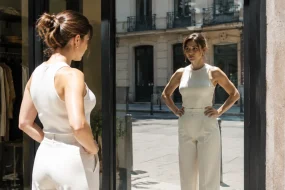
There is a genuine aesthetic argument for wearing things bigger. The oversized silhouette has been a strong visual trend across casualwear for several years now, and the look works. A boxy T-shirt, a coat with dropped shoulders, trousers with a wide leg, all of these read as deliberate choices when worn with some intention behind them. The same garments, in the same sizes, read very differently when they look like someone bought the wrong size and did not bother to fix it.
The difference is almost always in the length. An intentionally oversized garment is usually cropped, hemmed, or proportioned to read as a complete look. An accidentally oversized garment adds length where it is not wanted, covers the hands, drowns the waist, and generally looks like it belongs to someone else. Sizing up to achieve a relaxed look requires knowing where the fabric should stop, not just where it should begin.
A good example: a heavyweight flannel shirt in a size up will look clean and considered if the sleeve is hemmed to the right length. In its unaltered state, with three inches of extra sleeve bunched at the wrist, it looks like an accident. One inexpensive alteration separates the two outcomes.
Bodies That Do Not Fit the Size Chart
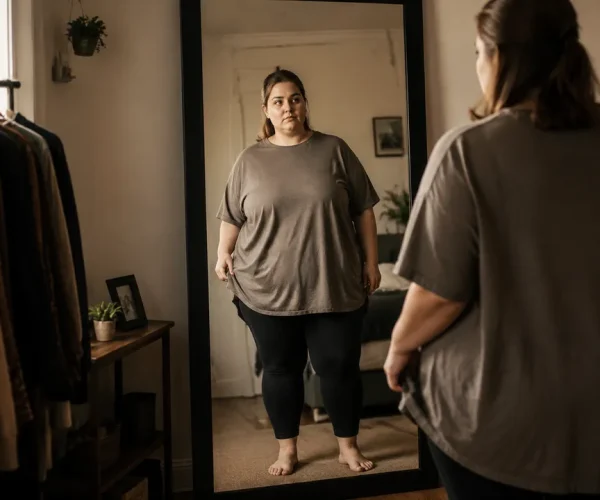
Standard sizing is built around proportional assumptions. Most size charts assume that as a number increases, every dimension increases roughly in proportion. In practice, human bodies do not scale that way. Someone with a broad chest and narrow hips will find that sizing up to accommodate the chest produces a waist that bags. Someone with wide hips and a narrow torso faces the reverse. Someone with a longer-than-average torso will find that the right chest size hits at the wrong length, and so on.
For these situations, sizing up or staying put is rarely the complete answer. The better frame is: size for the dimension that is hardest to alter, and budget for a tailor to handle the rest. For most garment types, that hardest dimension is the shoulders on a jacket, the seat on trousers, or the chest on a dress shirt. Everything else is fabric that can be moved or removed.
Tailoring is not an indulgence. On a garment that costs more than about eighty dollars and is intended to be worn regularly, a thirty-dollar alteration that makes it fit correctly is simply part of the cost of buying clothes. A coat that fits the shoulders perfectly and has been taken in at the waist will outlast and outperform one that fits neither dimension well and was never touched after purchase.