


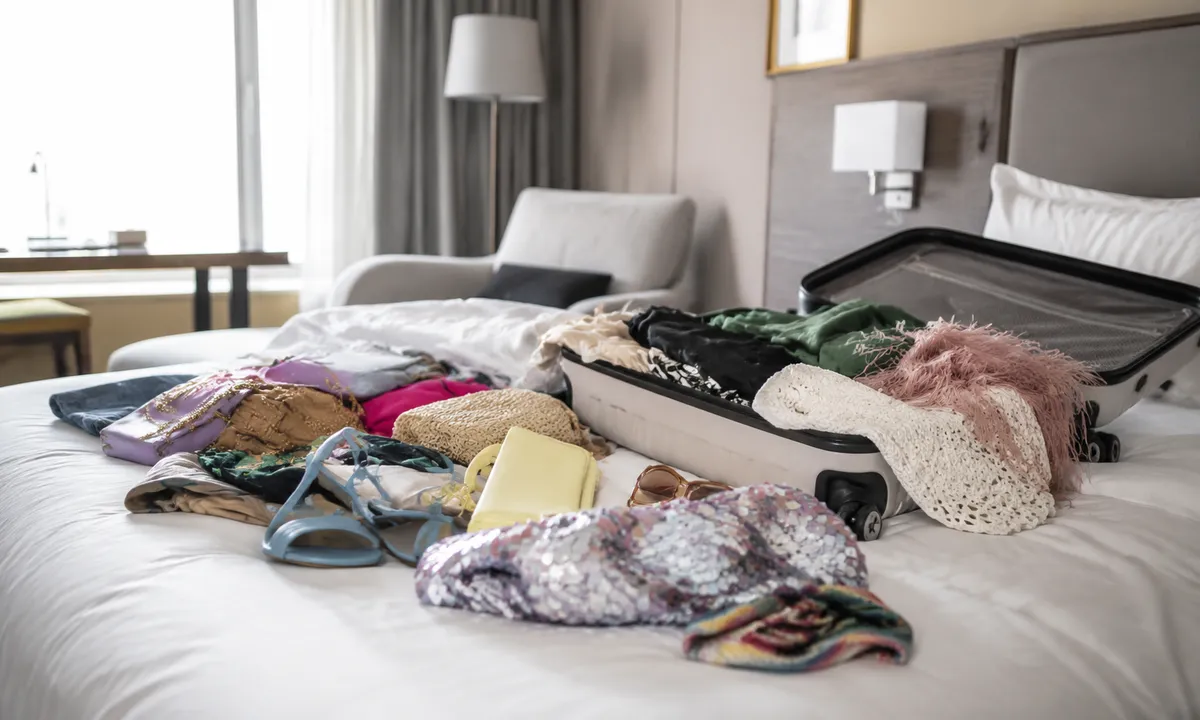
Vacation packing used to be a straightforward negotiation between luggage weight and trip length. Now there is a third variable: the trend cycle, and it has made everyone’s suitcase worse.
The problem is not that people want to look good on holiday. The problem is a particular kind of suitcase that gets packed in spring or early fall, loaded with pieces that were everywhere on Instagram three months ago, worn exactly once each, and then left hanging in a hotel wardrobe while the owner cycles back to jeans and a white shirt by day four. The trendy items looked right in a grid. They looked wrong at dinner.
The Gap Between Browsing and Wearing
Fashion content thrives on the hypothetical outfit. A knit coord on a poolside terrace, a barrel-leg trouser in a cobblestone alley, a sculptural tote slung over a linen blazer, these images are easy to click and save because the fantasy is frictionless. The real trip is not frictionless. There are delays, humidity, a dinner reservation that turned out to be more casual than the menu photos suggested, and four miles of walking a day.
Trendy pieces tend to be precise. They are cut for a specific silhouette that is having a moment, in a specific color family that the runways pushed last season, with a specific styling logic that works in one setting and nobody else’s. That precision is the whole point of trend dressing; it signals fluency in current fashion. But vacation life, with its constantly shifting contexts, punishes precision.
Classic, versatile wardrobe staples stay versatile because they have been tested across decades of varied situations. A linen shirt in a neutral tone has been worn to beach bars and business lunches long enough that its flexibility is almost structural. A piece that debuted in the wild six months ago has no such track record, and a traveler betting on it is essentially doing beta testing on their own holiday.
Cognitive Load Is a Real Packing Cost
Getting dressed on vacation should take maybe four minutes. Instead, a suitcase packed with trend-heavy pieces introduces a small but persistent tax on attention. Each new-ish item comes with a set of unresolved questions: which shoes work with it, what bag makes sense, whether the location even calls for it. These questions are mostly unanswerable until the moment arrives, which means every morning involves a fresh round of decision-making that would not exist with a simpler wardrobe.
The anxiety is cumulative. Day one, the thought is “I need to wear the asymmetric skirt at least once.” By day three, it becomes a background obligation, a piece taking up mental shelf space and physical suitcase space without contributing anything yet. The skirt starts to feel like homework.
A capsule of well-chosen basics, by contrast, takes almost no mental energy to work with. The decisions are already made because the relationships between the pieces were thought through before the trip, at home, without the pressure of a check-out time.
The One-Setting Trap
Many trendy pieces are designed around a single, legible visual statement. The whole point of a wide-brim raffia hat with a colored ribbon, or a cotton set in an abstract print running on every surface, is that it reads as an outfit immediately. That readability is a strength at a resort pool or on a specific kind of European beach. Anywhere else, the piece just sits in the case.
Pack four or five of those single-setting pieces and the wardrobe becomes a map of planned moments rather than a flexible system. The trip starts bending to the clothes instead of the other way around. The family decides to spend Tuesday exploring the old town on foot rather than renting sunbeds, and three of the trend items lose their window.
Flexibility is not glamorous to think about when packing, but it is what determines whether a piece actually gets worn. A pair of straight-cut trousers in a neutral that can go from a museum to a wine bar to a reasonably casual dinner carries more real value in a seven-day bag than any single garment whose moment never quite arrives.
When the Trend Has Already Peaked
The speed of the trend cycle means that by the time most people have bought into a look, photographed it, and worn it a handful of times at home, it is already drifting toward saturation. A trip planned in January and taken in June might be working with pieces that felt fresh in autumn and now register, to anyone paying close attention, as slightly behind the curve.
Vacation photos have a shelf life, and photos shot in something that already reads as last season age quickly. This is not a reason to be paralyzed by trend timing; most real people are not fashion critics and do not notice these things with any precision. But it is worth acknowledging that the aspirational version of the trendy vacation wardrobe, the one seen in travel editorials and influencer grids, was usually shot months before publication, often in pieces that were gifted or pulled from a showroom, and styled by someone whose full-time job is making clothes look better than they photograph in real life.
The gap between that image and a real suitcase is wide. Packing heavily toward trend pieces is partly an attempt to close the gap, and it almost never works the way the reference images suggest it will.
What a Good Vacation Wardrobe Actually Looks Like
The most consistently well-dressed travelers tend to pack fewer pieces and spend more money per piece. That sounds like a cliche until you look at the actual ratio. Ten items that work together in many combinations, in fabrics that hold up to heat and folding, in colors that do not require specific shoes, will produce better daily outfits than eighteen pieces crammed in to cover every possible trend moment.
There is also something worth saying about the difference between personal style and trend adoption. Personal style is stable across contexts; it shows up at the airport and at dinner and on a ferry, because it is built from preferences that belong to the wearer. Trend adoption is context-dependent; it needs the right setting to activate, and vacation is too unpredictable to supply that setting reliably.
One or two trend pieces in a trip wardrobe can work beautifully, as long as the rest of the bag can absorb them. A single statement piece, worn on the day or night most suited to it, lands better than five statement pieces competing for moments that may not materialize.
The Clothes That Stay in the Wardrobe
Every traveler has a specific memory of this: opening the hotel wardrobe on the last morning to find two or three pieces still hanging, unworn, that need to be folded back into the bag that is now somehow heavier on the way home. Those pieces are almost always the most trend-driven ones. The reliable jeans and the broken-in sandals are already packed. The crochet cover-up that seemed essential in March and turned out to be right for exactly zero of the week’s actual days is still on the hanger.
Packing them was an act of optimism. Leaving them behind would have cost nothing. And dragging them through two airports, re-folding them in a cramped bathroom at midnight, paying the extra checked-bag fee because the case ran over, those costs are real and they compound across every trip built around the same logic.
The crochet cover-up will probably get packed again next year, in a different shape, in a different color, carrying a different name, because that is how trends work. The hotel wardrobe will have a new item hanging in it on the last morning. The lesson takes a while to land.