


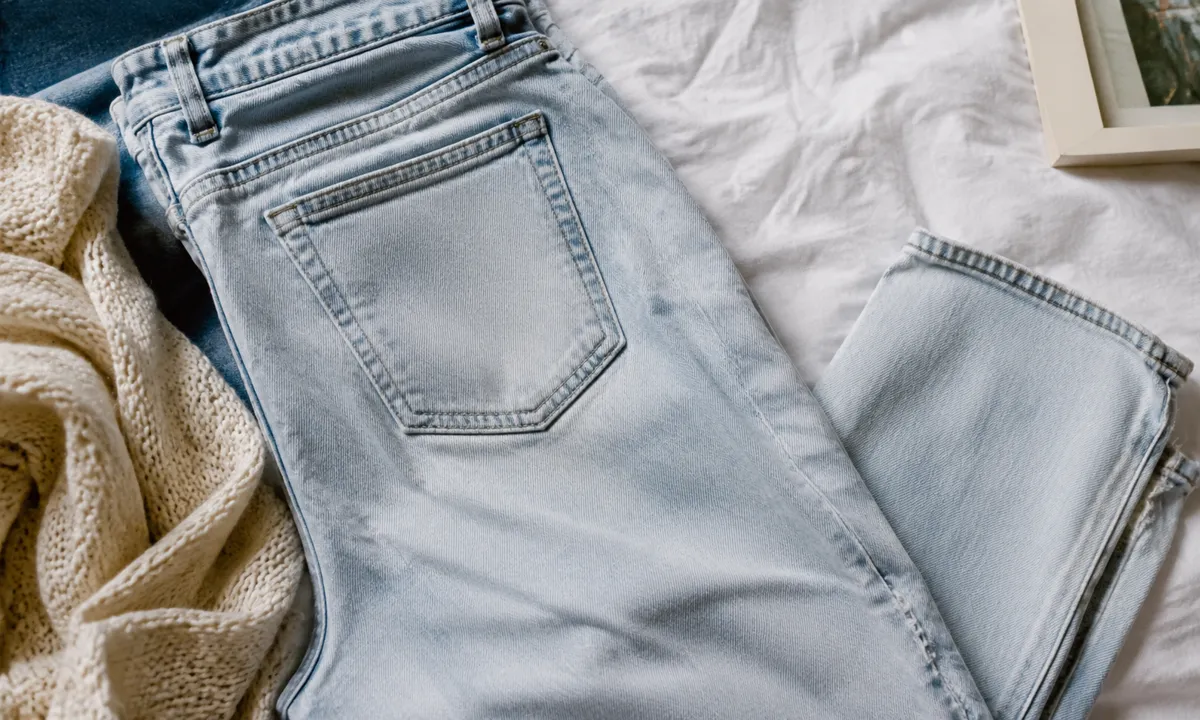
Light wash denim never actually left. It just spent about fifteen years being wrong. Wrong for the decade that wanted everything raw and stiff and indigo-dark, wrong for the minimalist mood that couldn’t tolerate anything that looked worn before you bought it, wrong in a way that felt almost moral, like it stood for a looseness of character. And then, without much warning, it stopped being wrong.
That reversal is worth paying attention to, because it didn’t happen the way most trend comebacks happen.
What the Dark Denim Era Actually Meant
From roughly the mid-2000s through most of the 2010s, the prestige move in denim was darkness and structure. Raw selvedge in deep indigo. Japanese mills. Denim that faded on your body and yours alone, over months and years, recording your specific crease lines and pocket wear. The whole appeal was seriousness: this fabric had provenance, it rewarded patience, it wasn’t trying to look like anything except what it was.
Light wash read as the opposite. Acid wash, stonewash, anything pre-distressed or artificially aged carried a faint stigma. Mall denim. Fast fashion. The kind of thing that faked a history it hadn’t earned. The denim community, such as it is, treated pre-fading as a kind of moral shortcut.
That attitude shaped not just enthusiasts but the broader market. Slim dark jeans became the default for anyone who wanted to look put-together. Lighter washes survived mainly in workwear-adjacent corners, in vintage shops, or on people old enough not to care what the current consensus said.
The Shift Came Through Vintage, Not Runways
Fashion trend cycles usually get explained in terms of designer collections trickling down. That’s not quite what happened here. Light wash came back primarily through vintage resale and the visual culture around it. Depop sellers and thrift-store pickers discovered that actual 1980s and early-1990s Levi’s, Lee, and Wrangler pieces in pale blue, almost grey-white, photographed beautifully. They looked relaxed in a way that dark rigid denim simply couldn’t. On a worn-in straight leg or a baggy high-rise, the fading looked honest rather than cheap, because it was honest: those jeans had actually lived in someone’s life for decades.
The image spread faster than the explanation. Young buyers who had grown up with only dark skinny jeans as the default saw light wash on vintage sellers and stylists and thought it looked genuinely free, unbothered in a way that required no justification. The association with cheap mall fashion from their parents’ bad-photo years either didn’t register or registered differently, because they were far enough removed from it. Distance turns embarrassment into reference material.
Silhouette Did Most of the Work
Here’s the part that often gets skipped in trend retrospectives: light wash didn’t come back on its own. It came back attached to a specific silhouette, and the silhouette is doing at least as much of the aesthetic work as the color.
A pale, washed-out jean on a skinny cut looks dated in a specific bad way, the way low-rise bootcut looked dated a decade after its moment. The same shade on a straight, wide, or barrel-leg cut looks completely different. The looseness of the current silhouette and the looseness implied by light wash reinforce each other. Pale denim on a roomy fit signals ease without effort. It has the quality of something you put on without thinking about it, even when you thought about it quite carefully.
That combination is what makes it feel fresh rather than nostalgic. Nostalgia would be the whole 1990s costume reassembled piece by piece. This is more selective: take the wash, update the proportions, wear it with something that isn’t from the same era. The light wash anchors the outfit in a specific visual temperature, and the rest floats free.
What Pale Blue Does to an Outfit’s Color Logic
Dark indigo jeans function something like a neutral. They recede, they sharpen a silhouette, they play background to whatever’s on top. Light wash does something different: it brightens from the bottom up. Because pale denim sits closer to grey and sky blue than to navy, it affects the whole outfit’s temperature in a way dark denim doesn’t. White cotton on dark indigo reads crisp and high-contrast. The same white top on pale denim reads softer, more faded-afternoon than morning-sharp.
That tonal shift is genuinely useful. Pale denim works well with colors that dark jeans flatten: warm tans, faded terracotta, muted olive, dusty pink. The low contrast between faded blue and other low-saturation tones creates an outfit that looks considered without looking coordinated. It’s a different kind of ease than black-and-white, which requires a certain confidence to carry. Light wash gives a lot back.
It also photographs differently in natural light, which isn’t a trivial point anymore. Pale denim catches light in a way dark denim absorbs it. Whether or not that matters to a given person, it has shaped what the larger culture sees and therefore what it registers as appealing.
The Industry Scrambled to Keep Up
Denim brands and retailers spent much of the 2010s invested in dark-wash infrastructure: the mills, the finishing processes, the marketing language around authenticity and fade. Light wash requires different finishing techniques, different chemistry in the wash process, different quality control because every imperfection shows more clearly in pale fabric. When demand for light wash returned, several mid-range brands found themselves behind.
The brands that benefited fastest were the ones that had never fully abandoned it. Levi’s kept light-wash options in the line even when they weren’t the prestige choice, which meant they had the tooling and the institutional memory when the cycle turned. Some smaller Japanese brands that had been producing pale, heavily washed denim for specific nostalgia markets found themselves suddenly relevant to a much broader audience.
The vintage market kept thriving regardless, partly because genuinely aged light wash has a quality that’s hard to replicate. The fading on a pair of jeans worn for twenty years isn’t uniform the way factory finishing is. It has variation, staining from specific moments, wear patterns that correspond to an actual body doing actual things. New light-wash denim can approximate that look, but the best vintage pieces make the approximation visible by comparison.
The Line Between Worn-In and Worn-Out
One real tension with light wash is calibration. The range between “authentically faded” and “looks like you’ve been wearing these for four years straight without washing them” is narrower than it appears in product photography. Styling photographs know how to hit the sweet spot: good structure in the waistband, clean hems, a fit that still has shape. In practice, a very pale pair of jeans that’s also blown out at the knees and fraying at the cuffs and carrying a gray cast from too many washes can read as simply worn out rather than stylishly faded.
The distinction mostly comes down to fit retention and fabric integrity. A light-wash jean that still holds its shape and has some structure to the weave reads as a choice. One that’s gone soft and shapeless reads as something that should have been replaced. The wash is almost secondary at that point: fit and fabric integrity matter more to the final impression than the specific shade of blue.
Why This Moment Specifically
The timing has something to do with a broader fatigue with the aesthetics that dark, structured denim represented. That whole vocabulary, serious craft, considered provenance, sartorial investments that reveal their quality slowly over time, spent a decade being the correct answer. It was and is genuinely good. It also became, for a lot of people, exhausting. The pressure to make every wardrobe choice a thoughtful one starts to feel like another kind of performance.
Light wash doesn’t carry that weight. Its associations are looser: summer, being young somewhere warm, not thinking too hard about what you’re wearing. Those associations used to feel like weaknesses. After several years of earnest sartorial seriousness, they feel like relief.
There’s also the question of what’s been absent long enough to look new again. Anyone under 25 shopping today didn’t dress themselves during light wash’s peak. For them, pale denim has no baggage. It’s just a color that looks good on a relaxed silhouette, which is exactly what they’re already wearing. The cycle completes, but differently for each generation that meets it at a different point in their lives. A 45-year-old seeing light wash come back is watching a ghost return from storage. A 22-year-old seeing it for the first time is just buying a pair of jeans they like.