


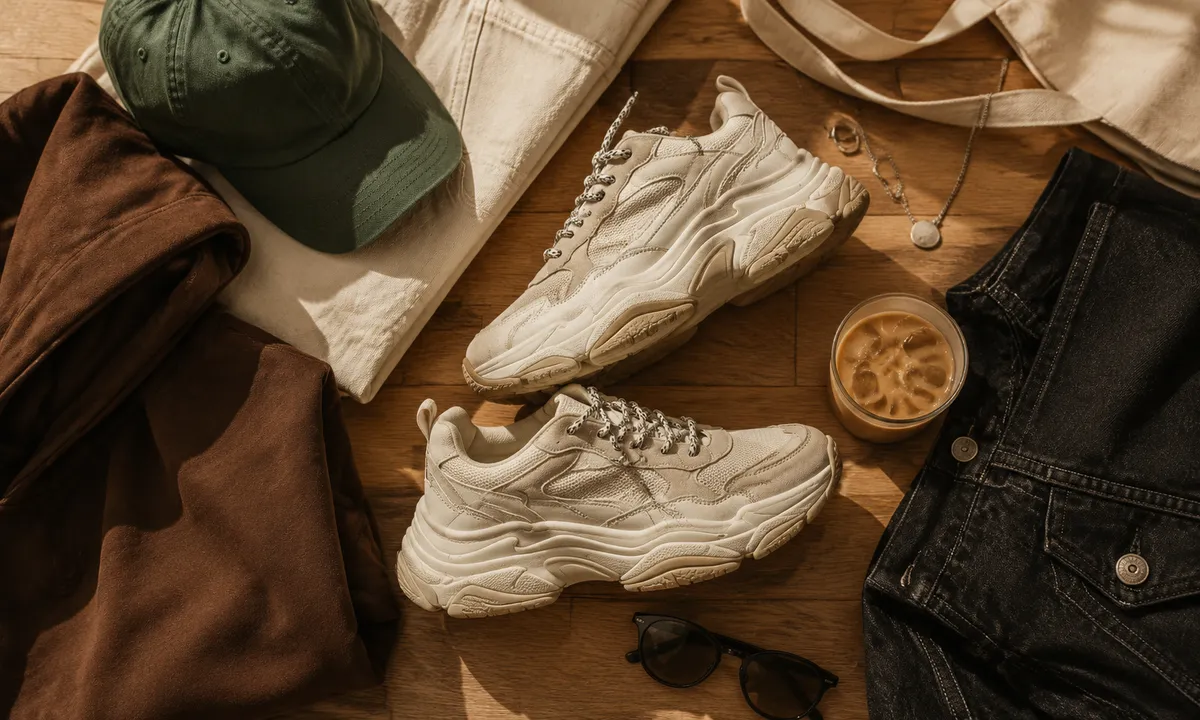
Chunky sneakers look better on outfits than they should. The math seems off: more mass at the bottom, more visual weight, a silhouette that by classical proportion theory ought to feel clunky and drag everything down. And yet, on the right outfit, a thick-soled trainer with a stacked midsole and a wide toe box does something that a sleek runner almost never does. It anchors. It grounds. It makes even a thrown-together look feel like a decision was made.
This is not purely subjective. There is a visual mechanic at work, and once it is seen it becomes difficult to unsee.
The Anchor Effect and Why Thin Soles Fight It
When a silhouette tapers to almost nothing at the foot, the eye keeps moving. There is no visual stop, no period at the end of the sentence. A thin-soled sneaker, a flat leather shoe, a barely-there sandal, these all create a silhouette that just sort of trails off. The proportions of whatever is worn above, whether a wide-leg trouser or a mid-length skirt or an oversized jacket, have nothing to push against. They float.
A chunky sole creates a base. The midsole, typically somewhere between 30 and 50 millimeters on a modern platform trainer, reads as a horizontal shelf that the rest of the outfit stacks on top of. The eye lands on it. The composition settles.
Architects and graphic designers understand this principle automatically. A heavy base communicates stability, and stability reads as intention. An outfit that looks intentional reads as cool. The shoe is doing a structural job.
Contrast That Creates a Focal Point
One of the quieter reasons chunky sneakers upgrade an outfit is that they create contrast with the leg. A slim ankle or tapered trouser cuff looks slimmer against a wide, boxy sole. This is an old trick in fashion proportion, but the chunky sneaker applies it more aggressively than most footwear does. The greater the contrast between the mass at the foot and the line above it, the more deliberate the whole thing appears.
Baggy jeans with a chunky sneaker work for the same reason a wide cuff on a dress shirt looks good with a simple watch: the two elements define each other by being different. The trouser and the shoe are not competing. The trouser is generous and relaxed; the shoe is heavy and structural. Each makes the other’s character more legible.
Slim, tapered footwear reads the same note as a slim, tapered leg. When the shoe and the pant echo each other in volume, the total silhouette becomes a single monotone statement, technically cohesive but visually quiet in a way that registers as safe rather than considered.
What “Casual” Actually Means in a Silhouette
Dressing well has shifted toward a particular register over the past decade or so. The goal is rarely formal authority anymore. It is more often easy, uncontrived cool: the impression that the wearer could not be bothered to try too hard but still arrived looking like they know exactly what they are doing. Chunky sneakers communicate this in a way that dress shoes and even clean white court shoes do not.
Part of it is categorical. Sneakers with exaggerated proportions read as sportswear ancestry, and sportswear ancestry reads as ease. But the proportions themselves amplify that signal. A shoe that is physically large looks like it was chosen for comfort first, aesthetics second. That ordering, comfort before convention, is culturally readable as confidence. And confidence is the core ingredient of looking cool in any era.
A loafer or a ballet flat says “I considered the occasion.” A thick-soled trainer says “I considered my preferences.” One is deferential; the other is not.
The Height Shift and Its Effect on Proportion
Platform soles, which are common on the chunkier end of the sneaker spectrum, add height, and added height changes how proportions fall across the body. Longer apparent leg length tends to elongate an outfit’s silhouette. Hemlines sit differently. Wide-leg trousers that might bunch or pool on the floor with a flat shoe skim correctly above the ground. The visual weight of the upper body distributes more evenly against a longer lower half.
This mechanical effect is real regardless of what is fashionable in a given season. Proportion is proportion. A 40-millimeter platform raises the hip-to-floor ratio measurably, and the outfits calibrated for that shift look more pulled-together because the pieces are hitting the right points on the body rather than sliding around the wrong ones.
It is not magic. It is just that the shoe acts as a pedestal.
Why the Same Effect Does Not Work With Every Chunky Shoe
The chunky sole that improves an outfit has a particular character. It reads as a considered object, usually with defined lines, material contrast between the upper and the midsole, and a silhouette that, even at high volume, has some kind of internal logic. A shoe can be large and still look designed.
Rubber gardening clogs are chunky. Orthopedic walking shoes can have substantial soles. Novelty platform shoes from a costume shop are technically platform shoes. None of these do what a well-designed chunky trainer does, and the difference is in visual resolution, how crisp the edges are, how clearly the different parts of the shoe are distinguished, how deliberately the proportions seem to have been chosen. A shoe that looks like mass was added carelessly reads as exactly that. A shoe where the mass looks like a choice reads as a design object, and design objects signal taste.
This is why certain sneakers in this category have pulled cultural gravity for years: the New Balance 990 series, the Nike Air Max lineup, the Salomon trail runners that moved from hiking into everyday wear. Each has a particular density that feels specific rather than generic. The chunkiness is a feature with a rationale, not an accident of manufacturing.
What Happens at the Outfit Level When the Shoe Gets It Right
Consider a relatively ordinary combination: a straight-leg dark denim, a plain white or neutral crew-neck shirt, nothing special. With a clean slim runner, the outfit is fine. Presentable. It reads as someone who got dressed without thinking about it, which is accurate, and that accuracy is legible. Nothing wrong with it, but nothing to look at either.
Drop in a substantial chunky trainer with real midsole bulk and material contrast, and something shifts. The jeans look like they were picked for their cut. The shirt looks like it was chosen to let the rest of the outfit do the work. The same two garments acquire context. The shoe retroactively makes the outfit look like it was assembled rather than just put on.
This is perhaps the most useful thing chunky sneakers do. They raise the apparent effort level of whatever is worn above them, without adding actual effort. A single strong piece at the base of an outfit acts as evidence of taste, and once that evidence is visible, viewers extend credit for the whole look. The oversized shirt is now a deliberate choice. The wide trouser is now thoughtful. The minimal jewelry is now restraint rather than forgetting.
The shoe is doing interpretive work. It is giving the rest of the outfit permission to be read generously, and in fashion, that kind of permission is worth more than almost any other single purchase. A well-chosen shoe at the right scale does not just complete the look. It authorizes it.