


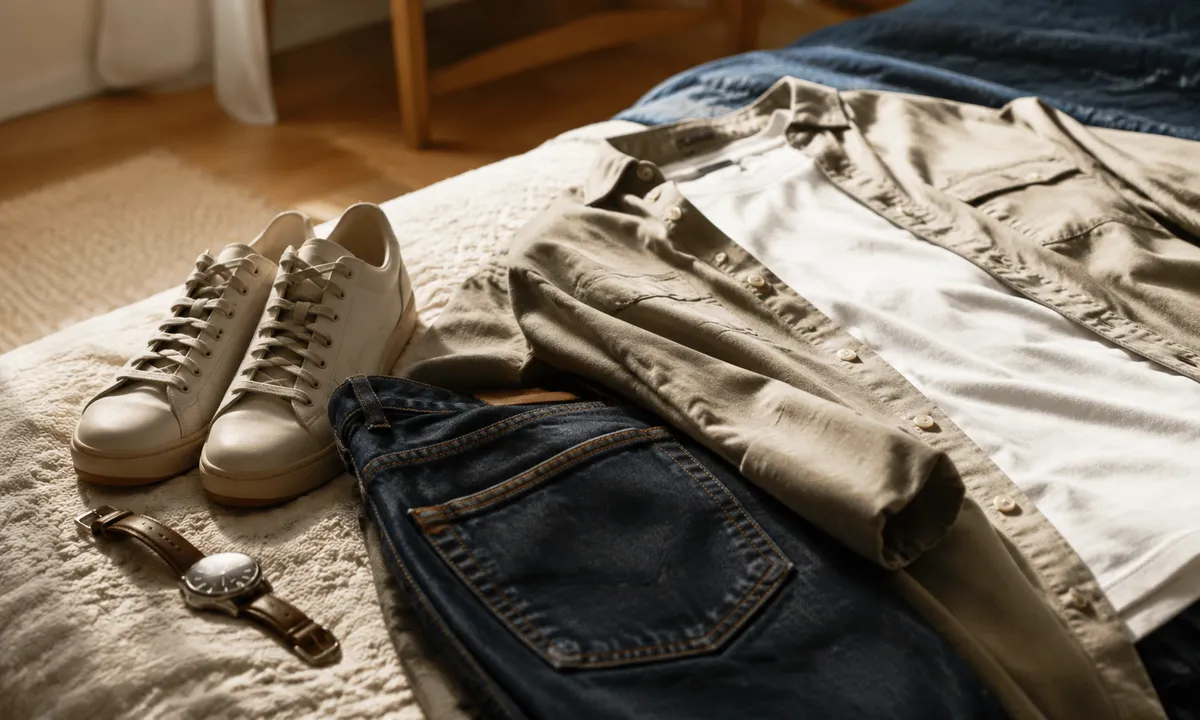
Casual is the hardest word in a dress code. Formal has rules. Smart-casual has its own anxious genre of forum threads. But casual, left to its own devices, stretches from a clean white shirt to the joggers someone wore on the Tube this morning. The first date sits right in the middle of all that ambiguity, and the clothes chosen for it are doing more work than most people admit when they’re standing in front of the mirror at half six.
The job is not to look impressive. It is to look like yourself, in your best iteration. That distinction matters because first dates have a way of unravelling: something funny comes up, a second drink appears, the conversation turns personal. Whoever shows up in the clothes is who the other person starts to form an opinion of. Wearing something that performs a version of you that doesn’t exist yet is a strange kind of trap to set for yourself at the start.
The Venue Is Your First Clue
The word casual in the date’s context usually means a coffee, a walk, a pub with no tablecloths, a low-lit bar that takes bookings but doesn’t require them. It means somewhere the other person would feel odd turning up in black tie, and somewhere you’d feel equally odd in head-to-toe activewear. The location actually narrows things down more than people realise. A Sunday afternoon at a canal-side cafe calls for something different to a Wednesday evening at a dimly lit cocktail bar, even if both technically qualify as casual.
Work backwards from the room. What is the floor made of? What is the lighting doing? Who else will be there? The mental image of the venue is a remarkably reliable filter for getting clothes roughly right before you’ve even opened a wardrobe.
What Actually Reads as Attractive Effort
There is a difference between effort that reads and effort that announces itself. A pressed Oxford shirt in a good-fitting cut reads. A shirt so crisp it looks freshly unwrapped, paired with trousers two shades too dark and shoes that have never been outside before, announces. The second one makes the other person feel underdressed. It also makes the wearer look like they have been rehearsing since Tuesday.
The items that reliably read as attractive effort are the ones that suggest care without formality: well-fitting jeans with no visible wear at the knees, a knit with actual structure rather than a shapeless jumper, a jacket that isn’t a suit jacket but still has some spine to it. Clean shoes. Not new shoes. The difference is audible in how someone carries themselves.
Fit is doing most of the work here. A medium-weight crew neck in a muted colour, if it fits properly across the shoulders and doesn’t bunch at the waist, reads better than a more expensive shirt that’s two sizes too wide. Most people know this and ignore it anyway, because buying the right size sometimes means going back to the shop.
Colour and the Impression It Leaves Before Anyone Has Said Anything
Colour communicates a tone before the conversation starts. An all-black outfit reads as put-together but slightly closed. An all-white one reads as confident but unforgiving on a drizzly Tuesday. Brighter colours, worn as the dominant note, can feel like a performance in the wrong setting. None of this is a hard rule. It is an awareness that the eye arrives before the personality does.
The colour combinations that tend to work on casual first dates are the ones that feel considered rather than matched. Navy and off-white. Olive and stone. A single muted mid-tone worn top to bottom with different textures to break it up. The logic is that a calm, coherent palette puts the face and the person in the foreground rather than the outfit.
One point of contrast, whether a slightly brighter sock, a different-toned layer, a watchstrap that sits outside the expected palette, gives an outfit some life without turning it into a statement. It is the sartorial equivalent of a specific detail in a story: it makes everything around it feel more intentional.
The Practicality That People Forget Until It’s Too Late
First dates move. What starts as one drink can become dinner somewhere else. A walk that seemed like forty minutes turns into two hours. Shoes chosen for appearance alone, rather than any capacity to actually walk in them, become the defining feature of the evening somewhere around hour three. The wearer is thinking about their feet. The other person is wondering why their date looks distracted.
The same applies to cold. London in October, or March, or sometimes August, will undermine any outfit that didn’t account for a fifteen-minute wait outside a pub that lost the reservation. A good layer that works with rather than against the rest of the clothes, a coat that doesn’t immediately require stuffing somewhere awkward, these are small decisions that stop the practicalities from becoming a subplot.
Wearing something you’ve worn before also matters in this direction. A new top might fit differently when sitting down for an extended period. New trousers have an uncanny ability to feel fine in the bedroom and wrong everywhere else. The night before a first date is a poor moment to field-test a garment.
A Note on Trying Too Little
Under-dressing for a casual first date has become its own kind of performance. The person who turns up in a faded band T-shirt and scuffed trainers is sometimes genuinely relaxed. More often they are communicating something: that they are above the conventions of making an effort, or that they consider themselves interesting enough that the clothes don’t need to do any work.
This is worth thinking about honestly, because the other person is still a stranger. They don’t yet have the context to read studied understatement as confidence. What they see is what’s in front of them. Effort is a form of consideration. It says: I thought about this meeting, and I thought about how it might feel for you to sit across from me.
When the Date Happens to Be Your Own Style
Some people have a genuinely developed aesthetic, and their everyday clothes are already doing the right kind of work. The person who always wears tailored vintage pieces and looks completely comfortable in them should wear tailored vintage pieces. The person who lives in well-cut workwear should wear well-cut workwear. The question is always whether the outfit is a real expression of the person wearing it, or a costume assembled for the occasion.
Personal style, when it’s actually personal, is one of the more efficient things to bring to a first date. It gives the other person something real to react to. It starts the actual conversation about who someone is earlier than the small talk usually allows.
The difficulty is that most people’s genuine style is messier and more specific than what they wear to make an impression. The challenge of the casual first date is finding the version of your real wardrobe that is also its best version, which is a smaller category than it sometimes feels standing there at quarter past six, running slightly late, wondering whether the green jacket is too much.
Scent, Grooming and the Details That Don’t Photograph Well
The most intimate parts of how someone presents themselves on a first date are the ones that don’t show up in any mirror check before leaving the house. Scent carries in a way that colour and silhouette do not. A small amount of a fragrance that is actually yours, meaning one chosen for how it smells on your skin and not because it was given as a gift or left over from someone else’s recommendation, is one of the few additions that survives the whole evening intact.
Hair that has been attended to but not stiffened into place. Nails that are clean. Skin that has been looked after recently enough that it doesn’t look like a sudden concern. These are not vanity items. They are signals of the same order as clothes: they tell someone how much thought went into the meeting before it started.
There is a reason that people remember what someone smelled like long after the specific details of the conversation have gone. First dates are experienced physically as much as verbally. The details that live close to the body tend to be the ones that last.
The Thing to Actually Avoid
A single item that requires explanation is a tax on the evening. The T-shirt with an in-joke that only people who attended a specific gig in 2017 would understand. The jacket with a long story attached. The shoes that people always ask about, which is charming the fourteenth time and a mild drain on hour one of a first date.
Conversation pieces belong in wardrobes. A first casual date is not the context for wearing the thing that makes other people come to you; it is the context for wearing the thing that lets the actual conversation find its own way there. The green jacket that was too much? Probably leave it for the third date, when there is already enough shared texture that it can be a detail rather than an opening gambit.