


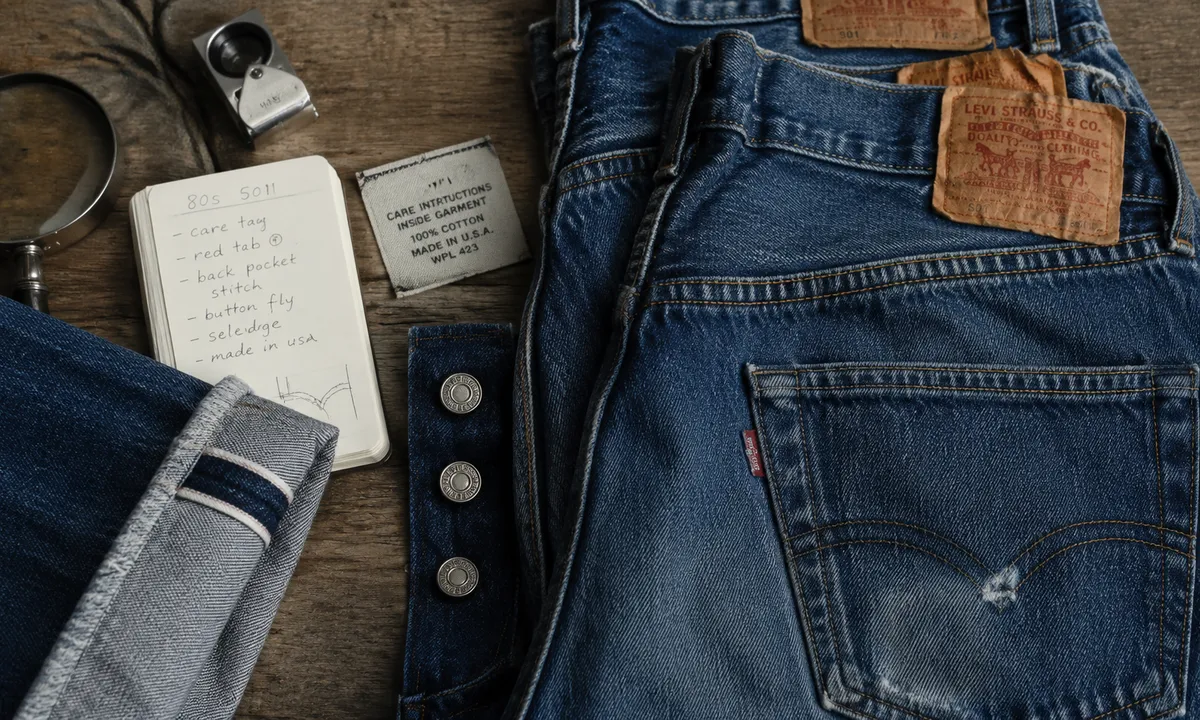
Vintage Levi’s 501s from the late 1980s are easier to find than ever, and harder to buy well than they have ever been. The resale market has been indexed, catalogued, and priced with a thoroughness that removes almost every advantage a casual browser once had. Knowing that a pair exists is no longer the hard part. Knowing whether the pair in front of you is actually worth what you are about to spend, and whether it will fit once you get it home, is where the whole project gets interesting.
The mythology around vintage denim runs ahead of the reality. People talk about selvage edges and chain-stitch hems as though those details alone guarantee something. They do not. A pair can have every mark of legitimate vintage construction and still fit like a paper bag, fade unevenly after one wash, or have a seat so blown out that no tailor wants to touch it. The details matter, but they are not the destination. They are a checklist you run before you decide to care.
What the Tag Is Actually Telling You
The first thing most people do when they pick up a vintage pair is flip them over and look at the back label. That is the right instinct, done for the wrong reasons. The label is not primarily a quality signal. It is a date stamp.
American-made Levi’s shifted manufacturing gradually through the 1980s and 1990s. A red tab with all capital letters on the “E” in Levi’s predates 1971. The two-horse patch going from leather to a cardboard-style material happened in the early 1980s. A care instruction label sewn into the waistband narrows the window further. None of these details make the jeans better or worse to wear. What they do is help you date the garment, which tells you roughly what construction methods and materials to expect, and gives you a baseline for whether the asking price makes any sense.
The same logic applies to other brands. Lee Riders from the 1970s have specific union label formats. Wrangler Broken Bows have their own dating tells. Every house has its own internal clock, and learning to read it costs nothing except time spent handling a lot of pairs.
The Fit Problem Nobody Prepares You For
Vintage sizing is a genuinely different system, and calling it “inconsistent” undersells how strange it gets. A pair tagged 32x 32 from 1985 might measure 34 inches at the waist and 30.5 inches in the inseam. This is not a mistake. Manufacturing tolerances were wider, shrinkage was factored in differently, and the rise on a pre-1990 jean sits two to three inches higher than what most people are used to wearing now.
The only number worth trusting is the one you get from measuring the actual garment. Lay the jeans flat on a table. Measure the waist by doubling the distance across the waistband at the top. Measure the inseam from the crotch seam to the hem. Measure the rise from the crotch seam up to the top of the waistband. That last number is the one most buyers skip and then regret. A 12-inch rise on a pair of straight-leg jeans will sit on your body in a completely different place than an 8.5-inch rise on a pair with identical waist and inseam measurements.
Thrift stores rarely provide measurements. Online sellers who do provide them are doing you a real service, and it is worth paying a modest premium for that information. You are not just buying the jeans. You are buying certainty that they will clear your hips when you get them home.
Reading Wear Before You Commit
There is wear that is cosmetic and wear that is structural, and they look almost identical to an untrained eye until something fails six weeks later.
Cosmetic wear is the surface stuff: fading on the thighs, small abrasions at the back pockets, a slight pilling along the inseam. That kind of wear adds character without compromising anything functional. Structural wear is different. It lives in the seat, the crotch seam, and the inner thighs, and it shows up as thinning fabric, not fraying at the edges but actual thread depletion where the weave itself has worn down to gauze. Hold those areas up to a window or a light source. If you can see light coming through fabric that is supposed to be opaque denim, that area is on borrowed time.
Crotch blowouts are the most common failure point in vintage denim, and they can be repaired by a good tailor or someone who knows sashiko-style darning. But the repair will show, and it will change the drape of the fabric in that area permanently. Factor that into what you are willing to pay. A pair with a pre-blown crotch is not a deal at half price if you are planning to wear them constantly. It is a project, and projects deserve project prices.
Where to Actually Find Good Pairs
The obvious places, estate sales and Goodwill bins, still produce good finds but less often than they did even a decade ago. Professional pickers have shortened the window between an item hitting a donation bin and hitting a resale platform. This is just the state of things now, and being annoyed by it does not change the math.
The more reliable hunting grounds are geographic and demographic. Rural estate sales in the midwest and south, particularly those clearing out the possessions of someone who worked a physical job, turn up work-weight denim that was bought to last and then stored rather than worn out. Small-town thrift stores in areas without large young populations have not been picked over at the same rate as stores in college towns or dense urban neighborhoods. This is a generalization with plenty of exceptions, but it is a generalization that holds up over time if you drive it enough.
Online, the honest answer is that eBay’s completed sales are your calibration tool, and finding a deal there means understanding the listing well enough to know when a seller has misdescribed or understyled a pair. A grainy photo, a vague description, measurements listed only as “tag size 34,” those listings get fewer bids. Sometimes there is a reason. Sometimes someone just did not bother to photograph the jeans well, and you can benefit from that.
The Wash Question Has a Real Answer
Vintage denim that has been stored unwashed for years carries years of body oils, storage smells, and sometimes mildew from humidity fluctuations. The question of whether to wash before wearing is not really a question. The answer is yes, and the method matters.
A cold soak in a bathtub with a small amount of gentle detergent, followed by a slow air dry away from direct sunlight, is conservative enough to preserve most of what makes a pair valuable while actually cleaning the fabric. Hot machine washing with aggressive agitation is how you get unexpected shrinkage in an already short inseam, and how you lose the particular patina that has developed in the denim over decades. The fades on a well-worn vintage pair are not just cosmetic. They are a record of how the fabric moved, and they are destroyed quickly by the same conditions that would fade any other fabric fast.
If a pair smells like it spent twenty years in a cedar chest, that smell dissipates with a proper wash and airing. If it smells like mold, look closely at the fabric before you commit. Mold damage to cotton fiber is often invisible until the fabric is cleaned and dried, at which point weakened areas can develop small tears under normal handling.
When the Price Is Actually Worth It
A clean, well-preserved pair of American-made 501s from the early 1980s in a common size will run anywhere from eighty to two hundred dollars depending on the platform, the seller, and how well the listing is presented. That range is not arbitrary. It reflects real variation in condition, rarity of the specific size, and whether the seller did the work of documenting what they have.
The ceiling on price gets justified by scarcity of fit. A 29-inch waist with a 34-inch inseam in pre-1980s denim is rare enough that a buyer who needs those measurements has limited alternatives, and prices reflect that. A 34x 30 in the same era is far more common, so the same condition pair sells for less. This is not about the jeans being worse. It is about supply and the specific population of people who fit them.
The calculation that actually matters is simple: cost per wear over a realistic ownership period. A pair that fits correctly, has no structural damage, and was made with the construction quality of American manufacturing from forty years ago will outlast almost anything at the same price point from a current retailer. The math works, but only if the fit is right and the condition is honest. A beautiful pair that fits badly will sit on a shelf and eventually get sold again, at a loss, to someone else who hopes it will work for them.