


Everyday style right now is quieter than it has been in a while, which is not the same as boring. The clothes people are actually reaching for, the ones that survive more than a single season in regular rotation, share a few qualities that are easy to name once you see them together: relaxed but intentional, referencing the past without costuming in it, and built around pieces that hold up to scrutiny in daylight rather than only reading well in a photo.
That last part matters more than it sounds. The image-first era of fashion encouraged a lot of pieces designed to flatten into something arresting on a small screen: saturated color, exaggerated silhouette, obvious branding. Some of that still exists and probably always will. What has shifted is that a portion of the people who care about dressing well have grown visibly tired of it. The pieces getting attention right now tend to earn it through texture, proportion, and small details that reward a second look.
Trousers That Have Actual Room In Them
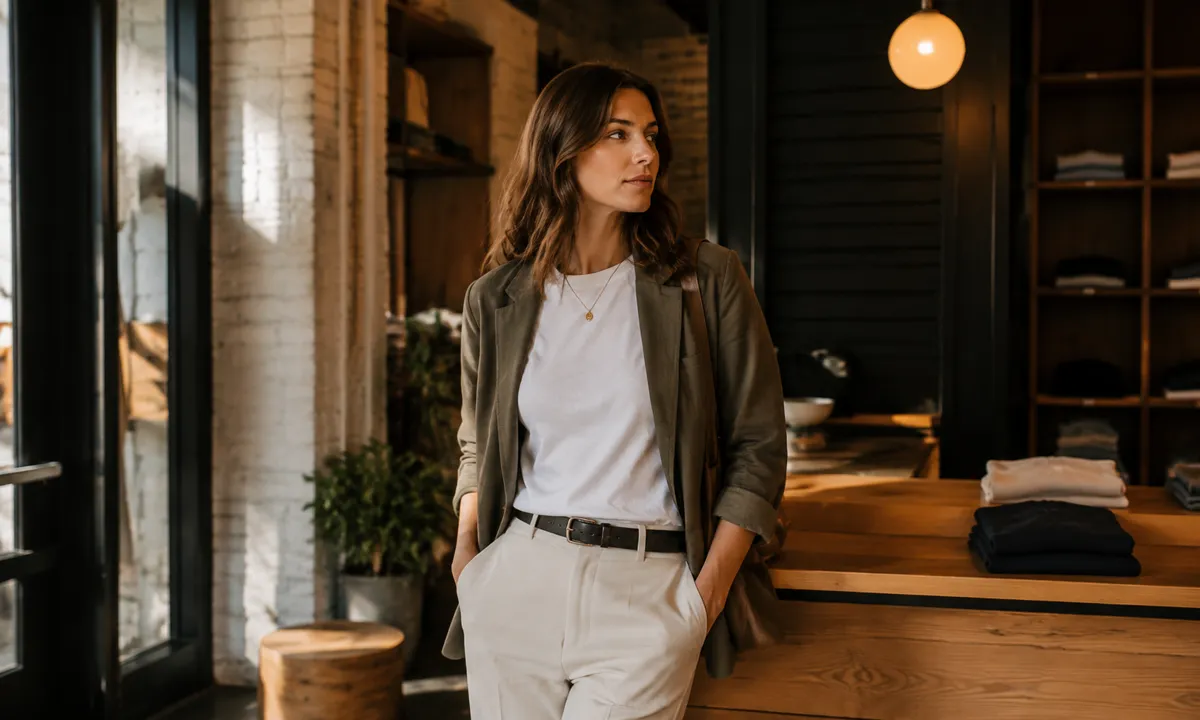
The slim trouser held on longer than anyone expected. It works on some bodies and in some offices and has never entirely left. But the trouser that reads current right now has room through the thigh and a clean, straight leg that hits somewhere around the ankle, sometimes a touch above it. The silhouette is neither relaxed enough to read as athleisure nor shaped enough to read as tailored in the old sense. It sits in a precise middle distance that takes a little confidence to wear.
The fabrics that work best here are heavier than you might expect: a mid-weight wool twill, a cotton with enough body to hold the shape of the leg as you move, a linen blend in summer that drapes rather than collapses. The trouser that reads slouchy in a cheap fabric and reads easy in a good one is the same pattern. The fabric is making the distinction.
Color has opened up here more than in most categories. Camel, chocolate, a deep dusty olive, and a clay-tinged off-white are all showing up on regular people in regular places, not just in editorials. The move away from strict navy-black-grey bottom dressing is real and sustainable because these colors still combine easily.
Outerwear Doing Less Signaling
The logo-heavy puffer had its moment, earned its associations, and is now beginning to feel dated in the way that branded athletic wear from a decade ago feels dated: still legible as fashion, just fashion from a specific time.
What has taken its place is not a single silhouette but a general tendency towardcoats and jackets that look considered rather than conspicuous. Long wool coats in solid, muted tones. Overshirts in thick flannel or brushed cotton that function as a light jacket nine months of the year. Barn jackets and chore coats that trade on workwear’s aesthetic without requiring actual farm use, which is a move that has been around long enough now that the sincerest versions of it no longer feel ironic.
Fit here is important in a particular way. These pieces generally work because they are slightly oversized on the wearer but retain clear structure in the shoulders and chest. An oversized coat that has lost its shape at the shoulder just looks like a large coat. An oversized coat that holds its lines reads as a choice.
White and Cream Shirts Worn Without Decoration
The plain white or off-white shirt is having one of its periodic revivals, and this one feels more durable than the last few. Part of what is driving it is a broader appetite for pieces that do not shout, combined with the practical reality that a shirt in good white cotton or a soft off-white linen can sit under almost anything and read as intentional rather than neutral.
The shirts getting worn right now tend to have a slightly relaxed body, a boxy-to-straight cut rather than a tapered one, and collars that are neither aggressively stiff nor deliberately soft. Some have a classic point collar. Some have a camp collar, which has earned a longer life than most trends because it works equally well tucked, untucked, buttoned to the top, and open over a T-shirt. A few have no collar at all, a mandarin band or a simple round neck that reads cleaner than a collar in certain layering contexts.
The specific quality that elevates a plain shirt into a piece someone keeps for years is usually the hand of the fabric: a cotton poplin with a slight sheen, a linen that softens with each wash, a brushed twill that feels like something rather than just functions as something. The shirt as pure commodity, bought in three-packs and replaced on a cycle, still exists. The shirt as an actual garment someone chose has come back into focus.
Shoes Grounded in Practicality, Not Irony
Chunky-soled shoes ran hard for several years and are still present, but the silhouette that reads freshest right now tends toward something simpler: a leather loafer with a modest sole, a clean Oxford or derby in brown or tan rather than black, a plain leather sneaker or minimal canvas shoe that does not shout any particular brand or subculture.
The loafer in particular has settled into genuine everyday use in a way it had not managed for a couple of decades. Part of this is the trouser silhouette it pairs with so cleanly. The straight-leg, slightly cropped trouser and the loafer are genuinely complementary: the trouser shows the shoe, the shoe grounds the trouser, and neither piece is working against the other. When two pieces in an outfit have this kind of structural conversation, the whole thing reads as composed without looking assembled.
Running shoes with thick midsoles are still widely worn and are not going anywhere because they are genuinely comfortable. They just no longer read as fashion-forward, which is not a criticism, only a description of where the cycle is. The person reaching for a pair of clean leather trainers instead of a technical runner right now is making a quiet but legible style statement.
Accessories Scaled Back Toward One
The maximalist accessory approach, layered chains, stacked rings, multiple earrings per ear, hats and bags and scarves all at once, belongs to a particular strand of contemporary style that is genuinely alive and worth doing when it is done well. It is also not where the broader current is moving for everyday dressing.
The shift is toward fewer pieces, each one more considered. A single interesting ring rather than five. A belt that is actually doing structural work rather than functioning as decoration. A bag chosen for its material and proportion rather than its logo. A watch, if worn, in a scale that fits the wrist rather than commanding it.
This is a harder look to pull off than it sounds because fewer pieces means each one carries more weight. A plain outfit with one genuinely well-chosen accessory reads as secure and edited. A plain outfit with one mediocre accessory just reads as plain. The move toward restraint rewards quality in individual pieces more than the layered approach does, which is partly why it tracks with the general shift toward buying fewer, better things that has been building in this part of the market for several years.
Color That Has Temperature
The colors showing up in everyday dress right now tend to share a quality that is easier to see than to describe: they have been pulled toward warmth or muted toward grey in a way that feels settled rather than sharp. Raw camel. Warm stone. A terracotta that is closer to a clay pot than to a safety cone. Forest green with enough brown in it to feel autumnal year-round. Burgundy that reads wine rather than cherry.
This is a color language that pairs well across pieces without requiring much thought, which is one reason it has staying power. Warm neutrals, muted earth tones, and the occasional deep jewel shade all sit in a range that is easy to combine. Two pieces from this palette worn together rarely fight each other the way a bright cobalt and a cool grey can fight.
Black is still widely worn and always will be, but it reads differently now as a total-look choice than it did five years ago. The all-black outfit still exists and still works. It has just lost some of its claim on effortless cool and settled into something more utilitarian, more city-uniform. The people most engaged with current style are more often mixing these warmer tones, reaching for black as one element rather than the answer.
The Fit That Makes Everything Above Work
All of this comes to very little if proportion is off. The clothes described here share a silhouette logic: relaxed through the body but with structure at the key points, slightly longer or roomier than the cropped-and-skinny look that preceded it, and calibrated to the actual body wearing it rather than a generic fit model.
Tailoring, basic hemming, and jacket suppression are more relevant now than they have been in a while precisely because the current silhouette has more fabric to manage. A straight-leg trouser that breaks at the wrong point reads shapeless. The same trouser hemmed cleanly to just above the shoe changes the whole picture. The difference between an outfit that reads current and one that reads as an attempt at current is usually somewhere in that inch or two of hem.
The tailor making those small adjustments is not performing a luxury service in the way that a full bespoke suit is a luxury. It is closer to maintenance, the finishing work that completes what the clothes were trying to do before they got to a specific person’s body. That frame, style as maintenance rather than acquisition, is probably the most honest way to describe what distinguishes the person whose everyday dress holds together from the one who bought the same pieces and wonders why it never quite adds up.