


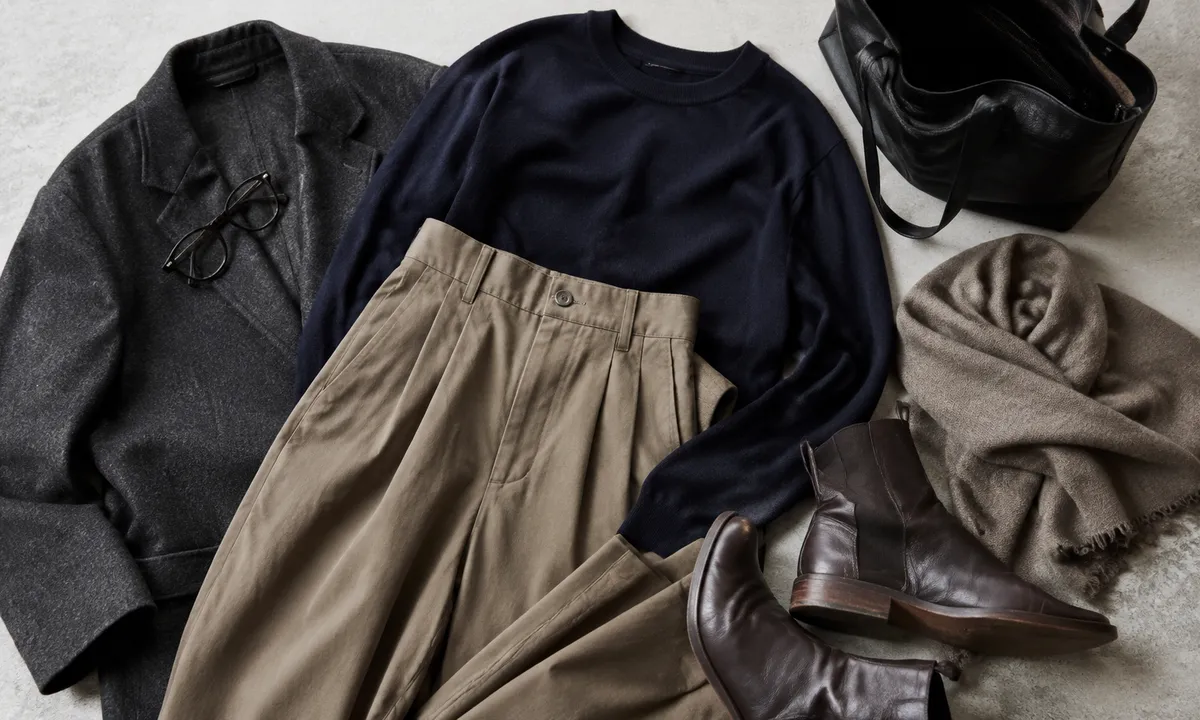
Spend enough time near fashion editors and a pattern emerges that their published work rarely admits: the clothes they reach for on an ordinary Tuesday are almost aggressively quiet. Not minimal in the architect-wearing-black sense, which is itself a kind of performance. Just quiet. A navy crewneck. Trousers cut wide enough to walk quickly in. Boots that have been resoled once already.
The logo question matters more in fashion than anywhere else, because fashion is the industry that invented the logo as status device. For editors specifically, it creates a particular bind. Wearing the house you cover looks like lobbying or gratitude. Wearing a rival looks like a statement. Wearing something with no allegiance at all turns out to be the most useful move, professionally and personally.
The Uniform That Isn’t One
Ask a fashion editor what she wears on a day with no events, no showroom appointments, no photographers around, and the answer tends to cluster around a handful of categories: Japanese workwear brands, old French basics, British heritage pieces worn past the point of looking heritage, and the kind of Italian knitwear that has no logo because the factory never thought one was necessary.
Nîmes denim from a brand most readers will not recognise. A linen shirt from Uniqlo’s Japanese line, bought on a trip and worn until the collar softens. A coat from a small Scottish manufacturer that makes perhaps three hundred units a year. The connecting thread is not country of origin or price point. It is the absence of anything that shouts.
This is not anti-fashion. It is a very particular form of fashion literacy: knowing what a garment is made of and by whom, finding that knowledge satisfying in itself, and needing no external confirmation that you got it right.
What “No Logo” Actually Means in Practice
Logoless dressing among people who work in fashion does not mean cheap, and it does not mean self-denying. A cashmere turtleneck from a small Italian spinner in Biella can cost three hundred pounds and carry nothing on its surface except the weight of the fibre. A pair of wide-leg trousers from a Japanese brand that has been making workwear since the 1970s reads as nothing to a civilian, and as quite a lot to anyone who has spent time in the industry.
That insider legibility is part of the appeal. The same impulse that drives certain collectors toward unbranded vintage pieces or obscure archive items is operating here. The knowledge is the point. The garment communicates only to people who already know.
Which is also, it must be said, its own form of status signalling. Pretending otherwise would be dishonest. But the signal is different in kind: it requires the person reading it to have done the same homework, which filters the audience down considerably.
The Brands That Keep Appearing
Certain names come up with a frequency that moves beyond coincidence. Auralee, the Japanese label founded in 2015, has built a following among people who work in fashion that is almost comically disproportionate to its public profile. The clothes are expensive, made from exceptional fabrics, and carry no visible branding. A pale grey coat from Auralee in a changing room looks like it might be a prototype for something else. On a person who knows what it is, it reads as a considered choice.
Lemaire sits in a similar position. Charles Lemaire’s work at his own label since leaving Lacoste has attracted the sustained devotion of people who spend their professional lives watching clothes. The silhouettes are loose and slightly curious, the palette runs toward sand and rust and muted green, and the branding on the outside of a garment is essentially nonexistent. Editors wear it the way other people wear a favourite shirt: repeatedly, without announcement.
Margaret Howell is the British version of this. Shirts in proper poplin. Trousers with a proper rise. Woolcoats that look like they were made to last twenty years because they were. Her clothes have an impatience with ornament that reads, on the right person, as a complete statement of values.
Johnstons of Elgin, Sunspel, Carrier Company: the list goes on, and the common characteristic is the same. These are brands that trust the quality of the object and have never felt the need to put their name on the front of it.
Vintage as the Purest Form of the Logic
The most committed version of logoless dressing is simply old clothes. A 1980s Armani trouser suit from a market in Paris, before the brand became its own parody. A cotton knit from an unnamed Italian maker, found in a charity shop in Edinburgh and still going after fifteen years. A leather jacket that once had a label but lost it to repeated dry cleaning, which is now just a jacket, full stop.
Vintage solves the problem completely because the original commercial context has dissolved. Nobody is being sponsored. The garment outlived its moment and became just an object with good proportions and an honest fabric. Fashion editors with long careers tend to have wardrobes anchored in pieces like this, bought because they were structurally interesting or made from something worth preserving, held on to because they kept working.
There is also something in the fact that vintage clothes were made before brands fully understood how to turn their own names into the product. A 1970s French trench coat was selling a trench coat, not a lifestyle. The clarity of that transaction, whatever its limitations, produces objects that do not require decoding.
When the Industry Turns Its Own Logic Inside Out
None of this is secret, which is why fashion has spent the past decade trying to absorb it. Luxury brands began making “quiet” lines. Marketing departments discovered the word “understated” and ran it into the ground. Stealth wealth became a trend, which is the moment any authentic instinct gets hollowed out and sold back to itself.
The editors who established this sensibility mostly moved on before it calcified into a look. That is the nature of the thing: once enough people are doing it deliberately, the people who were doing it out of genuine preference are already somewhere else. A new Japanese brand nobody has covered yet. A Portuguese shoemaker with a six-week lead time. A tailor in Glasgow who does not have a website.
Fashion editors are professionally allergic to arriving at the same place as everyone else, and that allergy shapes how they dress even when they are not thinking about it.
The Shoes Are Often the Tell
If there is a single category where this preference concentrates most visibly, it is footwear. The logoless sensibility tends to express itself in shoes with a particular character: a good last, a proper sole, a shape that has been refined over decades rather than invented for a season.
Church’s brogues resoled so many times the original leather has developed a patina that cannot be bought. Paraboot Michels, the French rubber-soled derby that has not changed since 1945 and carries its brand name so quietly on the sole that it might as well not be there. Tricker’s boots in a colour the brand calls Acorn Antique, which is the shade of something that has been walked in for a long time andcared for properly.
These are not fashion shoes. They are not intended for runways or lookbooks. They are intended to be worn, hard, for years, and to get better. The editors who choose them are making an argument with their feet: that quality and durability are more interesting than novelty, and that the most radical thing in fashion might simply be buying something good and keeping it.
A pair of Church’s Graftons resoled for the third time, laces replaced once, toecaps brushed back to life with a cloth and a little wax: that is the garment as commitment, as anti-trend, as the slowest possible rejection of an industry built on next season. Some fashion editors find that funnier than anything they could actually publish.