


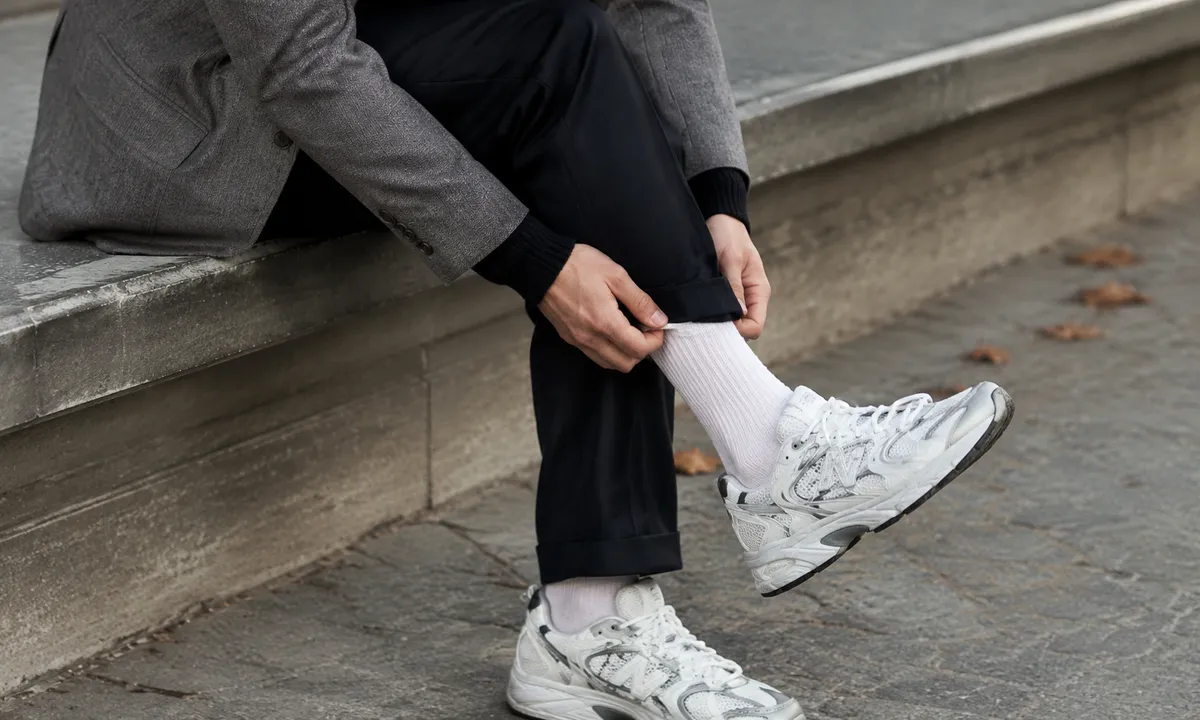
Sportswear and tailoring have been circling each other for decades, and the overlap is now close enough that a person can get it badly wrong or quietly, devastatingly right. The difference between those two outcomes is not price. It is proportion, occasion-reading, and a set of rules that almost nobody writes down because the people who understand them absorbed them gradually, the way you absorb grammar.
Start with the fact that these two categories were built on opposing principles. Tailoring exists to impose structure on the body: a jacket with a chest canvas, a trouser with a clean break at the shoe, a collar that stays put. Sportswear exists to release the body from structure: stretch panels, elastic waistbands, fabrics that move. When the two are combined without any awareness of that tension, the outfit looks like a mistake. When that tension is acknowledged and used deliberately, it looks like a decision. The entire art of the mix lives in that gap.
Proportion Is the First Conversation the Outfit Has
The most common failure in this combination is a loose athletic piece paired with another loose tailored piece. A boxy track jacket over an unstructured blazer, for instance, reads as volume without intent. The body disappears inside it. The rule that actually works: one piece does the shaping and one piece relaxes. A fitted, structured trouser with a clean line from hip to ankle earns a relaxed bomber or sweatshirt. A wide-leg, pleated trouser asks for something with a defined shoulder and a contained silhouette up top.
This is not a strict formula. It is a way of thinking. Every outfit should have a center of gravity: one piece that provides structure, and the rest that orbits it. When both pieces are trying to do structural work, the outfit becomes a competition. When neither is, it collapses.
What the Fabric Actually Tells the Room
Fabric is the element that most people underestimate. A good technical fabric, something with a flat, matte finish and a precise woven structure, can sit next to a fine wool trouser without embarrassing either of them. A cheap, pilling polyester cannot, regardless of the cut. The eye reads surface quality as a signal about intent. When two fabrics of roughly equal quality share an outfit, the mix reads as considered. When one is clearly better than the other, the lesser piece looks like it wandered in.
Texture contrast works differently from quality contrast. A neoprene bomber in charcoal sitting over a flannel trouser in a complementary grey works because neoprene and flannel are both dense, matte, serious materials. They have different surfaces but similar weights in the room. A shiny satin bomber over the same flannel trouser creates a clash that no amount of careful color-matching can fix, because one fabric is dressed and one is casual in a way that the eye cannot reconcile.
The practical shortcut: hold the two pieces together in natural light and ask whether they look like they belong to the same decade and the same level of effort. That test catches most mistakes.
The Color Alignment That Actually Holds
Sportswear arrived with its own color logic: performance palettes built on high-visibility primaries, neons, and white-on-black branding. Tailoring arrived with its own: navies, charcoals, mid-greys, earthy tones that age well. When those two palettes are simply pushed together without mediation, the result is energetically incoherent. A red and white athletic jacket over olive trousers and brown leather shoes asks the eye to reconcile three entirely different moods.
The approach that holds up over time is extracting a single color from the sportswear piece and anchoring the tailored elements to it. A navy and grey athletic jacket, for example, gives a clean bridge to charcoal trousers and a slate or off-white sneaker. The boldest color in the athletic piece becomes a point of interest rather than a disruption. The tailored pieces frame it. This sounds like basic color theory because it is, but the specific application to sportswear-tailoring mixes gets ignored constantly in favor of “wearing what you like,” which is a fine aspiration and a useful excuse for not thinking.
The Footwear Decision Is Where the Mix Gets Resolved
Shoes are the declaration at the end of a sentence. In a sportswear-tailoring combination, they either pull the outfit toward casual or toward dressed. A clean low-profile sneaker in leather or suede, something without a thick EVA midsole stack and without visible branding on the side panel, reads as footwear rather than athletics. It does not drag the trouser down into pure streetwear and it does not fight the jacket. A full-on running shoe with a sculpted heel counter and foam geometry reads as athletics, which shifts the whole outfit register toward gym-adjacent and away from the intended gray zone.
That gray zone is the actual goal. Not “I am wearing athletic clothes” and not “I am dressed up but with sneakers.” The target is a register where the outfit reads as a single coherent choice rather than two separate wardrobes sharing one body. The shoe is often the piece that tips it one way or the other.
Leather loafers and derbies work in this mix more often than people expect, particularly when the tailored trouser is doing the structural lifting. A track pant in a clean, unbranded technical fabric with a leather derby and a structured single-breasted jacket is an outfit that exists comfortably on its own terms. The trouser and the shoe create a kind of productive incongruity that reads, when executed well, as intentional.
The Branding Problem
Visible logos are the single most polarizing variable in this conversation. A large chest logo on an athletic piece immediately signals the brand’s world rather than the wearer’s. In a tailoring context, that signal competes with everything else the outfit is trying to say. The piece becomes a brand advertisement rather than a garment, and the tailored elements around it start to look like the supporting cast in someone else’s story.
This does not mean branding is always wrong. A small, understated logo, the kind that sits at chest height and measures about the same as a shirt button, is absorbed into the outfit without dominating it. The difference between a discreet embroidered symbol and a three-inch wordmark printed across the chest is not just a question of taste. It is a question of how much real estate the brand occupies versus how much the person does.
Some brands have crossed over completely into the tailoring conversation, their logos now carrying associations that read as considered rather than athletic. But that crossing is genuinely rare, and leaning on it as a justification for heavy branding in a tailored context is usually wishful thinking.
Reading the Occasion Without Overcalibrating
The mix has a natural habitat: situations that are not formal but are not purely casual either. A meeting at a creative agency, a dinner at a restaurant that does not require a jacket, a weekend event where effort is expected but a suit would be strange. These are the occasions where sportswear-tailoring earns its keep. They are also more numerous than formal occasions, which is part of why the category has grown.
Where the mix struggles is at the edges. A funeral, a wedding, a job interview in a traditional industry: these are contexts where tailoring needs to do its historical work of signaling respect and compliance with a shared code. Introducing sportswear into those contexts is a legible statement about rejecting that code, which is sometimes deliberate and sometimes just careless. Knowing which one applies is on the wearer.
The other edge is the purely casual occasion where the mix becomes more work than it is worth. A backyard gathering or a grocery run does not need the productive tension of tailoring against sportswear. The calculation is only worth making when the occasion genuinely sits in the in-between.
What Fit Does That Nothing Else Can
Tailoring, at its best, fits the body with a precision that sportswear rarely attempts. Athletic pieces are sized to allow movement across a range of bodies, which means they are almost always slightly off for any specific body. In a mix, that slight imprecision in the athletic piece becomes more visible precisely because the tailored piece beside it has been cut to a tighter standard. The trouser with a clean inseam and a hem that breaks exactly right makes the jacket with a too-long body and dropped shoulders look worse than it would on its own.
The answer is not to have athletic pieces tailored, though some people do and the results are almost always worth the cost. The answer is to select athletic pieces with the same attention to fit that goes into selecting tailored ones. Sleeve length, shoulder seam position, body length relative to the hip: these details exist in sportswear even when the category pretends they do not matter. In a tailoring context, they matter considerably more.
A track jacket whose shoulder seam sits exactly where the arm begins, whose sleeves end at the right point on the wrist, whose hem hits at or just below the hip without covering the trouser rise: that jacket in a tailoring context looks like it belongs. The same jacket in the wrong size, worn because the brand only made it in M and L, looks like a concession. Concessions accumulate. Four of them in a single outfit and the whole thing reads as approximation rather than intention, and approximation is the opposite of what this kind of dressing is supposed to achieve.