


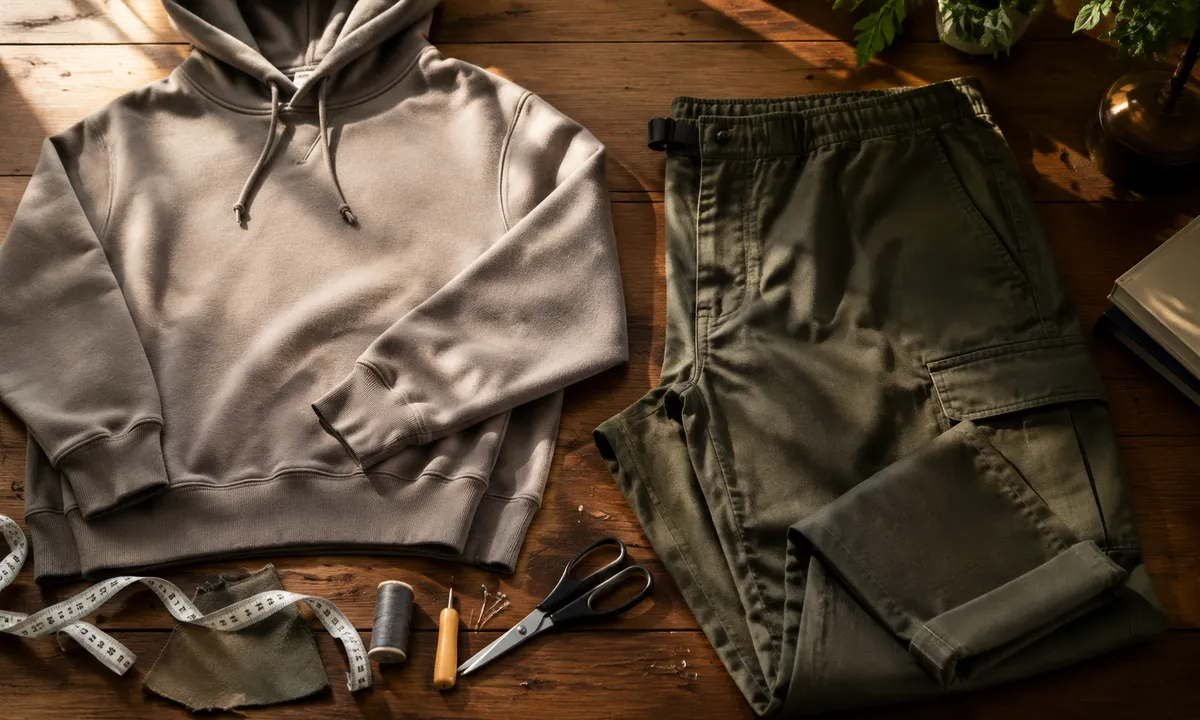
Fit is the variable that separates a wardrobe that reads as intentional from one that just looks like clothes. This is as true for a hoodie and cargo pants as it is for a tailored suit. The assumption that casual streetwear operates outside those rules, that it is supposed to look loose and unconsidered, has left a lot of otherwise well-chosen pieces doing very little for the people wearing them.
The adjustments involved are not dramatic. Nobody is asking for a full tailor overhaul of a cotton crewneck. What makes the difference tends to be smaller: a sleeve shortened here, a waistband taken in there, a hem brought up just enough to show the shoe properly. Each one individually seems minor. Stacked together, they shift how a whole outfit reads.
Where the Sleeve Ends
Sleeves on mass-market hoodies and sweatshirts are sized for coverage, not proportion. They land wherever they land on whoever is wearing them, and for most people that means somewhere past the wrist bone and creeping toward the knuckles. The sleeve doesn’t look wrong exactly, but it does look unresolved.
Shortening a sweatshirt sleeve by an inch or an inch and a half, so the ribbedcuff sits cleanly at the wrist rather than bunching over the hand, does something that sounds cosmetic but registers as structural. The arm looks proportional. The cuff becomes a detail instead of a pile-up of fabric. A tailor can do this alteration for a modest price, and because sweatshirt fabric is thick and forgiving, the altered hem rarely looks touched.
Layering a long-sleeve under a short-sleeve tee, a common streetwear approach, makes sleeve length even more critical. If both underlayer and overlay end at the same point, the layering reads as accidental. A visible inch or two of the underlayer cuff, intentional and clean, turns the same combination into something considered.
What Tapering Cargo Pants Actually Does
Cargo pants occupy a strange position in streetwear: genuinely useful, heavily worn, and almost universally too wide in the leg for anyone who didn’t already seek out a tapered cut. The utility pockets are part of the appeal, and nobody is suggesting they come off. The issue is the leg opening, which on a standard pair is wide enough to swallow a chunky sneaker whole.
A tailor can taper the leg from the knee down without touching the thigh or the pockets. The result keeps all the volume where cargo pants are supposed to have it and narrows the silhouette below the knee, where that bulk tends to turn into a shapeless column. The shoe gets to show. The stack of the pant over the sneaker, if that’s the look, becomes deliberate rather than a side effect of excess fabric.
This one alteration tends to cost between twenty and forty dollars depending on the city and the shop, and it changes a pair of pants from something that reads as utilitarian overflow into something that reads as chosen.
The Waistband Problem on Loose-Fit Denim
Loose-fit and wide-leg denim has been the dominant silhouette for several years now, which means a lot of people are wearing jeans that are sized up at the waist in order to get the leg width they want. The exchange isn’t always worth it. A waistband that gapes at the back or sits two inches lower than intended doesn’t read as relaxed. It reads as borrowed.
Taking in the waistband of a pair of jeans is among the most common alterations a tailor does, and on denim it is especially effective because the rest of the pants, the leg, the seat, the rise, all stay exactly as they were. The visual looseness that made the jeans appealing is preserved. The waistband simply holds where it should. Worn with a tucked tee or a cropped jacket, the fit looks entirely different from a pair that gapes and slides.
Hem Height and the Shoe
The relationship between a trouser hem and the top of a sneaker is one of the most visible details in a streetwear fit, and it gets less attention than it deserves. Too much break and the shoe disappears into a puddle of fabric. A hem that sits too high starts to look like it shrank in the wash rather than a deliberate decision. The range where things look right is narrow, roughly a quarter to a half inch of break for a clean stack, no break at all for a cropped or tailored-trouser aesthetic.
Getting there requires actually hemming the pants to the specific shoe rather than to a general preference. A pair of joggers hemmed to land right on a low-profile runner will stack differently on a thick-soled basketball sneaker. Streetwear built around rotation through multiple silhouettes of footwear benefits from having the hem set for the shoe it gets worn with most, and then accepting that other pairings will look a little different. That specificity is part of how a fit communicates that someone paid attention.
Shoulder Seam Position on Oversized Tees
Oversized tees are sold on the premise that the proportions are the point. The dropped shoulder, the extra body width, the longer length: these are features. But there is a version of oversized that works and a version that simply swamps. The difference almost always comes down to where the shoulder seam falls.
When a shoulder seam drops far enough down the arm that the sleeve cap begins at the bicep rather than near the shoulder joint, the shirt stops looking intentionally large and starts looking like something borrowed from a much bigger person. The silhouette collapses inward at the torso because there is nothing structuring the top of the garment. A seam that drops one or two inches past the shoulder point reads as relaxed. Four or five inches reads as lost.
Tailoring a shoulder seam is more involved than hemming, and for a basic cotton tee the cost may not be justified. The more practical approach is to shop tees from brands and cuts where the dropped shoulder is controlled rather than accidental. When oversized is built into the pattern from the start, the proportions hold. When it is achieved by simply sizing up a regular shirt, the seam placement tends to fall apart.
Cropping and Its Limits
Cropping a sweatshirt or a heavy jacket is the alteration that gets talked about the most in streetwear circles, and also the one most likely to go wrong. The appeal is real: a cropped hem changes the visual balance of an outfit by revealing more of the waistband or the rise of the pant, making the whole proportion feel intentional. A slightly cropped fleece over a wide-leg pant is a different silhouette from the same fleece at full length.
The limit is that cropping doesn’t improve a garment that has other problems. If the sleeves are too long and the shoulder seams are dropping, cropping the hem only concentrates attention on those remaining issues. It works best when it is the final step on a piece that already fits well everywhere else, not the first move on one that doesn’t.
Length is also harder to undo than to do. A good tailor will ask to see the piece worn before marking the hem, and that conversation is worth having. An inch makes a significant difference in how much of the pants below are visible. Two inches makes it a different garment.
Finding the Right Tailor for the Right Fabric
Not every alteration shop is comfortable with streetwear fabrics and construction. A tailor who works primarily on dress shirts and suit trousers may hesitate with thick fleece, bonded nylon, or the kind of multi-pocket cargo construction where altering one seam requires navigating several others. Asking before bringing the garment in, describing the fabric and the work, takes two minutes and saves a ruined jacket.
In most cities, tailors who work near colleges or in neighborhoods where streetwear is actually worn see these pieces constantly. They know how to work with raw hems on denim, how to shorten a ribbed sweatshirt cuff cleanly, how to taper a synthetic pant without making the seam allowance show. Word of mouth from other people who wear the same category of clothing is a more reliable guide than online reviews, which tend to skew toward formal work.
A single good tailor, found once and returned to consistently, changes the entire calculus of buying. Pieces that are close but not quite right become worth buying. The gap between what’s on the rack and what would actually fit gets smaller. That gap is usually just an inch, and closing it is almost always cheaper than buying something new.