


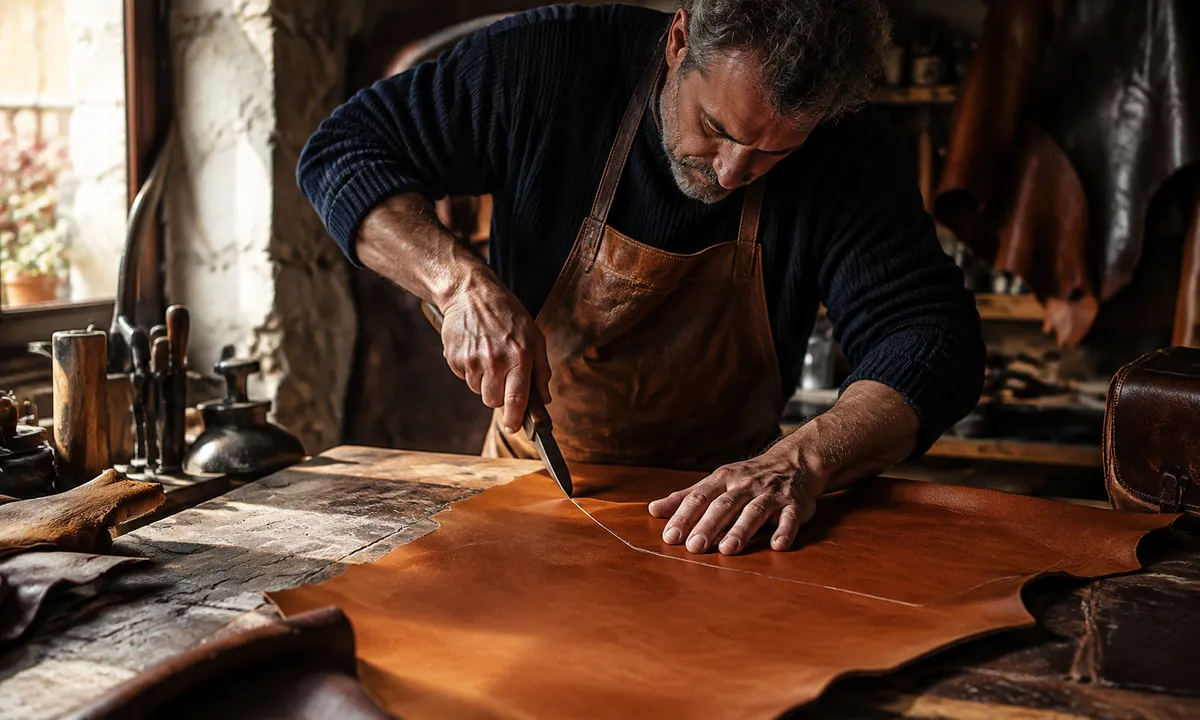
Somewhere in a narrow street off the main square of a provincial Italian town, behind a door with no sign, a craftsman is cutting a shoulder of vegetable-tanned cowhide into panels that will become a handbag. He has been doing this for thirty-one years. His workshop supplies three or four small labels you have never heard of, and it also, quietly, supplies one you certainly have. The bag he makes for that famous name retails in London for around fourteen hundred pounds. The bag he makes for his own small label, using the same hide from the same Tuscan tannery, sells direct for six hundred and forty.
This is not a secret in any conspiratorial sense. It is simply the way European luxury leather manufacturing has always worked, and understanding it changes how a person shops for a serious bag.
The Geography of Where Good Leather Comes From
The craft is concentrated in a surprisingly small number of places. The Santa Croce sull’Arno district in Tuscany has beencuring hides since the Middle Ages and still produces some of the most sought-after vegetable-tanned leather in the world. The Brenta Riviera, a stretch of the Veneto between Venice and Padua, became a footwear and accessories manufacturing corridor in the mid-twentieth century and now houses hundreds of small workshops, many of them family-run across three or four generations. Parts of the Ubrique valley in Andalusia, Spain, have a similarly concentrated tradition; the town has a population of around seventeen thousand and produces leather goods for a roster of houses that reads like a map of the Paris luxury district.
What all these places share is infrastructure: specialist tanneries, skilled stitchers who learned the trade locally, hardware suppliers making brass and palladium-plated fittings to consistent standards, and a culture in which quality control is absorbed rather than imposed. A youngcutter in Ubrique grows up around leather the way someone in a wine region grows up around vines. The knowledge is ambient.
Why the Same Hands Make Bags at Very Different Prices
The large houses understood decades ago that manufacturing leather goods at scale, while maintaining genuine craft quality, required partnerships with these regional workshops. A Parisian or Milanese flagship does not employ thousands of leather cutters in its home city. It builds relationships with factories andateliers in exactly the districts described above, provides specifications and hardware, applies its own quality inspection, and ships finished goods back to be sold under its name. This is standard practice and there is nothing dishonest about it.
The consequence, though, is that the skill and the material are often shared across price points. A mid-sized Brenta workshop might produce bags for a recognisable European label, for a smaller Italian brand, and under its own name, all in the same week. The difference in the finished product is real but narrower than the price gap suggests: the famous label brings its own hardware, its own lining fabric, tighter stitch-per-centimetre requirements, and more rigorous final inspection. It also brings its name, which is where most of the price lives.
Strip the name away, and what remains is a leather bag made by people who know exactly what they are doing, using hides tanned by the same regional suppliers, at a price that reflects the actual cost of production plus a modest margin.
What “Half Price” Actually Means in Practice
The figure varies, but it is not unusual to find independent European leather workshops selling structured totes, crossbodies, and shoulder bags in full-graincalf or lamb at prices between three hundred and seven hundred pounds, in a category where recognisable names charge seven hundred to fifteen hundred for comparable construction. The saving comes almost entirely from the absence of retail infrastructure: no flagship stores in Sloane Street, no global advertising budget, no department store wholesale margin.
A few of these workshops have begun selling direct through minimal websites, sometimes in English, often in Italian or Spanish with serviceable translation. Others sell through small multi-brand platforms that curate independent European makers. A handful still operate primarily through word of mouth, taking orders by email and shipping with a lead time of several weeks.
The buying experience is different. There is no returns portal that processes a refund within forty-eight hours. There may be no phone number. But the bag that arrives has usually been finished by someone who would notice if it was not right, because their name, or their family’s name, is on the label.
How to Tell If a Workshop Is the Real Thing
The signals are learnable. Full-grain leather, the surface layer of the hide with the grain intact, develops a patina and softens over years in a way that corrected-grain or bonded leather does not. A maker who specifies the tannery by name, and particularly one who uses Conceria Walpier, Badalassi Carlo, or one of the other named Tuscan producers, is telling you something verifiable. Vegetable tanning, which uses plant-derived tannins and takes weeks rather than hours, produces leather with a firmer hand, a distinctive earthy smell when new, and a longer useful life than chrome-tanned alternatives.
Stitching density matters more than most buyers realise. Eight to ten stitches per centimetre on stress seams is the standard for serious production; fewer is a cost cut, and it shows eventually at the corners and handle roots. Saddle stitching, done with two needles passing through the same holes from opposite sides, is more durable than machine lockstitching and is still the method of choice in workshops that have not moved entirely to industrial production.
Hardware weight is a tell. Lightweight zinc alloy fittings feel thin and corrode quickly under normal use. Solid brass, even plated, has a different sound when it contacts another surface: a dull, cleanclink rather than a hollow rattle. Makers who are proud of their hardware will name the metal.
A Few Workshops Worth Knowing
Nuvola Bianca is a small Florentine label that produces structured bags and wallets in vegetable-tanned Tuscan calf and sells direct, with prices that sit well below equivalent construction from established names. Il Bisonte, also Florentine, is better known than most independents but remains genuinely craft-oriented, and its prices reflect manufacturing costs rather than luxury positioning. In Spain, El Caballo from Seville has been working in fine leather for over fifty years and sells equestrian-influenced bags and accessories that have almost no profile outside Spain despite consistent quality.
Portugal has become increasingly relevant. The Alentejo and Lisbon regions host workshops that have historically supplied mid-market European fashion labels and are now building their own names through direct sales. Makers such as Atelier de Bagagerie operate at the quieter end of the market, without the marketing apparatus that would double their prices.
None of these are hidden in any dramatic sense. They are findable with moderate effort. The barrier is not access; it is the habit of defaulting to names one already recognises.
The Specific Question of Bespoke and Small-Run Orders
Several of these workshops will take bespoke commissions, or at least accommodate requests for non-standard colours or hardware from their existing range. This is worth knowing because it means the independent route can deliver something a department store genuinely cannot: a bag made to a specific size, in a specific hide, without a waiting list managed by a brand’s allocation system.
Lead times for bespoke work are typically six to twelve weeks. Correspondence is sometimes conducted over email in imperfect English, occasionally through a mediating agent. The process is slower and requires more engagement than a retail purchase. For a buyer who has carried the same bag for eight years and knows exactly what they want next, that engagement is not an obstacle.
The finished object, a bag made to a specific person’s requirements by a craftsman who signed off on every seam, sits in a different category from something pulled off a shelf in a brand’s seasonal collection. It does not carry a famous name, which means it will not signal anything to a stranger. That is, for a certain kind of buyer, precisely the point.