


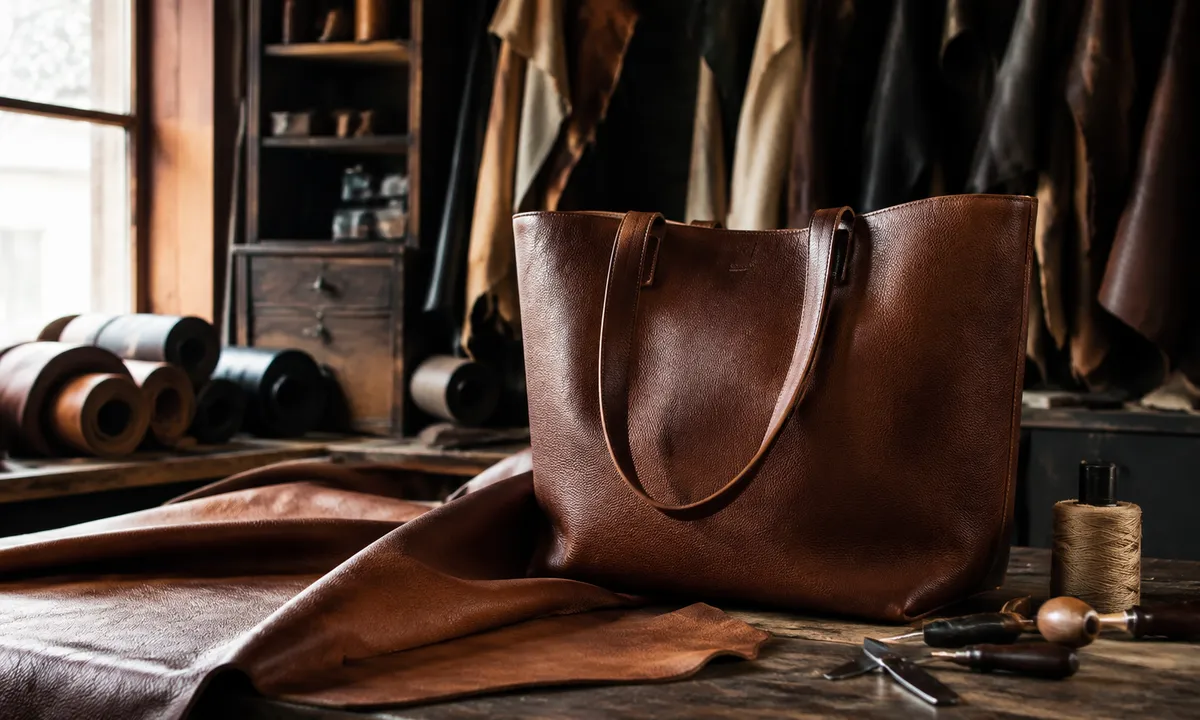
A well-made leather tote from a serious brand costs somewhere between $400 and $2,000 at retail. That range is wide enough to feel meaningless, and most brands are not particularly interested in explaining what sits inside it. What actually goes into building one of these bags, from the hide on the cutting table to the finished piece on the shelf, is a story told in small, expensive decisions, most of which a buyer never sees and the brand rarely advertises.
The Hide: Where Most of the Money Is Committed Before Anything Is Cut
Full-grain vegetable-tanned leather from a reputable tannery in Tuscany or the Horween facility in Chicago runs roughly $25 to $60 per square foot, depending on the weight, the finish, and the relationship between the tannery and the buyer. A single structured tote requires somewhere between 6 and 10 square feet of usable leather, which sounds straightforward until you factor in waste. Hides are irregular. They have belly sections that stretch unevenly, areas near the legs where the grain is loose, scarring from wire fencing or insect bites. A carefulcutter working from a quality hide might lose 25 to 35 percent of the surface to unusable sections. That waste is not an accident or a sign of poor workmanship. It is the cost of selecting only the tight, dense fiber in the shoulder and back, where the leather performs best over years of use.
Material cost for the leather alone, on a well-made tote, often lands between $180 and $400 before anyone has touched a needle.
Hardware, Lining, and the Parts That Hold Everything Together
Solid brass hardware, cast and polished rather than zinc die-cast and plated, costs several times more per unit and weighs noticeably more in the hand. A set of D-rings, rivets, a swivel snap hook, and a magnetic closure in solid brass might run $15 to $30 just for the hardware components on a single bag. Plated zinc versions of the same hardware cost a fraction of that, and they look identical in a product photograph. They also start to show wear at the plating edges within a year of regular use.
A canvas or woven cotton lining, properly glued and stitched rather than just dropped in, adds another $8 to $20 depending on the material and the complexity of interior pockets. Some manufacturers use a bonded leather backing on the interior panels instead of fabric lining, which adds cost and structure. Edge finishing, either burnished with a heated bone folder and a water-based compound or folded and stitched, takes time that shows up in labor rates, not material invoices.
Labor: The Cost That Varies Most by Geography
A skilled leather worker in northern Italy, working in one of the smallateliers outside Florence that supply or directly produce for heritage brands, earns a wage that translates to a labor cost of $80 to $150 per finished bag for a piece requiring 6 to 8 hours of skilled assembly. That number includes cutting, skiving the edges to reduce bulk at seams, gluing panels before stitching, hand-saddle stitching or running a consistent lockstitch on a heavy-duty machine, setting hardware, burnishing edges, and a final inspection.
The same labor performed in a factory in southern China or Vietnam, under honest conditions with fair wages, costs roughly $18 to $40 per bag. The wage differential is not a judgment about quality. A trained worker in either location can produce excellent work. It does mean that a $600 Italian-made tote and a $180 Vietnamese-made tote can share nearly identical material specifications while carrying very different labor economics.
What shifts with geography is not always the skill but the structure around it: the training pipeline, the oversight per worker, the tolerance for rework versus shipping a piece that is almost right.
The Pattern, the Sample Room, and Development Costs That Never Appear on a Hang Tag
A new tote design does not walk into production. It goes through pattern development, which at a serious atelier or design house involves a pattern maker producing an initial technical template, a sample cut in leather, a fit and proportion review, revisions to handle length or base dimensions, and sometimes three or four iterations before the final sample is signed off. For a small brand working with an independent sample room in New York or London, that process can cost $800 to $2,500 per design, spread across however many units eventually sell.
Brands producing at volume absorb that cost across thousands of units. A designer making 200 bags per season absorbs it across 200. That math shows up in the retail price, and it should.
What “Made in Italy” Actually Costs to Label
The country-of-origin label carries real weight with buyers and carries real cost for manufacturers. Italian production involves higher labor rates, studio overhead in a region where real estate and regulatory compliance are expensive, and the inefficiencies that come with smaller batch sizes. A workshop producing 50 bags per week operates nothing like a factory producing 500. Setup time, machine adjustments, thread changes, and quality checks per unit all cost more when the runs are short.
There is also the material sourcing expectation. An Italian-made bag that uses chrome-tanned split leather from a discount source and sells for $350 is wearing a geography as a signal of quality it has not actually earned. The origin label means something only when the full stack, materials, construction method, labor standards, and finishing choices, matches the implied promise. When it does, the cost to produce is real, and a retail multiple of 2.5 to 3.5 times the manufacturing cost is a thinner margin than most people imagine for a brand with physical retail presence, a small team, and no outside investment.
The Price Points That Do Not Add Up
A structured full-grain leather tote, made in Europe with solid hardware and a clean interior finish, that retails for $150 is worth examining closely. At that price, after retail markup, importation costs, brand overhead, and the cut that goes to the platform or the store, the manufacturing cost implied is somewhere around $40 to $55. Full-grain vegetable-tanned leather alone, in the quantity needed, costs more than that. Something in the material specification has been substituted: a corrected-grain leather with a heavy embossed surface to simulate a tight grain, or a split leather with a polyurethane coating that photographs well and wears poorly. That substitution is not obvious in a product image, and the language on the listing will often still say “genuine leather”, which is a legally correct description of almost any material that was once part of an animal hide.
Corrected-grain leather andcoated splits are not inherently dishonest materials. They have uses where durability and uniformity matter more than character. In a tote marketed on natural aging, patina development, and longevity, they are a significant misrepresentation.
Aging, Patina, and the Cost of Leather That Actually Changes
Vegetable-tanned leather darkens with handling, softens along the crease lines, and develops a surface record of where it has been. After five years of daily use, a shoulderstrap on a well-made tote will show the oils from a hand, the specific pressure of a grip, a color shift from tan to deep amber at the contact points. That is not marketing language. It is what the material does when it is finished minimally and tanned with plant-based compounds rather than chrome salts.
Chrome-tanned leather, which dominates global production because the process takes days rather than weeks or months, stays more stable in color and texture over time. It is also softer from the start and more water-resistant. Neither tanning method is strictly superior for every application. For a tote that a buyer intends to carry for twenty years and wants to watch develop a specific character, vegetable tanning is the relevant choice. The cost of that choice is in the slower production timeline at the tannery, the higher price per hide, and the additional care the finished piece requires in the first years of use.
A vegetable-tanned tote that arrives stiff and pale and requires six months of regular use before it becomes fully supple is not a product defect. It is the material behaving correctly. Buyers who understand that tend to keep the bag for a decade. Buyers who do not return it in the first month, which is a real cost the brand absorbs and prices for.
The Thread Count That Determines Whether a Seam Survives
Saddle stitching, done by hand with two needles and a waxed linen or polyester thread passing through pre-punched holes from both sides, produces a seam where the thread locks itself. If one pass breaks, the rest holds. A machine lockstitch, when the top thread breaks, can unravel back along the entire seam. On a tote carrying 15 pounds of books and a laptop, the seam at the handle attachment point is under sustained stress, and the stitching method matters considerably more than it does on a decorative pocket.
Hand saddle stitching adds time: a skilled worker might stitch 8 to 12 inches of clean saddle stitch per minute on thick leather. On a full tote, the main seams and handle attachments alone can represent 45 minutes to an hour of stitching time. At European labor rates, that single element adds $35 to $70 to the manufacturing cost. Most brands making at volume have moved to heavy-duty double-needle lockstitch machines, which produce a good seam quickly. The choice between the two methods comes down to production economics and the realistic stress loads the bag will face.
When a brand specifies hand saddle stitching on load-bearing seams and prices accordingly, that is a legitimate cost. When it appears as a decorative flourish on an exterior panel that sees no stress, it is a design choice, not a structural one, and the price premium it justifies is much smaller.