


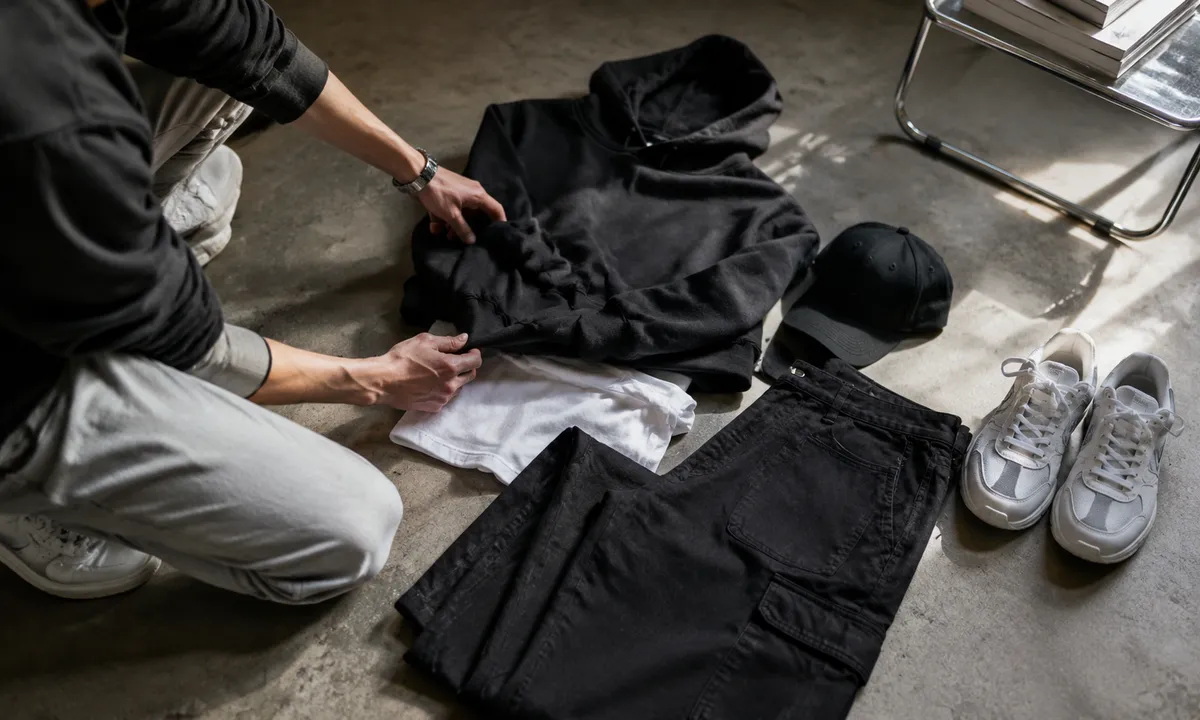
Baggy street style looks effortless in the way that good cooking looks effortless: the effort is real, it just happened earlier, and mostly off-screen. The specific version of it that reads as clean and intentional rather than sloppy and accidental runs on one rule that almost nobody names out loud. Not a rule about brand or fit or color. A rule about proportion and where it is allowed to live in a single outfit.
The rule is this: volume is a budget, and the body gets only one withdrawal per outfit.
One Oversized Piece, Everything Else Held
Pick up any photograph of someone whose baggy streetwear actually works, and run a quick inventory. Wide-leg cargo pants that pool slightly at the ankle? The jacket is cropped or fitted through the body. An oversized bomber that buries the shoulder line and hits mid-thigh? The pants underneath are straight and slim enough to show the leg. A huge boxy tee with a drop shoulder and a chest that belongs to someone two sizes larger? The bottoms are fitted chinos or tapered sweats that land at the ankle with no drama. One piece holds the volume. The other one holds.
When both pieces are big, the human inside them disappears. The outfit stops reading as a silhouette and starts reading as a pile. The eye needs a landmark, some point where the body is understood, to make sense of the generous piece beside it. Without that anchor, generous just becomes formless.
This is not a rule invented by stylists. It is closer to something that good tailors have always understood and that the best streetwear figures arrived at independently by looking hard at what worked and what did not.
Where the Silhouette Gets Read
The human eye reads a standing figure from roughly the widest horizontal point. Shoulders and hips are the two anchors. A wide shoulder line gives the brain something to orient around; it makes everything below it legible. This is part of why an oversized top that adds volume at the shoulder and chest still feels structured when the pants are slim: the anchor is clear, the variation is obvious, the contrast is doing work.
Wide-leg pants operate differently. They add volume at the hip and below, which means the top half needs to stay closer to the body to preserve any sense of a waist or torso. A tucked tank, a fitted mock-neck, even a snug half-zip: any of these give the eye that midpoint to land on before the pants open up below. The pants can be as wide as they want from there. The silhouette holds.
This is also why the tucked tee under wide pants works so reliably. It is not about trendiness or decade. It is about giving the eye exactly the information it needs to make the lower half feel intentional.
Length Is Part of the Equation
Proportion is not only about how wide something is; it is also about where it ends. An oversized top that hangs past the hip is functioning differently from one that hits at the natural waist, even if the chest measurement is identical. The longer the top, the more it eats the trouser line, and the harder it becomes for the pants to register as their own element. When the top ends around the high hip and the trouser rises somewhere visible, two distinct pieces exist. When the top comes down to mid-thigh over wide pants, the whole lower half vanishes into a column of fabric.
Clean baggy dressing tends to respect breaks. The break between top and bottom is visible. The break at the ankle, where the pant meets the shoe, is clean rather than buried. These breaks give the eye the stops it needs to read each piece on its own terms while also reading the whole thing as a composed outfit.
Ankle exposure matters more in this context than in fitted dressing, because a bit of visible ankle below wide-leg or baggy pants signals the bottom of the stack and makes the width above it read as width rather than as failure to fit.
The Shoe Does Structural Work
Nobody opens with the shoes, but in clean baggy dressing the shoe is often the last piece of structure in the outfit. A chunky sneaker under wide trousers creates a visible base, a platform that the pants stack onto, and the extra sole height exaggerates the stacking in a way that reads as intentional streetwear rather than borrowed clothes. The shoe grounds the look literally and visually at the same time.
A flat, thin-soled sneaker under the same wide pants does something different. The pants overwhelm the shoe and the whole bottom half looks like it is melting into the floor. There is no problem with that shoe in a different context. In this one, it removes the one structural anchor at the base of the outfit.
Loafers and low boots work for the same reason the chunky sneaker does: they have enough presence to read as a deliberate full stop under a generous hem.
Color and the Appearance of Intentionality
The tonal approach, where top and bottom are close in color or closely related in tone, is standard in clean baggy dressing because it reduces the number of decisions the eye has to make. When both pieces are in the same family of navy or stone or black, the silhouette reads as a unit, and volume becomes a formal choice rather than an accident. The contrast between the two pieces lives in shape alone, which is enough.
Contrast color between a baggy top and wide pants can work, but it raises the stakes. When there is a strong tonal break right at the waist or hip, the eye goes straight to that line, and if the proportions are off, it announces itself. Tonal dressing is more forgiving precisely because it asks less of the proportions. Which is probably why so many of the cleaner-looking baggy outfits in street photography are built in a narrow color range.
Fabric Weight and Why It Changes Everything
A baggy outfit in a limp, thin fabric collapses differently than the same silhouette in a stiffer or heavier material. Wide-leg trousers in a lightweight linen thatclings even slightly to the leg when walking are going to read messily unless everything else is locked down. Wide-leg trousers in a heavier cotton twill or a structured wool blend maintain their shape as the wearer moves, which means the volume stays volume rather than becoming wrinkle.
This is one of the reasons why the clean baggy outfits that photograph well tend to use materials with some structure or weight. Heavyweight fleece, dense poplin, canvas, ripstop nylon, a thick jersey: these are fabrics that hold their own shape and contribute to the silhouette rather than surrendering to gravity or movement.
Drape is a different skill and produces a different aesthetic entirely, one that is beautiful in its own right. But the specific thing being discussed here, clean baggy street dressing, leans on structure over drape. The volume is supposed to look held, not dissolved.
The Fit Beneath the Fit
The most consistent underlying reality of clean baggy dressing is that the sizing is actually deliberate. The pants are sized to sit where the wearer intends them to sit, not three inches lower because the waist is too big. The sleeves on the oversized jacket end at the wrist or just past it, not dangling over the knuckles because the shoulders are two sizes too wide. Even when something is intentionally large, it is large in a controlled way. The extra fabric goes where the wearer put it.
This is harder to see from the outside, but it is exactly what separates the look from dressing in clothes that simply do not fit. The volumes are chosen. The proportions were considered. Someone looked at themselves and moved things around until the oversized piece was big in the right way and the fitted piece was doing its job of making the big piece legible.
The quiet rule is not a secret kept by insiders. It is just something that becomes obvious only once you see it: every clean baggy outfit is also, somewhere, a precise outfit. The bagginess is real, the ease is real, but so is the half-inch of visible sock above a low sneaker, the trouser waistband sitting exactly at the natural waist, the tee hem clearing the hip by two inches and not five. Those specifics are the rule. The rest is just fabric.