


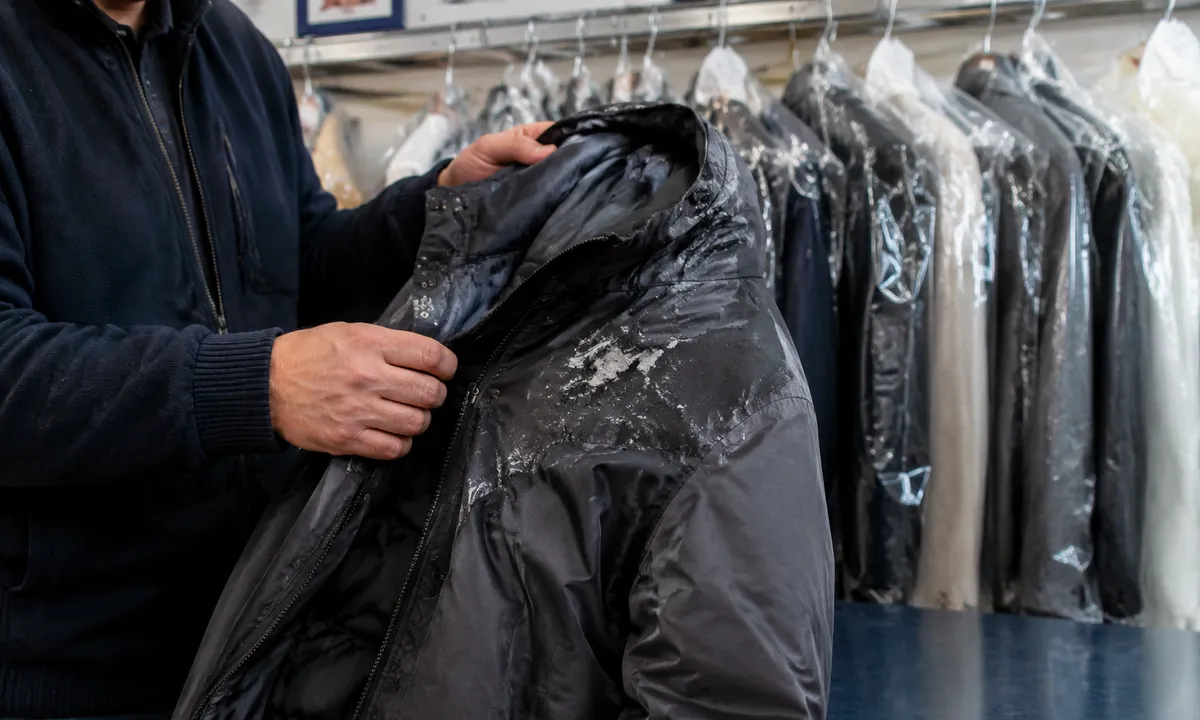
Dry cleaning a wool coat or a down parka every season feels like due diligence. It is, in fact, one of the most reliable ways to shorten the life of the garment. The care label says it is safe. The dry cleaner does it every day. And yet the specific chemistry at work inside that machine is doing something to technical fabrics and natural fibers that a simple laundering never would.
The problem is not that dry cleaning is a bad service. For certain garments, a silk blouse, a structured wool blazer, a heavily interlined suit jacket, it remains the correct choice. The problem is that outerwear occupies a different category of construction, and most people never learn the distinction before they hand over their coat.
What Perchloroethylene Actually Does
Most commercial dry cleaners still use perchloroethylene, a solvent known in the trade as perc. It is exceptionally good at dissolving oil-based stains, which is precisely why it became the industry standard. What it also does, with repeated exposure, is strip the durable water repellent (DWR) finish from the face fabric of any technical outerwear. That finish is not decorative. It is the reason a rain jacket beads water rather than absorbing it, and once it is compromised, the outer shell begins to wet out. A wet-out shell is heavier,colder, and dramatically less effective at managing body moisture during physical activity.
For down-filled garments the damage is more immediate. Perc is a fat solvent. Down clusters arecoated in natural oils that give them their loft, and those oils dissolve under prolonged solvent exposure. A freshly dry-cleaned down jacket may look fine coming off the rack. After a few sessions, the clusters have lost elasticity, the fill begins to clump, and the dead air pockets that provide warmth collapse. The jacket goes flat in a way that washing would never cause, and the flatness is permanent.
Wool outerwear fares somewhat better with perc but faces its own specific hazard: shrinkage and felting driven by heat and agitation during the finishing press, not the solvent itself. A wool overcoat that comes back slightly shorter and stiffer than it went in has been finished too aggressively, and that dimensional change is not reversible with steaming at home.
The Care Label Is Not a Cleaning Prescription
Care labels in the United States are written to the minimum standard of what a garment can survive, not what will serve it best over years of use. A label reading “Dry Clean Only” on a technical shell jacket often reflects the manufacturer’s liability concern more than a genuine material requirement. Many of those garments can be washed on a gentle cold cycle and tumbled dry on low with a clean tennis ball to re-loft the fill, and they come out better for it.
Conversely, some labels say “Dry Clean Only” on garments where it genuinely matters: anything with glued rather than sewn construction, garments with bonded interlining, and structured wool coats with taped seams that water would delaminate. The label alone does not tell a consumer which category they are holding.
The useful question to ask is what the garment is made of and how it is built. Technical fabrics with membrane laminates (Gore-Tex, eVent, and their equivalents) should almost never see a dry cleaner. Down-filled garments with sewn baffles are generally fine in a large-capacity front-loader with down-specific detergent. Structured wool coats with fused or glued interlinings genuinely do need dry cleaning, but they should be cleaned infrequently and by a cleaner who uses low heat finishing.
How Often Is Too Often
The cleaning frequency question matters more than most people realize. A down jacket dry-cleaned once at the end of a decade of hard use will survive. The same jacket dry-cleaned twice a season because the owner worries about odor will be a flat, ineffective shell within a few years. The solvent damage is cumulative. Each cycle strips a little more of the natural oil from the down, and the decline is gradual enough that wearers often attribute it to age rather than cleaning.
Spot treatment is almost always sufficient for outerwear that sees regular use. The collar, thecuffs, the zipper baffle: these are the areas that actually accumulate body soil. A damp cloth with a small amount of mild detergent handles most of it. A full clean, wet or dry, should be an annual event at most for a coat worn daily, and less frequent than that for one worn occasionally.
Professional wet cleaning, available at a growing number of specialty cleaners, uses water-based solvents and computer-controlled machines to handle garments that previously required perc. It is gentler on DWR finishes and causes no damage to down clusters. For anyone with a technical jacket they genuinely cannot machine wash at home (complex paneling, delicate face fabrics, very high fill power down that needs expert re-lofting), finding a wet cleaner is worth the extra search.
The Repair That Cleaning Makes Necessary
There is a particular irony in the relationship between dry cleaning and DWR. The solvent degrades the finish. The degraded finish causes the jacket to wet out in rain. The owner, noticing the jacket no longer repels water as it once did, brings it in for a thorough clean, assuming it must be dirty. The extra cleaning further degrades the finish. This cycle repeats until the owner buys a new jacket, concluding that the old one simply wore out.
DWR can be restored. A low-heat tumble dry after washing reactivates the finish to a significant degree by allowing the polymer chains to realign on the fiber surface. For more degraded coats, aftermarket DWR sprays and wash-in treatments can rebuild the finish. Neither of these options works particularly well on a coat that has been perc-cleaned repeatedly, because the substrate the finish needs to bond to has already been chemically altered. The treatment goes on, beads water for a season, and fails again quickly.
A coat that has been washed properly from the start, kept away from perc, and had its DWR refreshed every year or two will continue to perform almost indefinitely. The same coat, dry-cleaned every autumn, will need replacement in five to seven years regardless of how carefully it was otherwise stored or used.
The Specific Garments Worth Protecting
High-fill-power down is the category where the stakes are highest. A jacket filled with 800-fill or 900-fill goose down represents a real investment, and the performance difference between healthy clusters and degraded ones is immediately noticeable in cold weather. Protecting it from perc is simply part of owning it properly.
Three-layer hardshell jackets, the kind designed for sustained rain and wind, are expensive enough that their care deserves attention. The laminate that bonds the membrane to the face fabric can delaminate with repeated perc exposure and aggressive pressing. Once delamination begins, typically visible as bubbling or a crinkling texture under the surface, the jacket is functionally finished. No repair is practical. Machine washing on delicate with a liquid technical detergent, not a standard detergent that leaves residue blocking the membrane, is the correct maintenance here.
Insulated synthetic-fill jackets (Primaloft, Thinsulate, and similar) are among the most forgiving and can be machine washed and dried without concern. There is no natural oil to strip, no delicate cluster structure to damage. The instruction to dry clean them is almost always a liability hedge by the brand, not a technical requirement of the fill material.
A structured wool overcoat in a classic woven cloth, with no bonded layers and no technical finish, is genuinely the right candidate for dry cleaning. The argument here is not that dry cleaning is universally harmful. It is that most of the outerwear people routinely send to the dry cleaner would do better with a different approach, and the few garments that actually need it get swept up in a habit that the others should never have started.
What the Cleaner Probably Does Not Know About Your Jacket
A standard dry cleaner processes a high volume of garments across an enormous range of fabrics and constructions. The person behind the counter reads the care label, checks for obvious damage, and sends the coat through. They are not evaluating the specific membrane construction, the fill power, or the DWR chemistry. That knowledge is not their job. The burden of understanding what a garment is and what it needs falls entirely on the owner.
The trap, then, is a comfortable one. Drop the coat off, pick it up looking clean and pressed, and assume the process was appropriate because a professional handled it. The damage does not announce itself. The jacket does not come back visibly ruined. It comes back looking fine, wearing fine, and performing a little less well than it did before, in ways that are easy to attribute to normal aging. Season by season, the performance loss compounds. By the time the coat no longer keeps someone warm on a wet autumn walk the way it once did, the cleaning history is long forgotten, and the jacket goes to the donation pile. A coat that could have lasted fifteen years lasted eight. That is the full cost of the habit: not a dramatic ruined garment but a quietly shortened life, paid for one cleaning ticket at a time.