


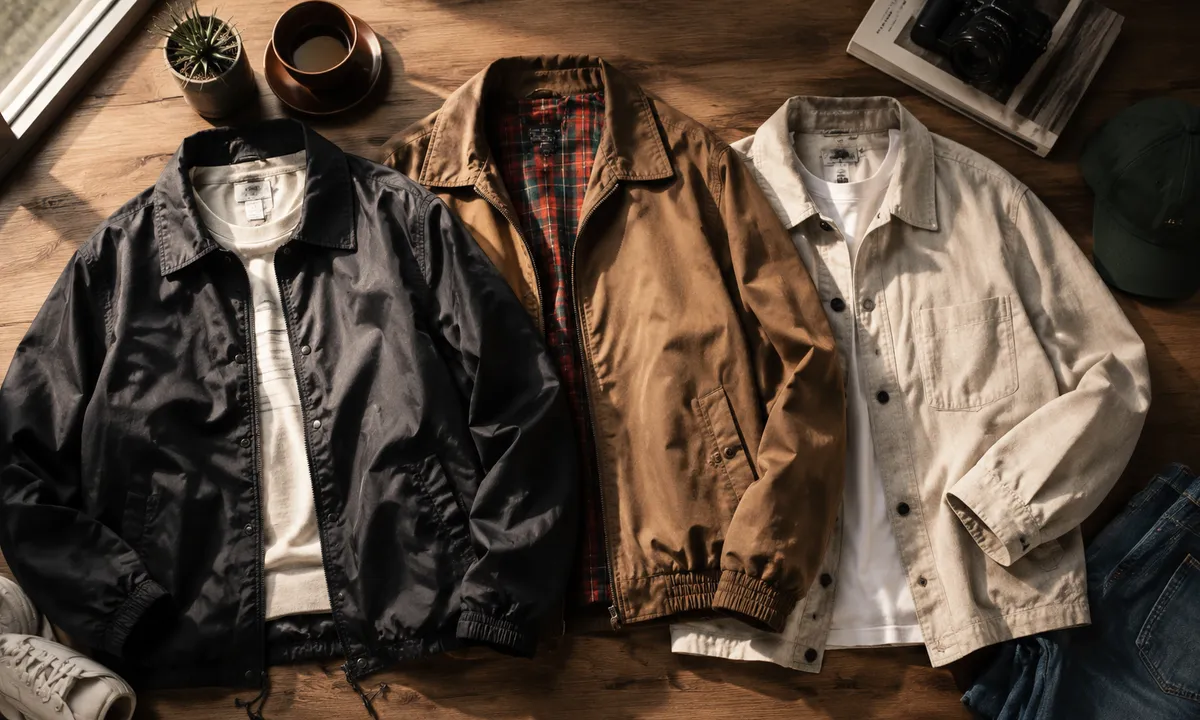
Casual jackets occupy an odd middle ground in menswear and womenswear alike: too relaxed for a blazer, too structured to be a sweatshirt, and precisely right for the kind of day that makes up most of real life. This season, that middle ground has gotten a lot more interesting.
Street style photographers in Copenhagen and Seoul have been catching the same silhouettes over and over: oversized coaches, lived-in harringtons, shirt jackets worn half-buttoned like a compromise between a layer and an afterthought. The looks are different in detail but unified by one quality. They all feel like someone got dressed with intention but without effort, which is harder to pull off than it sounds and impossible to fake with the wrong jacket.
The Coach Jacket’s Quiet Comeback
The coach jacket never really left. It just spent a few years being too available, showing up in fast-fashion bins and losing whatever edge it once carried. What’s happening now is a recalibration. The versions getting attention are heavier, cut longer through the body, and arriving in colors that sit somewhere between muted and saturated: dusty terracotta, washed olive, a particular shade of slate blue that photographs well in flat light. Some have chest patches or embroidered logos, but the cleaner ones are winning the longer argument.
The appeal is structural. A good coach jacket has a snap-button placket, ribbed cuffs and hem, and proportions that sit right over a hoodie or a heavyweight crewneck without pulling at the shoulders. It layers without bulk. That matters when the temperature is unpredictable and carrying a full outerwear piece feels like overcorrecting.
Brands like Carhartt WIP, Pop Trading Company, and several smaller Japanese labels have been producing versions that hold up to regular rotation. The fabric weight is important: too light and it collapses, too heavy and it stops being a casual layer. The sweet spot is around a midweight nylon or a polycotton twill that keeps its shape after a dozen washes.
Harringtons and What They Ask of the Rest of the Outfit
The harrington is a specific garment with a specific history. It showed up in British mod culture in the 1960s, got picked up by skinheads and rude boys, filtered through American prep, and arrived at the present day carrying traces of all of it. That accumulated context is part of the appeal. It communicates something without announcing it.
The silhouette is trim without being tight: a zip-through collar, a clean front, and a plaid or tartan lining that appears only when the jacket moves. The hem hits around the hip. Worn over a plain white T-shirt and straight-leg trousers, it does a lot of work quietly. Worn over a chunky knit, it pushes into different territory entirely, something more layered and deliberately considered.
What the harrington demands is that the rest of the outfit not fight it. It’s a jacket with a point of view, and throwing it over streetwear-heavy pieces tends to muddy both. The strongest combinations this season pair it with something simple underneath: a single-color tee, a plain Oxford, or a fine-gauge knit that doesn’t compete for attention.
The Shirt Jacket Worn as an Outermost Layer
Calling it a “shacket” would be accurate but annoying. Shirt jacket is the cleaner term, and the category has matured past the phase where every retailer was selling something with that word attached. The versions that are landing well now are the ones that commit to one direction: either they’re clearly a shirt scaled up into outerwear territory, or they’re clearly a jacket with shirting details. The hybrid ones that try to be both tend to succeed at neither.
Brushed flannel and heavyweight Oxford cloth are the materials doing the most interesting work. A flannel shirt jacket in a bold plaid worn over a plain long-sleeve base reads as intentional rather than haphazard. The collar stays open, the fit is relaxed but not shapeless, and the length lands somewhere between the hip and mid-thigh. It’s a practical piece: warm enough for a cool afternoon, light enough to fold over an arm when things heat up.
Japanese workwear labels have been the clearest influence here. The design logic in brands like Orslow and Engineered Garments (the latter more widely distributed) runs through the category: respect for utilitarian shapes, fabrics that age visibly and honestly, and a general skepticism toward anything that looks too finished or too precious.
Bomber Variations Worth Paying Attention To
The standard MA-1 silhouette has been done so many times that the default version registers as background noise. What’s happening at the edges of the category is more interesting. Longer bombers cut to the lower thigh, bombers in technical fabrics with visible seam tape, bombers in boiled wool or heavy bouclé that suggest outerwear without being fully weatherproof: these variations are pushing the form somewhere it hasn’t been in a few seasons.
The boiled wool bomber in particular has a texture that reads immediately in person and photographs as something denser and more architectural than a regular jacket. It doesn’t wrinkle, it doesn’t collapse, and it holds its shape across a full day of movement. The trade-off is that it doesn’t breathe especially well and it demands spot-cleaning rather than a machine wash. For some people that’s a dealbreaker. For others it’s the kind of specific inconvenience that comes with owning something genuinely good.
Color plays a larger role in this category than in others. A sage green bomber and a black bomber made from identical fabric and cut will read as completely different garments in use. The green one catches light differently, ages differently, and pulls different things from the rest of a wardrobe. This season, warm neutrals and earthy tones are doing more work than the cooler palette that dominated a few years ago.
Overshirts at the Heavier End of the Spectrum
There’s a category of garment that sits just below the shirt jacket in weight but above a regular shirt: the overshirt, worn open over a base layer or buttoned up as a standalone top. When the fabric is substantial enough, around 8 to 12 ounces per yard for denim or canvas versions, it functions as a casual jacket without requiring that label. The button front just happens to be more versatile than a zip.
Denim overshirts in a darker wash have been part of this conversation all season. The interesting move is proportion: a slightly oversized cut through the chest and shoulders, worn with a trim trouser, creates a balance that a slim denim shirt never quite achieves. It sits more deliberately on the body. It looks like a choice rather than a default.
Canvas versions in tan or brown carry a slightly more rugged quality. They reference workwear without cosplaying it, which is the right distance. The mistake is going too literal with the styling and ending up in a look that works better on a ranch than on a city block. Keep the rest of the outfit uncluttered and the overshirt does exactly what it should: adds structure, adds warmth, adds a specific tone to a look that might otherwise read as too simple.
Fabric and Fit as the Real Decision
Across all of these categories, the choices that separate a jacket that gets worn constantly from one that hangs in the closet come down to two things: how the fabric behaves over time and whether the fit is right without requiring adjustment. Both of these sound obvious and both are consistently underweighted when people are actually making purchases.
A jacket that fits well on a hanger often doesn’t move the same way when worn over a real body in motion. The sleeve length shifts, the back panel pulls, the collar gaps. Trying a jacket on with the kind of base layer it will actually be worn with is more revealing than any number of flat-lay photos or fit descriptions. Online retail has made this harder, which is part of why return rates in outerwear are so high.
Fabric behavior is slower to read but more consequential. Nylon that was crisp on day one can look cheap by month three. Heavyweight cotton ripstop that seemed stiff initially softens into something excellent. The surface texture of a boiled wool jacket will develop a slight patina with use that looks intentional rather than worn out. These changes are worth understanding before committing, which is an argument for handling a garment in person when the option exists.
How the Season’s Best Looks Are Actually Being Built
The strongest street style looks this season share a structural logic that isn’t about any single piece. The jacket sits at the outermost layer but it isn’t the focal point. The focal point, when there is one, tends to be something unexpected underneath: a wide-leg trouser in a textured fabric, a graphic tee from a label that isn’t widely recognized, footwear that adds weight and contrast at the bottom of the silhouette. The jacket is the frame, not the painting.
That framing role requires a jacket with enough presence to hold the composition together without dominating it. A too-loud jacket competes with everything. A too-quiet one disappears. The pieces that are working consistently are the ones with a single strong quality: an unusual color, a distinctive texture, a silhouette that sits slightly outside the familiar. One clear thing, executed well, worn over an outfit that knows what it’s doing.
The coaches and harringtons and shirt jackets gathering the most genuine attention right now share that quality. They’re not trying to do everything. They’re trying to do one specific thing and they’re doing it in the right weight, the right cut, and the right color for the moment. That’s a low bar in theory. In practice, it narrows the field considerably, which is exactly why finding the right one still feels like it means something.