


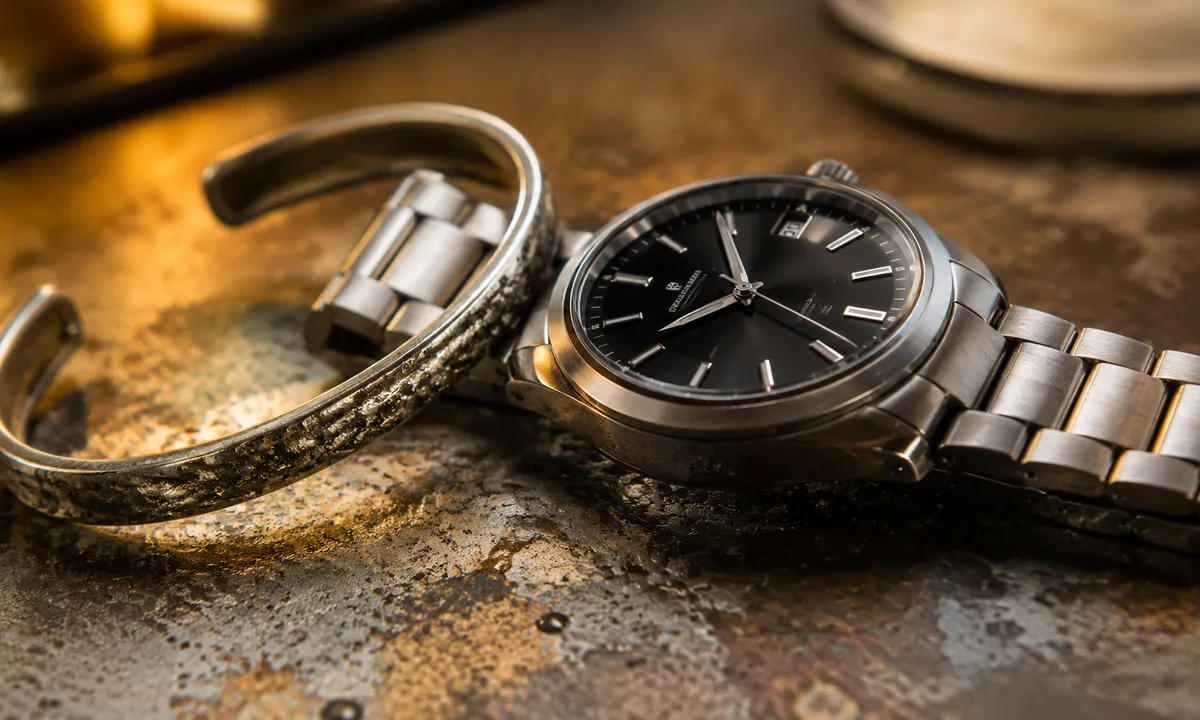
Galvanic corrosion is not a dramatic process. It does not happen overnight, and it does not announce itself. What it does is quietly eat through one of the two metals in contact, accelerated by sweat, rain, humidity, or any moisture that bridges the gap between dissimilar materials sitting pressed against each other on a wrist.
A stainless steel watch sits on one end of the electrochemical scale. Sterling silver, brass, copper, and many plated metals sit at different points. Whenever two different metals make sustained contact in the presence of an electrolyte, one of them becomes the anode and starts to corrode. Human sweat happens to be an excellent electrolyte.
The watch, almost always, survives better than the bracelet.
What Actually Happens at the Contact Point
When a brass or copper bracelet sits flush against a stainless steel case or bracelet, a small electrochemical cell forms wherever the two touch. The less noble metal, which in most pairings is the brass or the copper, begins to oxidize. The result is the familiar greenish residue on skin, the dull pitting on the bracelet’s inner surface, and sometimes a faint discoloration that transfers directly onto the wrist.
Sterling silver is slightly more complicated. On the standard galvanic series, silver sits fairly close to stainless steel, which means the reaction is slower. But sterling is only 92.5 percent silver; the remaining 7.5 percent is usually copper, and copper corrodes readily. Prolonged contact with stainless steel under sweaty conditions will tarnish sterling faster than wearing it alone ever would, particularly on the surfaces where the two metals press together.
Gold-plated bracelets behave differently still. The base metal underneath the plating, often brass or a zinc alloy, is what matters galvanically. Once the plating wears through at the contact point, which it will under friction and moisture, the base metal sits directly against the stainless steel. At that point the corrosion accelerates, and the plating loss accelerates with it. The two problems compound each other.
The Friction Problem Compounds the Chemistry
Galvanic corrosion is not the only mechanism at work. The physical contact between a bracelet and a watch adds constant micro-abrasion. Every small movement, a gesture, a shift of the wrist, a moment of typing, grinds the bracelet against the watch case or the watch bracelet. On a polished steel case, this produces fine scratches that are obvious in direct light. On a brushed case, it disrupts the directional finish, leaving circular marks that cannot be corrected without repolishing the entire surface.
Watch enthusiasts tend to be meticulous about finish preservation. Many would sooner scratch the crystal than the case. But the combination of abrasion and galvanic action at the contact point is particularly damaging because moisture concentrates there: it is trapped between the two surfaces, unable to evaporate, which keeps the electrochemical reaction running continuously rather than drying out and pausing between wearings.
Skin-side damage is often overlooked until it is already severe. The inner surfaces of both the bracelet and the watch case are harder to inspect casually, and so the pitting, the tarnish, and the finish disruption accumulate unnoticed. By the time someone turns a bracelet over and looks closely, the damage has usually been building for months.
Why Stainless Steel Watches Are Particularly Susceptible
The irony is that stainless steel’s reputation for durability encourages exactly the kind of carelessness that damages it. People layer metal on metal without thinking about it, because the watch feels solid and resilient. And in many ways it is: stainless steel cases shrug off drops, scratches from hard surfaces, and years of ordinary wear. Galvanic corrosion, though, works differently. It is a chemistry problem, and the alloy’s hardness offers no protection against it.
The grades of stainless steel used in watch cases, most commonly 316L and the increasingly popular 904L, both contain chromium, nickel, and in the case of 904L, a higher proportion of molybdenum. These alloys are chosen for their corrosion resistance in the presence of seawater and ordinary wear. Against a dissimilar metal sitting directly on their surface in a sustained electrolyte bath of sweat, their corrosion resistance helps them, but it does nothing to protect the other metal in the pair.
The watch case wins the galvanic competition. The bracelet loses it.
The Skin Under the Stack
Corrosion products are not inert. The green oxidation that forms on corroding copper or brass is primarily copper carbonate and copper hydroxide. When this material is trapped against skin for hours, some people develop localized reactions: redness, minor irritation, or that persistent green stain that will not wash off with soap. The stain is the least of the concerns. More prolonged exposure to corrosion byproducts under a stack of tight metal bracelets is simply not a situation that benefits anyone with sensitive skin.
Nickel is a separate issue worth keeping in mind. Many stainless steel alloys contain nickel, and nickel sensitization is the most common metal allergy in adults. If a bracelet’s metal is incompatible with the person wearing it, stacking it against a nickel-containing steel watch can increase the surface area in contact with potentially reactive metal. This is not a dramatic risk for most people, but for someone already sensitive to nickel, the combination is worth thinking about.
Bracelets That Sit Better on a Watch Wrist
The practical question is what to wear instead, because wearing nothing alongside a watch is not the point. The goal is choosing materials with compatible positions on the galvanic series.
Solid titanium bracelets pair well with stainless steel, sitting close enough on the galvanic scale to minimize the reaction. Ceramic, stone, and glass beads are essentially non-reactive and present no galvanic concern at all. Leather and fabric cords obviously sidestep the issue entirely. High-karat solid gold sits noble enough that the steel, not the gold, would theoretically be the anode, though the rate of reaction between the two is slow enough that it is rarely a practical problem with well-made pieces that do not trap moisture.
The common denominators in the problematic pairings are base metals used as filler or structure, thin platings over reactive alloys, and anything that traps moisture while sitting tight against a steel case. The bracelet that looks like gold but flexes slightly and feels light is almost certainly plated brass, and it will not survive prolonged contact with a stainless watch.
Distance and Positioning Make a Measurable Difference
When a bracelet wears loosely enough to hang away from the watch case, the contact time drops significantly. Sweat still accumulates on both surfaces, but it does not sit continuously bridging the gap between them. Some airflow reaches the contact zone. The electrochemical cell forms only when the two surfaces meet, which in a looser fit is intermittent rather than constant.
Positioning matters too. A bracelet worn on the same wrist as a watch does not have to sit directly against the case. Worn toward the hand, even a centimeter or two away from the lugs, it rarely contacts the watch at all except under specific wrist angles. This is the simplest behavioral fix, requiring no change of materials and no change of habit beyond paying attention to where the bracelet sits at the start of the day.
A clear silicone guard, the kind sometimes used between watch bracelets and cases during shipping, can function as a physical separator in everyday wear. It is not a beautiful solution, but for someone committed to a specific metal pairing that would otherwise be problematic, a thin non-reactive barrier that stops direct metal-to-metal contact also stops the electrochemical circuit cold. No contact, no electrolyte bridge, no reaction.
What a Corroded Bracelet Looks Like After Six Months
The inner curve of the bracelet is where the damage concentrates. On a brass piece, the surface there loses its finish first, going from smooth to slightly rough and pitted. The color shifts toward green-gray in the recesses. On a plated piece, small bare patches appear where the plating has worn through, and those patches expand faster than the original plating loss because the exposed base metal is corroding directly. On sterling silver, the tarnish on the contact side becomes a dark, almost black patina that polish will not fully remove because the oxidation has worked slightly into the surface.
Across the same period, the stainless steel watch will show fine scratches on the case where the bracelet pressed against it. On a polished surface this is clearly visible. The scratches follow the movement of the bracelet, so they tend to run in circular arcs across the lug area and the side of the case. They are not deep, but on a watch bought for its finish, they are permanent without professional repolishing.
Six months of daily stacking produces damage that many people would consider cosmetically significant on a bracelet worth a few hundred dollars. On a watch worth several thousand, the scratches alone justify taking the pairing seriously from the first day it is worn.