


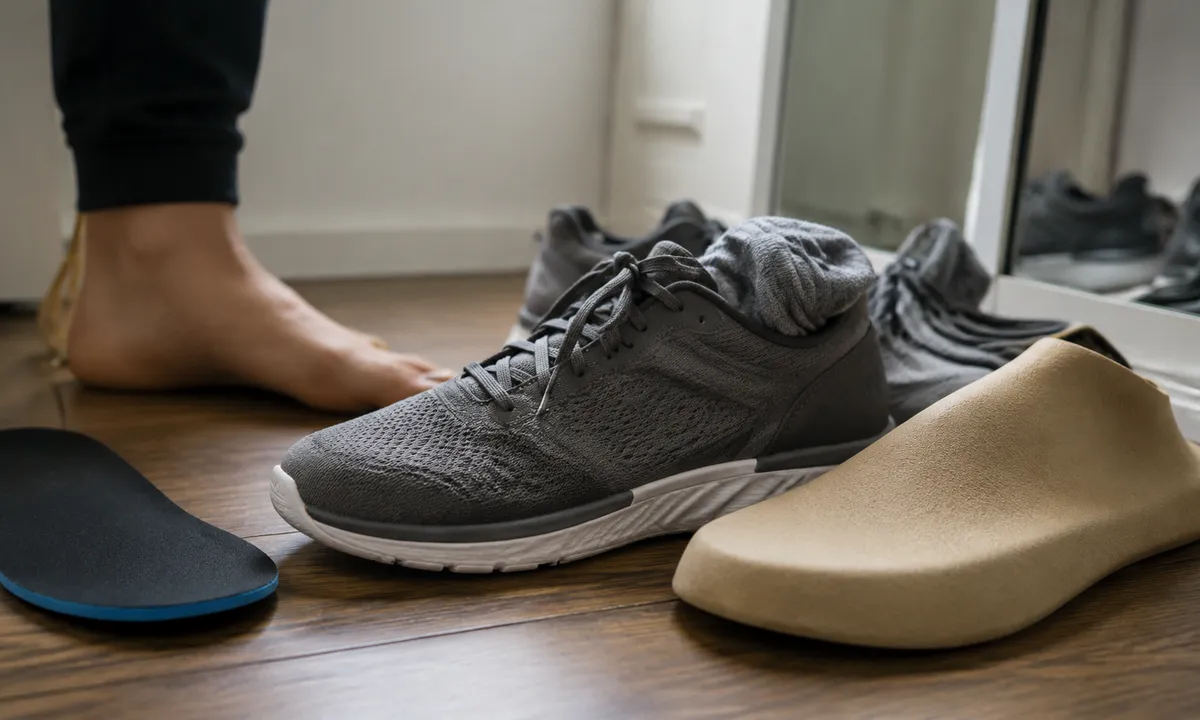
Sizing up is a folk remedy so old and so widely repeated that it has become indistinguishable from fact. Go to any shoe store, complain about a shoe that pinches at the toe, and someone will almost certainly tell you to try the next size up. Half a size, maybe a full one. It feels like practical advice. It also largely misunderstands what causes pinching in the first place.
A shoe pinches because the width, the shape, or the internal volume of the shoe does not match the foot inside it. Length is only one dimension. When someone moves up half a size to escape toe pinching, the shoe gets about 4 to 5 millimeters longer. The width increases slightly, yes, but not proportionally, and the shape of the toe box, whether it tapers sharply or has a rounded cap, does not change at all. If the toe box is too narrow, the longer shoe is still a narrow shoe with more dead space at the end.
That dead space is where the real problem starts.
What Actually Creates Pinching Pressure
The foot is not static. During a normal walking stride, the foot lengthens slightly under load and the toes spread. In a shoe that fits well in length but poorly in width, the toes are pressing outward into a wall of material with every step. That pressure is the pinch. It concentrates most often at the first and fifth metatarsal heads, the knuckles of the big toe and pinky toe, and at the lateral edge of the nail on the big toe, which is where ingrown toenails so often begin.
Sizing up does not widen those walls. The circumference of the toe box at the widest point, what shoemakers call the ball girth, is set by the last the shoe was built on. A half size change on the same last, from the same brand, in the same style, shifts the ball girth by only a few millimeters. For someone whose foot is genuinely wide, or whose foot simply does not match the geometry of that particular last, a half size larger is a cosmetic fix. The foot is still being compressed laterally. It just has more room to slide forward, which introduces its own set of problems.
The Heel Slip That Comes With It
When a shoe is too long, the heel counter loses contact with the back of the heel. The shoe rocks. Each step involves a small but real piston motion: the heel rises slightly inside the shoe before the foot pushes off. That friction is not trivial. It is the direct mechanical cause of blisters on the back of the heel, one of the most common shoe-related complaints there is. So a person who went up half a size to stop their toes from being squeezed now has a shoe that abrades the back of their foot instead. They traded one problem for another.
There is also a subtler consequence: once the foot begins slipping forward to fill the extra length, especially on downhill terrain or during long walks, the toes end up hitting the front of the shoe anyway. The toe box is still too narrow. Now the toes are also being jammed forward into it.
Width Sizing Exists and Is Worth Using
The standard width for a men’s shoe in the United States is D, and for a women’s shoe it is B or sometimes labeled M. These letters go in both directions. Narrower cuts are labeled C, B, and A. Wider cuts run through E, 2E (or EE), 3E, 4E, and beyond. A person with a genuinely wide forefoot who has been sizing up by half a step their entire life may simply have never worn a shoe in the right width. The difference between a D and a 2E in the same size is not a tiny adjustment. At a size 10, that difference at the ball of the foot can be close to 10 millimeters. That is real clearance, enough to stop lateral compression entirely.
The reason most people never explore this is that wide-width stock is harder to find in retail stores, and trying on a wider shoe requires asking for it explicitly. Many people do not know the option exists, or assume it is only relevant for people with medically unusual feet. It is not. A meaningful portion of the population has feet that fall outside the D-width standard, and they are the ones most likely to have been told, for decades, to just go up half a size.
Toe Box Shape Is a Different Problem Entirely
Width sizing solves lateral compression for a foot that is broadly wide. But some feet are not wide overall, they simply have a different toe geometry. The human foot tends toward a shape where the big toe is the longest, or where the second toe is slightly longer than the first, or where the toes spread fairly wide across the front even on a narrow heel. Dress shoes, fashion sneakers, and most pointed-toe styles are built on lasts that assume a foot tapers toward the front. On a foot that does not taper that way, no size adjustment makes that toe box comfortable. The shape is wrong.
The fix in that case is not a sizing correction at all. It is a different shoe. A rounded toe box, a square toe box, or a style built on a last that preserves more volume at the front will accommodate that foot. A cobbler can sometimes stretch the toe box of a leather shoe laterally, a targeted process that works on the specific area that is pinching rather than altering the length. Stretching a leather shoe with a ball-and-ring stretcher in the right spot, and leaving it overnight with a stretching spray, will often accomplish in one session what half a size change cannot accomplish at all.
When Shoes Need Breaking In and When They Do Not
Leather shoes do break in. The upper softens, the footbed compresses to the shape of the wearer’s foot, and a shoe that felt slightly stiff on day one often feels quite good after a few weeks of wear. Some amount of initial snugness in a new leather dress shoe is normal and expected. A shoemaker would say a shoe should feel like a firm handshake, present but not painful.
Synthetic materials do not break in the same way. A sneaker with a synthetic upper made mostly of mesh or engineered knit materials will not stretch and mold. What you feel on day one is essentially what you will feel on day one hundred. Buying that kind of shoe tight in the hope that it loosens up is almost never rewarded. It either fits or it does not, and if it pinches in the toe box, the answer is a wider style or a different last, not patience.
How to Actually Find the Right Fit
Feet should be measured standing up, not sitting. The foot spreads under body weight, and a measurement taken seated can be as much as a full size shorter than the loaded measurement. Many adults have not had their feet measured in years and are wearing the size they wore in their twenties, which is often not the size they wear now. Feet change shape across a lifetime. They tend to lengthen and widen with age as the ligaments relax and the arch lowers slightly. The number on the box from 1998 is not necessarily still accurate.
When trying on a shoe, there should be roughly a thumb’s width of space between the end of the longest toe and the front of the shoe. The widest part of the foot should sit at the widest part of the shoe’s interior, with no bunching or bulging of the upper. The heel should feel held, not clamped, with minimal independent movement. And the foot should be able to spread naturally across the toe box without any toe pressing into the edge of the material.
If those conditions require going up half a size in length to achieve, that is fine. The problem is using length as a substitute for width and shape, which is what most people are actually doing when they size up to fix a pinch. The pinch comes from somewhere specific. Length rarely has anything to do with it, and a shoe that is a little too long carries its own costs all the way to the back of the heel.