


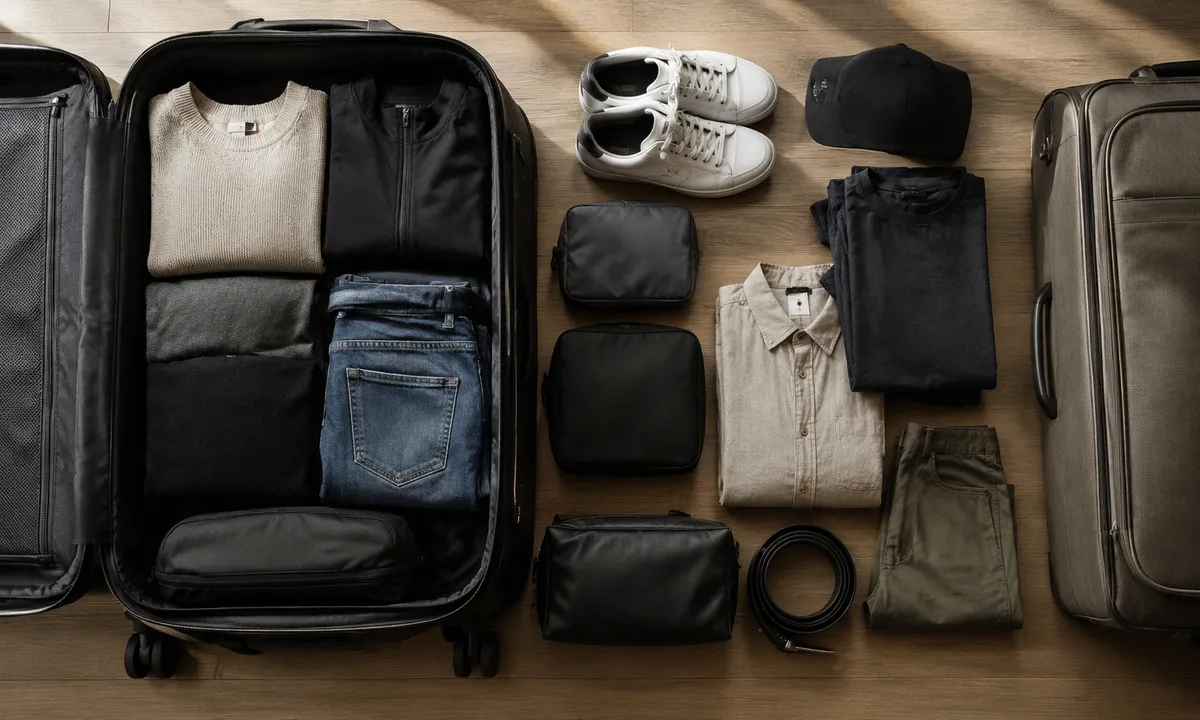
Pack light, walk far, repeat tomorrow. That is the essential contract of travel, and the shoes chosen to honor it matter more than most people admit until they are limping through an airport at hour six with a gate change and a heavy bag.
Sneakers and loafers both make a credible case for the travel day. They are both reasonable to wear on a plane, both acceptable in most restaurants, and both light enough to not wreck a baggage allowance. The question is what happens once the trip starts in earnest: the cobblestones, the museum marble, the ten-hour door-to-door stretch that nobody fully accounts for when they are packing.
What a Travel Day Actually Asks of a Shoe
A typical travel day involves more standing and walking than most people log in a regular week. Terminals, transit, check-in lines, and the aimless circling of a new neighborhood add up fast. The foot spreads slightly under sustained load, the ankle tires, and the back eventually registers a complaint. A shoe that felt fine at breakfast can feel punishing by late afternoon if it lacks the cushioning depth to absorb repetitive impact across hard surfaces.
This is where sneakers hold a structural advantage that is genuinely hard to argue away. A well-built athletic or lifestyle sneaker carries a midsole engineered specifically for shock absorption. Brands producing running and walking shoes spend considerable effort on foam compounds designed to compress and recover across thousands of footfalls. That engineering shows up as less fatigue in the heel and arch over long hours, not just comfort in the abstract but a measurable difference in how the legs feel after eight or ten miles of mixed terrain.
Loafers do not have that. A leather loafer, even a well-constructed one, typically sits on a sole that is flat or very lightly cushioned. The foot absorbs more of the shock directly. On a short urban stroll, a good loafer is perfectly adequate. On a full travel day across mixed surfaces, the deficiency compounds.
The Loafer’s Real Argument
None of that means the loafer loses the conversation entirely. Its argument is different: it is about versatility in the social and visual sense, the ability to walk from a daytime visit to a monument into an evening dinner without looking like someone who forgot to change.
Travel wardrobes are compressed by necessity. Packing one pair of shoes that covers airport to restaurant to gallery is not vanity, it is logistics. A dark suede or leather loafer in a neutral shade does that job in a way that most sneakers cannot. A white court sneaker might pull it off with the right trousers, but the category as a whole skews casual in a way that closes certain doors.
There is also the airport security point, minor but real. Loafers slip off without unlacing and slip back on without bending over. On a day with two connections, that matters a small but genuine amount.
Loafers in quality leather also age better than sneakers under hard travel conditions. Scuffs on leather can often be polished out or at least muted. The mesh upper of a running-style sneaker, once dinged, stays dinged. For trips where appearance has professional stakes, that durability differential is worth weighing.
Sneaker Design Has Eaten the Middle Ground
The sneaker category has, over the past decade or so, produced a type of shoe that complicates this comparison significantly. The dress sneaker, the leather trainer, the minimalist low-profile sneaker in cream or tan or black: these are athletic-construction shoes wearing business-casual clothing. They carry real cushioning, often with foam midsoles borrowed from performance running lines, inside an upper that reads as relatively polished from across a table.
Common Projects, On Running, New Balance’s more refined silhouettes, certain lines from Cole Haan that cross the two categories explicitly: these shoes are made precisely for people who have had this sneakers-versus-loafers debate and decided they want both answers at once. They are not cheap, but neither is replacing a pair of loafers that got destroyed by a European cobblestone week.
A shoe in this category can, with the right outfit, read as intentional and put-together rather than athletic, while still delivering the underfoot support that a full day of walking demands. It is the honest answer to the title question, even if it sidesteps the binary: the sneaker wins on comfort, the loafer wins on formality, and the best travel shoe for most people tends to be a sneaker designed to do both.
Fit, Break-In, and the One Rule That Overrides Everything
Whichever direction the choice goes, there is one consideration that outranks all others: never travel in new shoes. This sounds obvious and gets ignored constantly. A shoe that fits perfectly in a store can develop a pressure point at mile four, a place where the upper rubs the little toe or the back edge digs into the Achilles. On a travel day, there is no going home to change.
Leather loafers in particular need time. Quality leather is stiff when new and softens to the specific shape of the foot over several wearings. A loafer worn three or four times on normal days will feel entirely different from the same loafer on its first outing. A broken-in loafer in good leather can be genuinely comfortable for a full travel day in a way that a brand-new pair simply will not be.
The same applies to sneakers. A running shoe with a roomy toebox that has conformed slightly to the foot over a few weeks of wear is a different object from the same shoe taken straight from a box. Break-in matters, and that means the best travel shoe is always the one that has already been lived in.
Terrain Changes the Verdict
Paris, Rome, and Lisbon reward sneakers. The uneven stone paving in those cities is genuinely treacherous in leather-soled loafers, which offer minimal grip and no forgiveness when a toe catches a raised edge. The visual romance of the cobblestone street does not extend to the physical experience of walking on it in a flat-soled slip-on for six hours.
Cities built on relatively flat, smooth ground, or trips centered on indoor experiences, shift the balance. A day of gallery visits, business meetings, and nice meals in a city with good transit puts the loafer on more defensible footing. The comfort deficit is smaller, the visual upside is larger, and the social context rewards the choice.
The itinerary is part of the answer. Someone flying into a European capital for four days of walking and exploring is making a different calculation than someone spending two days on a short business trip with dinner reservations. Both might sensibly pack different shoes.
When the Bag Has Room for Both
The cleanest resolution to this debate is also the most practical one most travelers arrive at eventually: pack one pair of each, where the bag allows it. A versatile sneaker for walking days and a loafer for evenings covers the full range without compromise on either end. Loafers pack flat and do not take much room in a carry-on. A low-profile sneaker takes more space but earns it back across the physical demands of active travel days.
The traveler who packs both still has to decide which one gets worn through the airport, which is the longest and most physically demanding single stretch of the trip. Sneakers win that call, almost without exception, for the simple reason that airports are engineered for speed and efficiency, not for the kind of strolling that lets a flat sole feel adequate. The cushioning does its job most visibly when there is a long walk between gates, a heavy bag on one shoulder, and no particular reason to look formal.
The loafer goes in the bag. It comes out when the day calls for it. That division of labor is not a compromise; it is a sensible assignment of tools to contexts, which is how most good packing decisions work.