


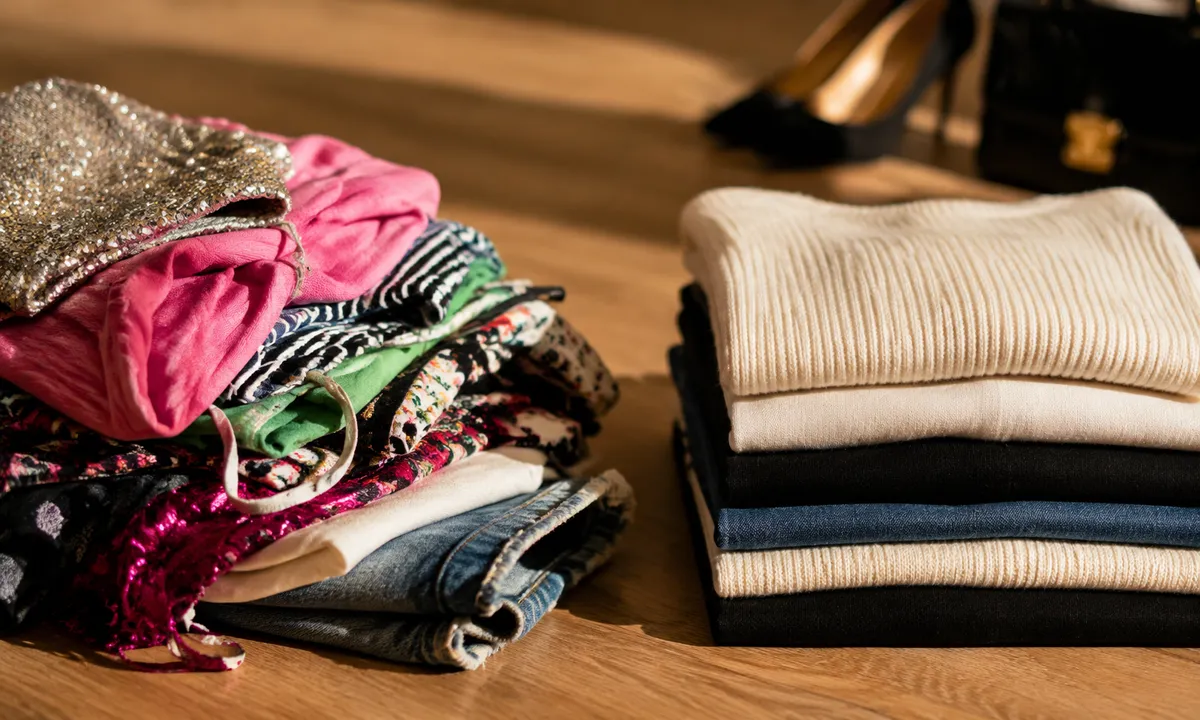
Fashion has a clock built into it, and the clock runs fast. A silhouette that felt essential in February can look exhausted by September, replaced by something that will itself look exhausted by the following spring. People who have been buying clothes for a while know this rhythm, and at some point many of them stop and ask a practical question: is chasing that clock actually worth it?
Capsule wardrobes have been around as an idea since at least the 1970s, when a British boutique owner named Susie Faux used the term to describe a tight, considered set of pieces that worked together year-round. The logic was plain then and remains plain now: buy less, choose carefully, and wear everything. Trends, by contrast, are the engine of the fashion industry. They are not a bug in the system. They are the system.
Both approaches cost real money and real closet space. Neither is neutral. The question is which one is actually serving the person doing the buying.
How Trend-Chasing Costs More Than It Appears
The individual price tags on trend pieces tend to look small. A fifteen-dollar top, a twenty-five-dollar pair of wide-leg trousers, a thirty-dollar clog that turns up everywhere for about four months. The low price is part of the logic: if it’s cheap, the risk of buying it feels low.
But the math adds up differently over a year. Someone buying even a modest number of trend pieces each season can find themselves having spent several hundred dollars on clothes they no longer reach for, all sitting in a drawer or donated in a garbage bag to a thrift store. The price per wear, which is the only number that actually matters when evaluating clothing value, gets ugly fast for things worn twice before they read as dated.
There’s also the cognitive cost, which doesn’t appear on any receipt. Trend-buying requires a kind of constant attention: reading what’s emerging, deciding what to act on, keeping track of what pairs with what, replacing something that now looks off. That’s a lot of mental labor for a wardrobe.
What a Capsule Actually Demands
The capsule ideal is easier to describe than to build. The standard version involves somewhere between thirty and fifty pieces: a few neutral trousers, a handful of shirts in clean colors, quality shoes that work across occasions, a coat or two that hold up over multiple winters. Everything mixes, nothing clashes, and the whole thing fits in a single section of a standard closet.
In practice, building a genuine capsule requires spending more per item upfront. A well-constructed wool blazer in a classic cut might cost significantly more than a trendy version from a fast-fashion retailer. The lining won’t separate in eighteen months. The shoulders won’t lose their shape. The color, a navy or a camel or a deep charcoal, won’t look tied to a specific year. That’s what you’re actually paying for: time.
The harder demand, though, is discipline. A true capsule requires the wearer to resist things they like. And fashion produces genuinely beautiful things, season after season. Staying out of the tent-sale rack when everything in it is appealing is a real act of will, not a simple default. The people who maintain functional capsules usually have a clear mental picture of what they already own and a near-physical aversion to anything that duplicates or disrupts it. That clarity is the actual skill.
The Persistent Appeal of Something New
Reducing trend-buying to a financial mistake misses something important. Clothes carry mood. A new piece bought in October, something with a deep rust color and an unexpected collar detail, can shift how a person moves through a dull Tuesday. That’s not nothing. Fashion has always worked partly as a form of permission, permission to be different this month from who you were last month.
And trends are not arbitrary. They move through culture because they reflect something, a collective shift in how people feel, what they’re reacting to, what aesthetic they’re collectively reaching for. The chunky-soled shoes that showed up a few years ago weren’t random; they connected to a larger moment of loudness and irony in design. The subsequent return of slim silhouettes wasn’t random either. Something cultural shifts, and fashion follows or leads it.
Opting entirely out of that has a cost too. A wardrobe built entirely from timeless classics can start to feel like a uniform. Fine for some people. Deadening for others.
Where the Two Approaches Actually Intersect
The framing of this as a binary choice, capsule or trends, is where most discussions of it go wrong. The capsule gives a person a foundation with no expiration date. Trends can still enter the picture at the edges, in specific and deliberate ways.
A scarf, a belt, a bag in a current color, a single statement piece worn against a backdrop of neutrals. These are low-stakes entries into trend territory. They cost less. They’re easier to remove when the moment passes. They let someone participate in the cultural conversation that fashion is having without restructuring an entire wardrobe around it.
The practical version of this looks like a closet where eighty percent of the pieces are slow, chosen for quality and versatility, and twenty percent are faster, lower-commitment things that register a current sensibility. The exact ratio matters less than having one. The mistake is having no ratio at all and just buying whatever feels good in the moment, which is how a person ends up with a closet full of things that don’t go together and nothing that actually fits their daily life.
What Body and Life Stage Have to Do with It
The capsule argument is strongest when a person’s body and life circumstances are stable. Build a collection of well-fitting classics and wear them for years: this only works if the pieces still fit in three years and still suit the context in which they’re being worn.
For someone in a period of transition, whether that’s a job change, a move, a shift in body size, a major life rearrangement, the capsule can be a frustrating aspiration. Spending significantly on a coat sized for a body that may change, or on workwear for an office job that doesn’t exist yet, is a different kind of financial mistake. In transitional periods, more flexibility and lower investment per item often makes more practical sense, even if it runs against capsule philosophy.
Age plays into this too, but not in the direction most style advice assumes. Younger people are often told to experiment freely and figure out their taste, which is reasonable, but that phase has a cost that isn’t always acknowledged. Figuring out what you actually like requires buying some things that don’t work, wearing them, and learning from them. The capsule is often an end point reached after that education, not a starting point for it.
The Pieces That Hold and the Ones That Don’t
Certain categories hold up under capsule logic almost unconditionally. A well-cut coat in a neutral color. A dark pair of straight-leg trousers in a quality fabric. Plain white and blue shirts without decorative details. Leather shoes in black or tan with a clean, unfussy silhouette. These genuinely do last, in the sense that they keep fitting into a life rather than working against it.
Other categories do not behave the same way. Knitwear is notoriously difficult: even expensive sweaters pill and stretch, and a stretched-out cashmere cardigan bought five years ago will look tired even if the style remains perfectly valid. Shoes wear down. Denim fades unevenly. Bags develop scuffs and broken hardware. The capsule fantasy sometimes smoothes over the reality that clothes are physical objects that degrade, and replacing capsule pieces costs the same as replacing anything else.
The strongest version of capsule thinking accounts for this: not just buying slow but replacing slow, maintaining pieces rather than replacing them, resoling shoes rather than discarding them, getting a coat relined rather than buying a new one. That level of engagement with clothes is real, but it’s work, and it requires access to good alterations and repair services that are unevenly distributed geographically and economically.
A Wardrobe That Answers to Its Owner
The honest answer to whether someone should chase trends or build a capsule is that the capsule produces better outcomes for most people in most stable situations, but the discipline it requires is real, the upfront cost is real, and the life circumstances that make it work best don’t apply to everyone at every point.
The version of this that actually holds up over time is a closet built with intention: knowing what you own, knowing what you reach for, and buying new things against that knowledge rather than around it. A person who does that might have a capsule, or something close to one, or a deliberately curated mix of slow and fast pieces. What they won’t have is a heap of clothes they forget they bought.
The real enemy isn’t trends. It’s buying without attention. Someone who tracks a specific trend, acquires one piece that represents it at a price they’ve thought about, and wears it until it genuinely no longer works, that person is doing something more rational than someone who fills a cart with “timeless” pieces on impulse because a sale made them feel like they were being responsible. The capsule is a framework, and frameworks only help people who are actually paying attention. The velvet blazer in the back of the closet with the original tags still on it doesn’t care whether it was supposed to be a classic.