


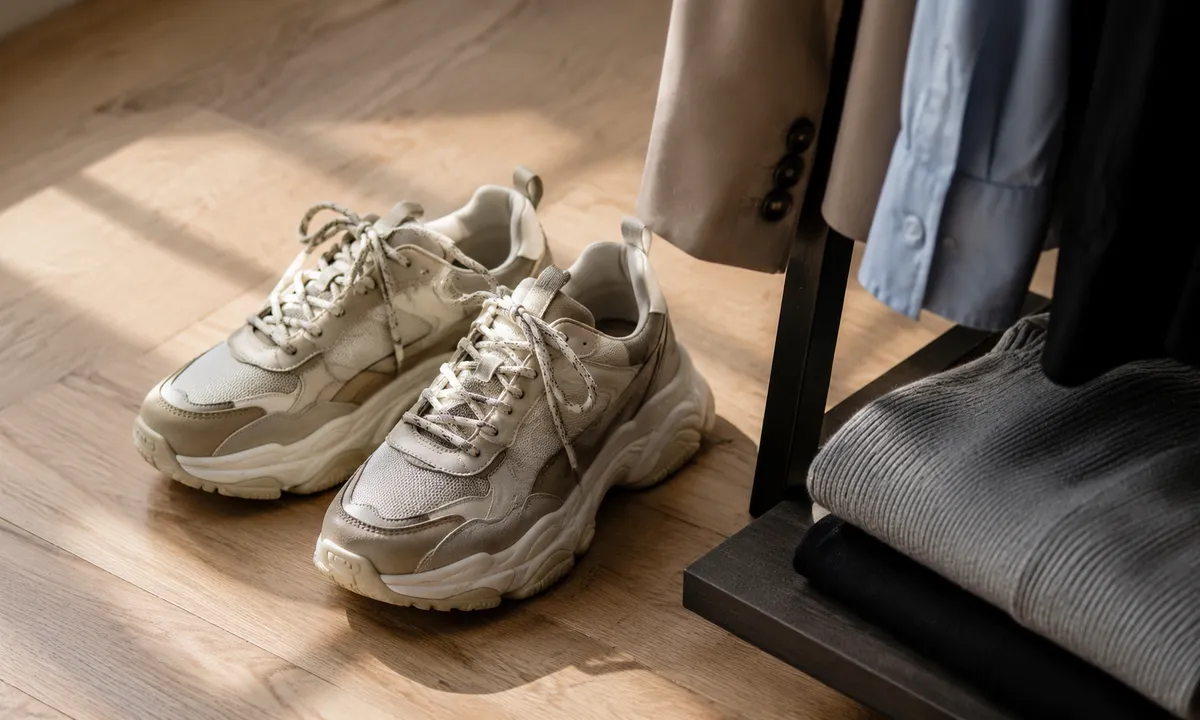
Chunky sneakers have carried a reputation since they first crawled out of the late nineties: loud, deliberate, belonging to a particular kind of person who shops at specific stores and owns at least one bomber jacket. That reputation stuck. And it made a real mess of how people dress.
The mess is this: an entire category of shoe gets locked into one aesthetic box, and anyone who does not identify with that box quietly rules the shoe out before even trying it on. Office workers, women who wear midi skirts and blazers, men who dress in the old continental tradition of slim trousers and a tucked shirt, anyone who describes their style as “clean” or “classic” or “French” has probably talked themselves out of a chunky sneaker at some point based on a piece of received wisdom that nobody ever stopped to examine.
That received wisdom is wrong.
Where the Streetwear Association Came From
The chunky sneaker’s modern incarnation has clear roots. The Balenciaga Triple S landed in 2017 with a sole stack that looked engineered for a different gravity than the one humans live under. It was deliberately ugly in the way that high fashion sometimes has to be ugly to announce itself. The brands that followed, from Buffalo to New Balance reissues to the Nike Air Monarch being adopted by people who were very much not dads, all got grouped together under a single cultural flag: streetwear, hype, drop culture, the world of Supreme and limited releases and standing in line at 5 a.m.
Streetwear did a lot with the chunky sneaker. It also got all the credit for it, and that crowded out the longer history. Platform sneakers existed in the seventies disco era. Chunky athletic shoes have cycled through fashion roughly every decade since then. The streetwear moment from 2017 onward was the loudest chapter, but it was not the only one, and loud does not mean exclusive.
What the Sole Stack Actually Does for a Silhouette
Here is the part that gets overlooked every time this conversation happens: a chunky sole functions the same way a block heel does. It adds height evenly across the foot, keeps the wearer’s posture upright, and creates a visible visual weight at the bottom of the outfit that grounds the whole thing.
Stylist logic has understood this for a long time when it comes to boots. A Chelsea boot with a stacked leather sole, a lug-sole loafer, a platform Mary Jane, all of these are considered safe, even elegant, in wardrobes that would describe themselves as anything but streetwear. The only reason the chunky sneaker gets quarantined from that conversation is the material: rubber and foam instead of leather and stacked heel. Strip away the material prejudice and the structural function is identical.
A wide-leg trouser with a flat shoe often loses its shape at the hem, pooling instead of breaking cleanly. The same trouser over a shoe with a substantial sole suddenly reads as intentional. The proportion works. This is not a trick specific to any aesthetic. It is geometry.
The Combinations That Actually Prove It
Consider a New Balance 990 in grey suede worn with a camel wool coat, straight dark-wash jeans, and a crew-neck sweater. That is not a streetwear outfit. It is the wardrobe of a person who reads on the weekend and has strong opinions about good coffee. The shoe earns its place not by being tamed or ironic but by doing exactly what a casual shoe should do, carrying the bottom of a relaxed-but-considered outfit without asking for attention.
A pleated midi skirt, a fitted turtleneck, and a New Balance 530 in silver and white. That combination appeared on Parisian streets years before it appeared on any streetwear account. The chunky sole under something feminine and structured creates the kind of tension that makes an outfit interesting rather than merely correct.
Even tailoring works, which should settle the argument by itself. A single-breasted suit in a soft fabric, slightly oversized in the shoulder, worn with a white chunky sneaker rather than a dress shoe, reads as fashion-forward in a way that a loafer in the same context does not. This has been the move in menswear editorial for the better part of a decade. The tailoring is not being streetwear-ified. The tailoring is being relaxed, and a well-chosen chunky sneaker is one of the cleaner ways to do that.
Color and Profile: The Two Levers That Change Everything
The specific shoe matters more than the category. A Triple S in a maximalist multicolor colorway with visible branding on every panel genuinely does lean streetwear. A New Balance 993 in a muted grey and tan is a different object even if it sits in the same shoe family. Both are chunky sneakers. They do not dress the same way.
Neutral colorways open the shoe up to more of the wardrobe. Grey, white, beige, navy, black, these are not limiting choices, they are the ones that let the rest of the outfit do its work without the shoe interrupting. The sole can be thick, the silhouette can be heavy, and the shoe can still recede into the outfit rather than announcing itself. Branding placement works similarly: a shoe with a single tonal logo mark or no visible branding at all carries differently than one that has the brand name across the heel, the tongue, and both sides of the midsole.
Profile is the other variable. Some chunky sneakers are wide as well as tall, with a midsole that extends visibly past the upper on all sides. Others are tall in the sole but relatively trim in the toe box and upper. The trimmer profile reads more versatile across different dressing contexts, even at the same sole height, because it does not interrupt the line of a slim trouser or a narrow skirt the way a laterally wide shoe sometimes can.
The Comfort Argument Nobody Wants to Make Directly
Comfort is treated as a guilty admission in fashion writing, as if acknowledging that a shoe feels good is somehow a concession to practicality at the expense of seriousness. This is a tiresome position.
A well-cushioned midsole with real stack height tends to be easier to walk in for extended distances than a thin-soled minimalist sneaker or a hard leather dress shoe on uneven pavement. People who stand at work, people who commute through cities on foot, people who have spent a decade in shoes that looked good and felt bad know this already. The chunky sneaker arrived at a moment when fashion started acknowledging that wearability and style are not in opposition, and a lot of its staying power comes from the fact that the shoes genuinely feel like something.
That is not a streetwear value. That is a human one.
The People Already Wearing Them Outside the Box
The most persuasive evidence is just what is already happening. Women in their forties and fifties who dress in clean, investment-piece wardrobes have been wearing New Balance and Hoka and On Running shoes under their clothes for years, sometimes because their feet demanded it, sometimes because they prefer the proportion, and increasingly because the shoe market gave them options that look considered rather than clinical. The demographic buying the New Balance 990v 5 is broad and largely not streetwear-identified.
In Europe, particularly in cities with strong traditions of understated dressing, the chunky sneaker under tailored or classic clothes has been normalized without much fanfare. The cultural conversation in the United States has been slower to catch up, partly because American style media spent several years covering chunky sneakers almost exclusively through the lens of hype and drops and collaborations, which framed the shoe as belonging to that world rather than to the larger population of people who simply wanted a comfortable, good-looking shoe.
What “Streetwear Only” Actually Costs
Locking a shoe into one aesthetic category has real consequences. It means people buy shoes that fit their aesthetic identity rather than their actual outfit or their actual feet. It means a woman who has been wearing thin-soled ballet flats all day through a city is walking on hard pavement in something chosen partly because it felt culturally safer, not because it worked better. It means a man in a well-cut suit owns five different dress shoes but reflexively avoids the one thing that might make the outfit more interesting and his commute less punishing, because he absorbed a piece of unexamined conventional wisdom about who chunky sneakers are for.
Fashion categories exist to be useful, and this one stopped being useful some time ago. The chunky sneaker earned a specific association in a specific moment. That moment is not the whole story of the shoe, and anyone still organizing their wardrobe around it is operating on information that expired a few years back. The shoe is neutral equipment now, like a white Oxford shirt or a clean leather belt. Where it belongs depends entirely on how it is used.