


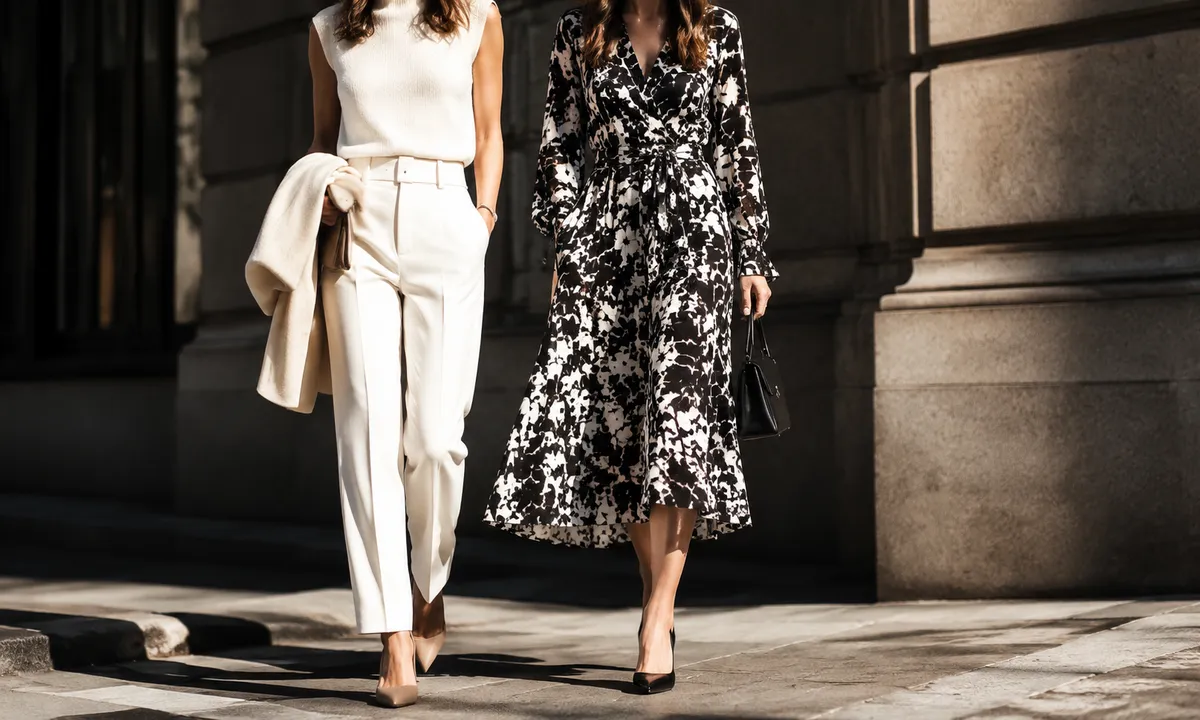
Petite dressing has accumulated a great deal of received wisdom over the decades, most of it arriving in the form of blunt commandments. Keep it simple. Avoid bold prints. Stick to one colour head to toe. The rules exist because the logic behind them is partly sound, but partly they have calcified into received wisdom that stops women experimenting with their own wardrobes.
The real picture is more interesting than any rulebook allows.
What Monochrome Actually Does to the Eye
A single unbroken colour running from neckline to ankle does something measurable: it removes the horizontal line that appears wherever two different colours meet. That line is significant because the eye reads it as a stopping point, and stopping points, in visual terms, shorten whatever they interrupt. A navy top with cream trousers creates a boundary at the waist. A navy outfit, top to toe, does not. The silhouette reads as one continuous vertical, and that continuity is what lends the impression of height.
This is why the monochrome case is so compelling for petite frames. It is not about camouflage or sleight of hand. It is about removing visual noise that interrupts a clean line. A petite woman in a well-cut camel coat worn over matching camel trousers looks genuinely taller not because she is hiding anything but because nothing is cutting her in half.
Deep tones work especially well here. Navy, forest green, burgundy and charcoal all carry enough visual weight to anchor an outfit without the starkness of black, which, while effective, can drain colour from a fair complexion when worn in large quantities near the face. Monochrome does not mean defaulting to black every time.
The Texture Variable That Most Guides Ignore
Monochrome dressing becomes more complex, and considerably more interesting, once texture enters the equation. Two garments in the same colour but different fabrics, a silk blouse tucked into wide-leg wool trousers, for example, or a ribbed knit over crepe trousers, create subtle contrast through surface rather than through hue. The colour register stays unified, but the outfit avoids the flatness that a single unvarying fabric can produce.
Petite dressing guides rarely discuss this because they tend to treat texture as a subset of pattern, which it is not. A chunky boucle jacket and slim tailored trousers in the same dusty pink are not a patterned outfit. The tonal unity is still doing its lengthening work. The textural difference is doing something else: it is giving the eye visual information to enjoy without interrupting the vertical line. Understanding that distinction opens up the monochrome option considerably.
Patterns: Scale Is Everything, Not the Pattern Itself
The standard advice runs something like this: small frames should wear small prints. It sounds intuitive. It is also, in practice, often wrong.
Small, dense prints, a tiny ditsy floral, a miniature houndstooth, a tight grid, create a texture-like effect at a distance. The eye cannot resolve the individual motifs and instead reads the fabric as a slightly busy solid. On a small frame, this tends to add visual bulk without adding interest. The pattern is doing the worst possible job: adding noise without adding clarity.
Larger-scale patterns, used carefully, can actually work well on petite frames because the motifs have room to read properly. A bold botanical print on a midi dress, or a generous geometric on a blouse, gives the eye something to follow. When those patterns run vertically, the effect is even better. A wide, vertical stripe, certainly nothing narrower than about two centimetres, pulls the gaze upward in a way that a cramped horizontal cannot. The key is that the pattern needs a direction or a clear structure. Patterns that drift in all directions simultaneously, irregular blotches, chaotic abstract prints, have no dominant line and therefore add width as readily as they add anything else.
Horizontal stripes deserve their reputation only when they are wide and block-like. Narrow, close-set horizontal stripes are genuinely problematic on a petite frame because the eye reads them as rungs, and rungs measure width. But a bold wide-stripe pattern on a shirt dress, say three or four inches per stripe, behaves more like a colour block and can work well if the overall silhouette is controlled.
Placement Matters as Much as Pattern Choice
A patterned top with plain trousers is the most common way petite women approach print, and it is also often the approach that shortens the silhouette most. The pattern sits on the upper half, the colour change sits at the waist, and the eye gets two pieces of information simultaneously: here is a print, and here is a horizontal dividing line. Both work against height.
A patterned dress, or a patterned skirt worn with a tonal top, tends to work better because it eliminates at least one of those problems. The full-length print of a midi or maxi dress runs continuously down the body, and if the print has any vertical element at all, the whole thing becomes a length-creating device. A column-style dress in a vertical stripe or a narrow floral with upward movement can add considerable visual length on a frame of 5 feet 2 inches or under.
Patterned trousers are underused and often overlooked in petite styling. A slim, straight-leg trouser in a clean vertical stripe, paired with a tucked-in, tonal top, keeps the horizontal break at the waist minimal while running pattern down the longest part of the body. The effect is the same logic as a monochrome outfit applied through pattern rather than through plain colour.
When Monochrome Fails
Monochrome is not a universal solution, and treating it like one produces outcomes that undermine the principle entirely. An all-over loose silhouette in a single colour is not flattering simply because it is tonal. Oversized monochrome dressing on a petite frame reads as volume, and volume reads as mass. The single-colour rule works only when the silhouette itself has some structure, a defined shoulder, a nipped waist, a clean hemline, because those structural details are doing half the work that the colour is doing.
There is also the problem of flatness. A petite woman in an unbroken beige outfit, same tone top to bottom, same fabric throughout, no contrast at the shoe, no tonal variation anywhere, can disappear into the clothes. The eye has nothing to follow. Good monochrome dressing uses tonal variation (a slightly lighter or darker shoe, a deeper bag, a matte top with a glossier trouser) to give the outfit dimension without introducing the colour break that disrupts vertical length.
The Honest Case for Wearing Whatever Pattern You Like
All of the above is real, and all of it is also contingent. Styling principles are not physics. The reason to understand how patterns and monochrome interact with a petite frame is not to construct a list of permissions and prohibitions, but to make deliberate choices rather than accidentally undermining what a garment could do for you.
A small woman who loves a wide floral print and understands that it will broaden her silhouette somewhat is making a different kind of decision from one who buys it without noticing that effect at all. Knowing what a pattern does gives agency. The rules only become counterproductive when they are applied without thought, or when a woman internalises them so thoroughly that she never experiments beyond navy and camel.
The pieces that actually look extraordinary on petite frames are rarely the safest choices. They tend to be something bolder that someone understood well enough to make work: a painterly abstract print on a long, columnar dress worn with barely-there footwear, all in the same terracotta family. A large-scale check in black and ivory on a single-breasted blazer over slim black trousers, where the check creates structure rather than chaos. The common thread is not caution. It is understanding what the eye follows and choosing accordingly.
Where Footwear Changes the Calculation
The boundary between trouser hem and shoe is often where both monochrome and patterned outfits either succeed or collapse for petite frames, and it receives far less attention than it warrants. A monochrome outfit in dark navy, completed with a white trainer, introduces a colour-break at the ankle, the narrowest, most visible point of the whole line. The white trainer is not wrong, but it is doing something specific: it is ending the vertical abruptly, at floor level, in a way that shortens everything above it.
Keeping the shoe in the same colour family as the hem of the trouser or skirt, a tan leather mule with an ecru trouser, a dark pump with a navy skirt, extends the vertical line all the way to the ground. On a petite frame, that few centimetres of extension is not trivial. It is often the difference between an outfit that reads as pulled-together and long-lined, and one that seems slightly truncated without the wearer being quite sure why.