


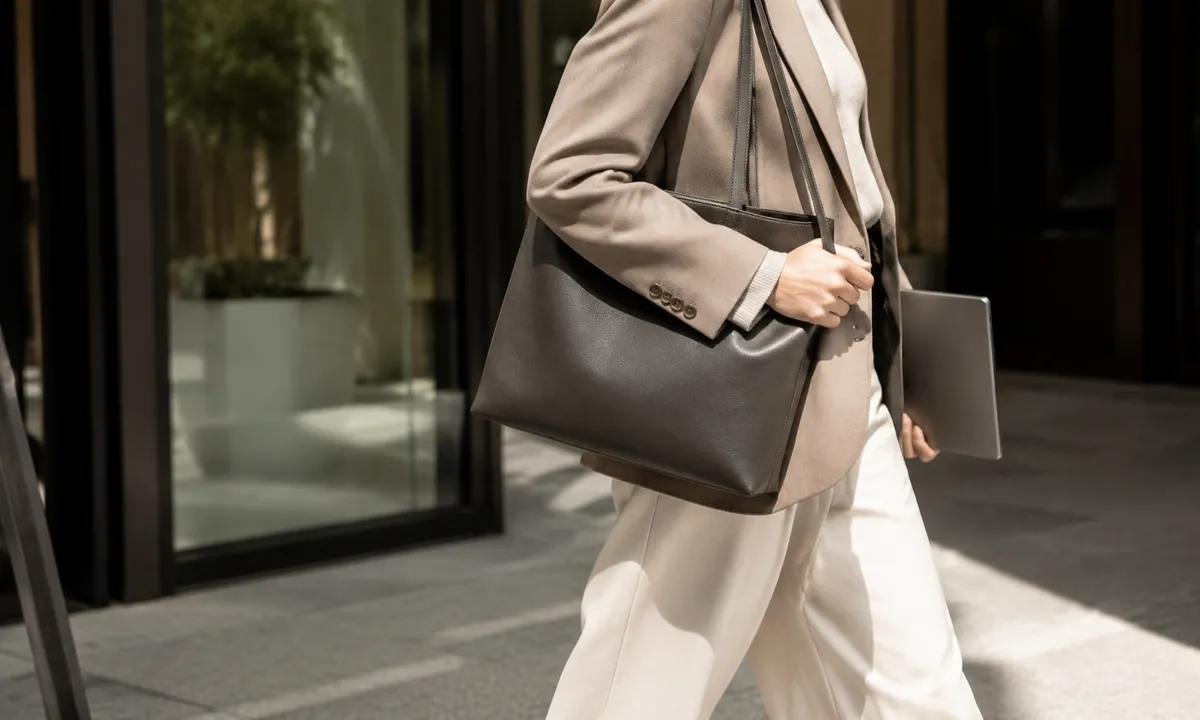
Leather bags are having a specific moment in offices right now, and it is not the structured, gold-hardware statement piece your mother carried to her law firm in 1994. The bags showing up in conference rooms, coffee queues, and commuter trains are quieter than that. Flat profiles. Muted hardware. Colors that answer to “cognac” or “slate” or just a clean black that is somehow warmer than synthetic black ever manages to be. They carry a laptop and a notebook and maybe a pouch of cables, and they do it without announcement.
That restraint is the whole point.
Office dress culture shifted, and the accessories shifted with it. The era of the big logo tote and the logo-clasp shoulder bag receded as workplaces stopped requiring the performance of obvious status. What replaced it was something harder to fake: quality you can see in the stitching, not in the branding. Minimalist leather bags sit exactly at that intersection. They look like a considered choice rather than a purchase, which, for the kind of person who carries one, is precisely the goal.
What “Minimalist” Actually Means in Leather
The word gets applied carelessly to a lot of things, so it is worth being direct about what it means when it describes a leather bag in 2025. A minimalist leather bag has a clean silhouette with no external pockets that break the line. Hardware is either absent or present in a single, functional piece: a magnetic closure, a simple turn-lock, a loop and buckle done in a matte or brushed finish rather than a polished shine. The exterior surface of the leather does most of the visual work, which means the leather itself has to be worth looking at.
Full-grain leather qualifies. It is the top layer of the hide, with the natural grain still intact, and it develops a patina over months and years of use rather than degrading. Pebbled calfskin qualifies because the texture is uniform and tactile without being decorative. Smooth vegetable-tanned leather qualifies and is probably the most coveted material in this category right now, partly because it starts stiff and pale and darkens and softens exactly where you handle it. That last quality is the opposite of minimalism in a philosophical sense, since the bag becomes a record of use, but it reads as minimalist in the visual sense: no added pattern, no dye job, no print. Just the leather doing what leather does.
Bonded leather, PU-coated leather, and anything marketed as “vegan leather” while being primarily polyurethane do not belong in this category. They can look minimalist on the shelf and begin peeling within eighteen months. A genuinely minimalist leather bag has very little to hide behind, which is why the honest ones are made from materials that age rather than degrade.
The Silhouettes That Actually Get Used
Four shapes dominate the office-minimalist conversation right now, and they address different practical needs.
The slim document tote has been the most visible. It is wider than it is tall, holds a 13- or 14-inch laptop in a padded interior sleeve, and sits flat against the hip when carried. No external zippers. The handles are often a single unstitched piece of leather rather than two separate straps, which gives it that single-seam look that photographs as expensive. It transitions from the commute to the conference table without looking like a bag that was meant for transit. That versatility explains its staying power.
The medium-body crossbody in a more structured shape, sometimes called a reporter bag or a flat messenger, is the second dominant form. It runs roughly A 4 or letter-size, with a single main compartment and a flat interior organizer. The shoulder strap is adjustable and wide enough to distribute weight without creasing a blazer. This one tends to read younger and more casual than the tote, which makes it the obvious choice when office dress skews business casual rather than formal.
The folio, sometimes called a portfolio clutch, is the most minimal form in the group. It is not a bag in the traditional sense: no strap, a single zip or wrap closure, and it holds a tablet or a thin notebook and a few cards. People who can genuinely travel light to meetings have made the folio their signal piece, carried under the arm in a way that reads as confident rather than underprepared. It takes some nerve to show up to an office with only a folio, which may be part of why the people who carry them seem to enjoy it.
The last is the top-handle structured bag, which is the most traditionally office-coded of the four. Boxy, firm-sided, carried at the crook of the elbow or by a single short handle. It has some history behind it, enough to feel intentional rather than trend-chasing, and in a deep brown or a rich black full-grain it can anchor a suit as well as a blazer and trousers. The newer versions have dropped the exterior hardware to near zero and thinned the silhouette enough that they do not read as retro.
Colors That Are Actually Moving
Black is reliable and perennial, but the interesting color action in this category is in the browns. Cognac is the name most brands use for a warm amber tan, and it has become the default statement color in minimalist leather precisely because it looks expensive next to neutral clothing: a cream shirt, a camel coat, grey trousers. It carries better in fall and winter light than in summer, which is probably why it feels so dominant right now.
Natural, which is the pale undyed or barely-tinted shade of vegetable-tanned leather, is growing fast as a choice. It starts looking almost cream and darkens through use toward a honey tan, which means every natural leather bag eventually becomes its own version of itself. The downside is that it marks easily in the first few months before the surface hardens and settles. People who want a bag to stay pristine should avoid it. People who want something that becomes more interesting with time should consider it seriously.
Dark forest green and a deep burgundy-adjacent color that brands variously call oxblood, wine, or bordeaux are the nontraditional colors getting the most traction in office settings. They work as neutrals in a way that bright colors never quite manage: they read as considered without reading as colorful, and they sit against navy and grey and olive without friction. The green in particular has moved from a fashion week conversation into actual everyday carry territory over the past couple of seasons.
The Hardware Detail That Separates the Good Ones
On a minimalist bag, hardware is not decoration. It is a decision. The brands making bags worth owning in this category understand that a single piece of hardware at the closure tells you a great deal about how the rest of the bag was made. Solid brass that has been brushed or antiqued rather than high-polished lasts longer and develops a tone that suits aged leather. Nickel hardware lookscolder and works better with black and slate leather than with warm browns. Stainless or aluminum hardware used in some cleaner Scandinavian and Japanese-influenced designs reads more contemporary and does not develop a patina, which is either a feature or a drawback depending on the bag’s overall character.
The worst hardware choice in this category is the plastic-core metal-coated piece that looks fine for a year and then chips at the corners where it gets handled most. It is not always visible from photos, which is why buying a leather bag this way, without handling it first or reading closely sourced reviews about hardware durability, carries real risk.
Exposedstitching color is the other detail worth paying attention to. Matching thread that disappears into the leather reads as refined. Contraststitching, done in a pale cream or tan against dark leather, reads as artisanal and can tip a bag toward craft-market territory rather than office-appropriate. A small distinction, but a real one.
What the Price Tiers Actually Buy
In the minimalist leather category, the meaningful price breaks sit at roughly three levels, and each one corresponds to a real difference rather than just brand premium.
Below around 150 dollars, the bags are almost always genuine leather in a loose sense: they may use split leather or lower grades of cowhide on less visible panels, with only the front face being full-grain. The stitching is machine-regular, which is not a problem in itself, but the thread quality and the tension setting are often where shortcuts appear. These bags look convincing for a year or two and begin to show their seams, literally, around the handles and the base corners after sustained daily use. For someone who changes bags seasonally or rotates several, this tier makes sense.
The 200 to 450 dollar range is where the honest minimalist leather bag lives for most buyers. Independent brands and mid-tier heritage brands operate here. Full-grain leather throughout, solid hardware, internal structure that keeps its shape after the bag is loaded. There are bags in this range that will outlast the job that required them.
Above 500 dollars, the buyer is paying for one of several things: a European heritage name with genuine craft behind it, a handmade process from a small studio with a long lead time, or occasionally just the margin that a luxury brand builds into products because their customers expect a high price as part of the experience. All three exist at that level. The first two justify themselves over a decade of daily use. The third requires honest self-assessment about what the buyer is actually purchasing.
How This Bag Works in the Office Every Day
The practical case for this style of bag is not complicated. A slim, well-made leather bag in a neutral color works across dress codes without requiring a swap. It goes under the desk without looking like luggage. It does not collapse when set down because the leather holds its structure. The interior, kept simple, forces organization rather than accumulating the sediment of a bag that has too many pockets to keep track of.
The more durable argument is the one about accumulating character. Office bags get used five days a week for months at a time. A bag made from material that improves with that use becomes something specific to the person carrying it rather than a product that stays generic. The worn-in corners of a good full-grain tote, the darkened handle where it has been gripped ten thousand times, the slight softening of a panel that used to be stiff: these are the details that make a physical object feel like it belongs to someone rather than having simply been purchased. That quality is almost impossible to fake, and it is entirely the reason minimalist leather bags continue to hold the room.